
Flatback Syndrome: What Happens When You Lose Your Natural Lumbar Curve?
Flatback syndrome is a loss of the normal inward curve (lordosis) in the lower back. Without this curve, the spine cannot balance the head over the pelvis. So you lean forward. Standing and walking become tiring. This imbalance only shows under gravity. That is why standing whole-body imaging is the clearest way to measure it.
Key points
- A healthy lower spine curves inward. When that curve flattens, the body tilts forward.
- Tiredness, back pain and difficulty standing upright are the main symptoms.
- Causes include past spine surgery, disc degeneration and long-term posture habits.
- Scans taken lying down can miss the problem because gravity is removed.
- A standing whole-body EOS scan shows how the whole spine balances under your own weight.
What is flatback syndrome?
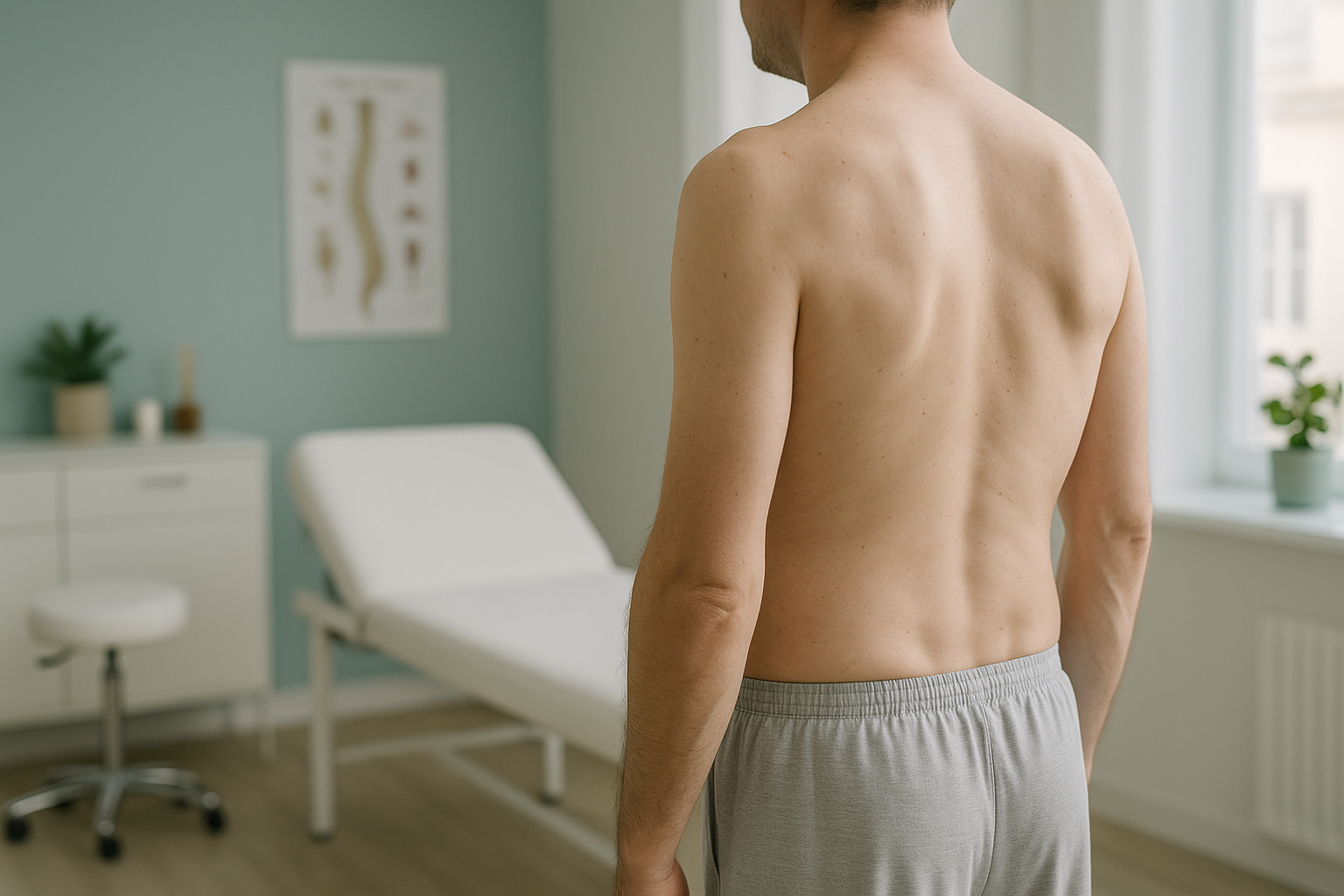
Flatback syndrome is a postural condition. The normal inward curve of the lumbar spine is greatly reduced or lost. A healthy lower back has a gentle lordotic curve that works like a spring. It helps you stand upright with little effort. When that curve flattens, the upper body shifts forward of the pelvis. You then have to work harder just to stand straight.
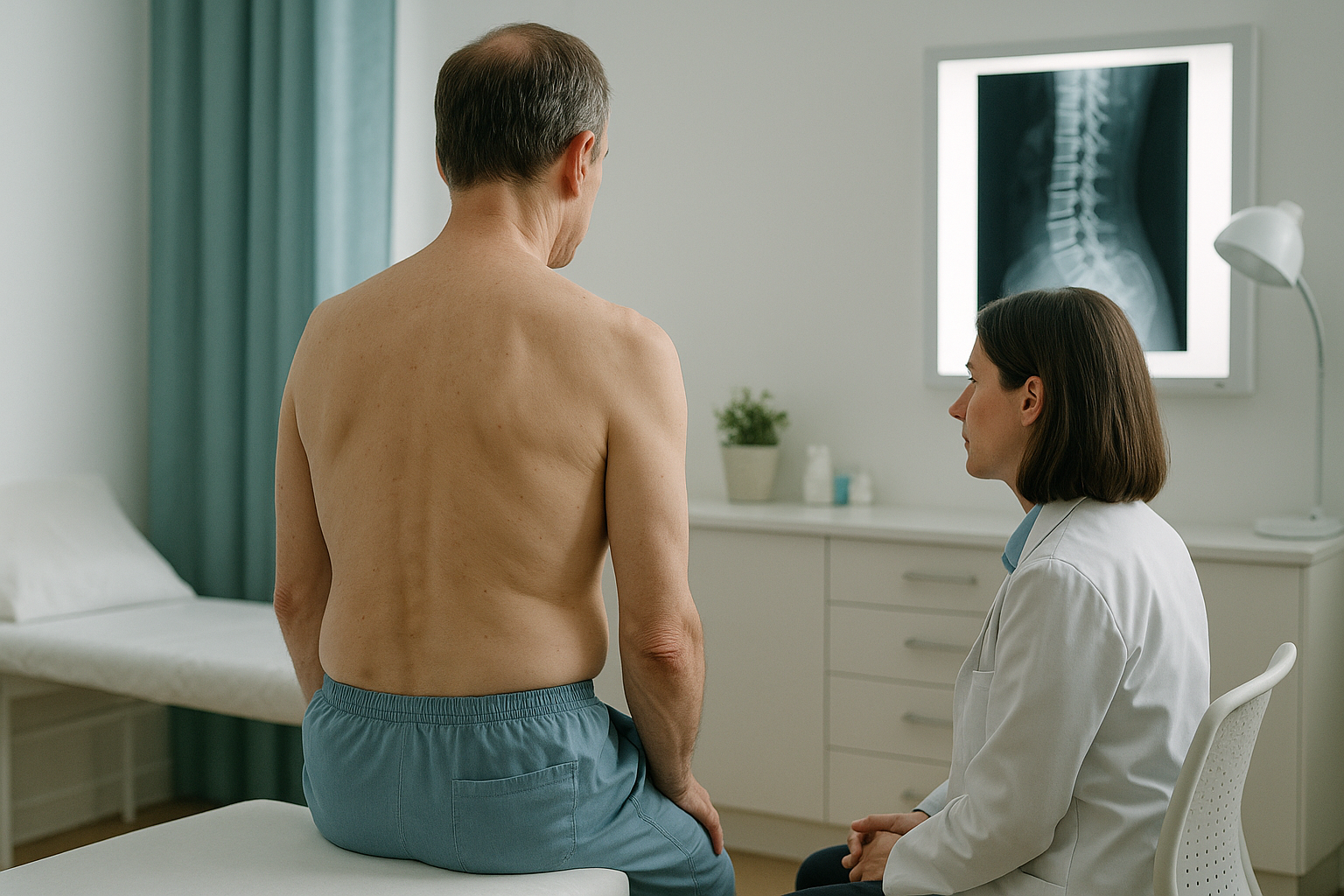
The body is a connected chain from your feet to your head. When the lower back flattens, other areas make up for it. Your thoracic spine may round more. Your hips and knees may bend slightly. Your muscles work overtime to keep you upright. This is why you might feel pain in your mid-back, hips or even your legs, not just in the lower back.
What are the symptoms of flatback syndrome?
The most common symptom is a feeling that you cannot stand upright without effort. Pain and tiredness tend to get worse as the day goes on. This is because your muscles tire from constantly working to keep you balanced.
You feel as if you are always falling forward, especially when standing still or walking.
Muscles in the back, buttocks and thighs ache more as the day goes on.
You may need to stop and rest, lean on a shopping trolley, or bend your knees to feel relief.
Symptoms often improve when you sit down, lean against something, or bend forward.
A note on nerve symptoms. If you have numbness, tingling, weakness in your legs, or any loss of bladder or bowel control, please get urgent medical help from your doctor or your nearest emergency department. These symptoms need assessment straight away.
What causes flatback syndrome?
Flatback syndrome can develop for several reasons. Sometimes it follows spine surgery, especially older fusion operations. In other cases it develops slowly through disc degeneration or long-standing posture patterns.
Older fusion hardware sometimes fixed the spine in a straighter position than ideal. This reduced the natural curve over time.
As discs lose height, especially at the front, the total loss flattens the curve over the years.
Vertebral fractures from osteoporosis can cause the front of a vertebra to collapse. This slowly flattens the spine.
Spending years in a slouched or bent position can slowly weaken the structures that keep the curve.
Often there is more than one factor. A scan that shows the full spine and pelvis while you stand helps find the mix of causes involved.
Why does standing imaging matter for flatback syndrome?
Standing imaging matters because flatback syndrome is mainly a problem of balance under gravity. When you lie down for a standard X-ray, CT or MRI, the muscles relax and the spine settles onto the table. The loss of curve can then look much less severe than it really is.
An EOS scan takes a full-length image of your skeleton while you stand in your natural posture. It captures the spine, pelvis, hips, knees and ankles in one shot. So the radiologist can see exactly how each area is making up for the lost lumbar curve. Your hips might be pushing forward. Your knees might be slightly bent. Or your thoracic spine might be rounding more than it should. All of these changes only become visible when standing.
EOS also uses about 90% less radiation than a standard X-ray, around ten times less. This makes it practical for follow-up scans if your specialist needs to track changes over time.
Would you like to find out whether a standing alignment scan could help explain your symptoms?
Book a free video consultationHow is flatback syndrome usually managed?
Management depends on how severe it is and what is causing it. Your treating specialist will use the scan findings along with your symptoms to decide the best path. Common approaches include:
- Physiotherapy and targeted exercises. Strengthening the core and hip extensors can help support the spine and reduce muscle tiredness.
- Posture awareness. Understanding your alignment pattern can help you make changes in daily life.
- Pain management. Your doctor or pain specialist may recommend medicines, injections or other approaches for symptom relief.
- Surgical review. In more serious cases, a spine surgeon may consider corrective surgery to restore the lumbar curve. Detailed standing imaging is usually essential for planning this.
ScanAlign is a diagnostic imaging clinic. We do not provide treatment. Our role is to give you and your treating specialist a clear, weight-bearing picture of your alignment. That way, any treatment decisions are based on the most accurate information possible.
Before you start treatment, or change the one you are on, it is worth getting a detailed diagnosis. Knowing whether the cause sits in the pelvis, the legs or the spine changes what will actually help.
When MRI is the better tool. EOS shows bones, joints and overall alignment. If your treating specialist suspects nerve compression, disc problems or soft-tissue injury, MRI is usually the more suitable scan. The two types of imaging work well together.
Frequently asked questions about flatback syndrome
Yes. This is one of the most common causes. Older fusion techniques sometimes straightened the lumbar spine more than intended. The curve loss may not become noticeable for years, as nearby discs degenerate and the body's adjustments build up.
Not quite. Poor posture can play a part. But flatback syndrome usually involves structural changes in the spine itself, such as loss of disc height, vertebral fractures or changes from surgery. It is a medical condition, not simply a habit.
Your muscles work constantly to keep you upright against the forward pull. By the end of the day they get tired, and the imbalance becomes harder to make up for. This is why many people with flatback syndrome feel better in the morning and worse by evening.
Exercises can help manage symptoms and improve support, especially strengthening the hip extensors and core. However, if the cause is structural, exercises alone may not fully restore the curve. A proper assessment helps make clear what is realistic for you.
No. ScanAlign accepts self-referrals. You can book a free video consultation directly. If a scan is suitable, it can be arranged without waiting for a referral letter from your doctor.
An EOS scan captures the whole skeleton from head to toe in one standing image. It uses about 90% less radiation than a standard X-ray, around ten times less. A normal X-ray usually covers only one small area and may be taken lying down.
Yes. The radiation dose is about 90% lower than a standard X-ray, around ten times less. You can find more detail on the FAQs and safety page.
For patients travelling from abroad, the price is confirmed during the free video consultation. You can read more on the FAQs page. There is no obligation to go ahead.
It can. When the lumbar curve is lost, the hips and knees often bend to help rebalance the body. This puts extra load on those joints and can cause pain away from the spine itself. A whole-body scan helps find these adjustments.
ScanAlign is based at 19 Harley Street, London. It is a private self-pay clinic operating under The Harley Street Hospital's CQC licence.
Understand your alignment, standing up
A free video consultation with our specialist radiographer can help you decide whether a standing whole-body scan in London is the right next step for your symptoms.
Book a free video consultationLearn more about how EOS imaging works on our EOS scan overview page, or read about spine alignment assessment.
Written by Abbas Dhami (Specialist Diagnostic Radiographer)
Sources
- Glassman SD, Bridwell K, Dimar JR, Horton W, Berven S, Schwab F. The impact of positive sagittal balance in adult spinal deformity. Spine. 2005;30(18):2024-2029.
- Schwab F, Lafage V, Boyce R, Skalli W, Farcy JP. Gravity line analysis in adult volunteers: age-related correlation with spinal parameters, pelvic parameters, and foot position. Spine. 2006;31(25):E959-E967.
- NHS. Back pain: causes, treatment and when to see a GP. nhs.uk/conditions/back-pain.
This page is general information and not a diagnosis.
ScanAlign is the trading name of CoreMed Solutions Ltd and operates under The Harley Street Hospital's CQC licence.