
Sway Back Posture: What Is It and How Do You Know You Have One?
Sway back posture happens when the pelvis pushes forward and the upper back rounds backward to make up for it. It shifts your centre of gravity. This puts extra load on the lower spine, hips and knees. Because it develops slowly, many people live with it for years without realising it is the root cause of their pain.
Key points
- Sway back shifts the hips forward of the ankles. It flattens the lower spine and rounds the upper back.
- It often causes pain far from where it starts, in the knees, hips or mid-back, because the body compensates along the whole chain.
- Scans taken lying down relax the muscles and can hide the misalignment. Standing, weight-bearing imaging shows the full picture.
- EOS whole-body imaging captures your skeleton from head to toe in a single standing scan, with about 90% less radiation than a standard X-ray.
- ScanAlign offers a free video consultation, so you can find out whether an alignment assessment is right for you before you plan a trip to London.
You may have been told your scans look "normal", but you still ache after standing or walking. If so, sway back posture could be the missing piece. It is one of the most common posture patterns. Yet it is rarely picked up on standard imaging, because those scans are usually taken lying down.
What does sway back posture actually look like?
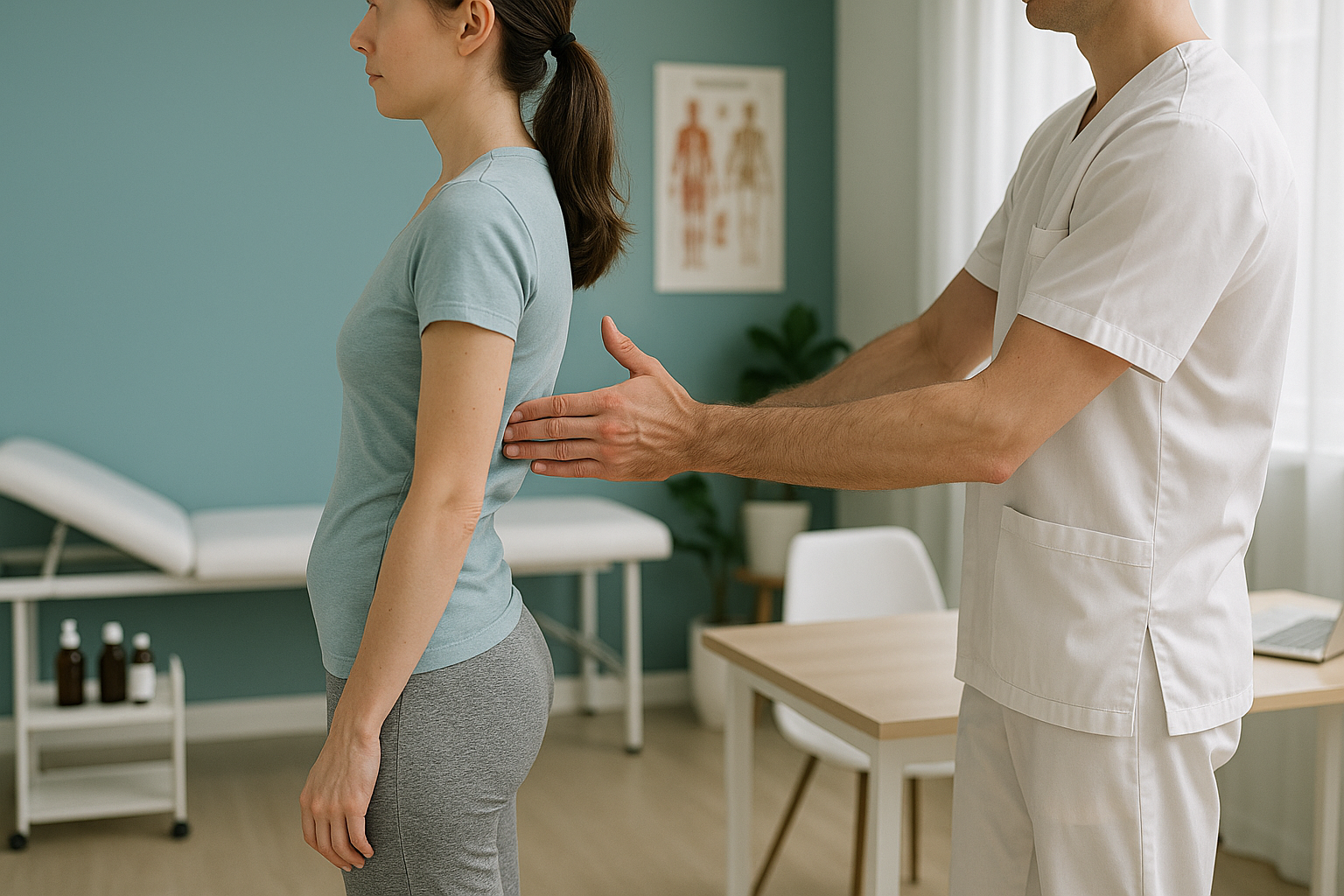
Sway back posture is a posture pattern where the pelvis drifts forward of the ankles while the shoulders lean backward. The lower back loses its natural inward curve and becomes flatter. The upper back rounds more than usual. From the side, you look as if you are leaning back, even though your feet are underneath you.
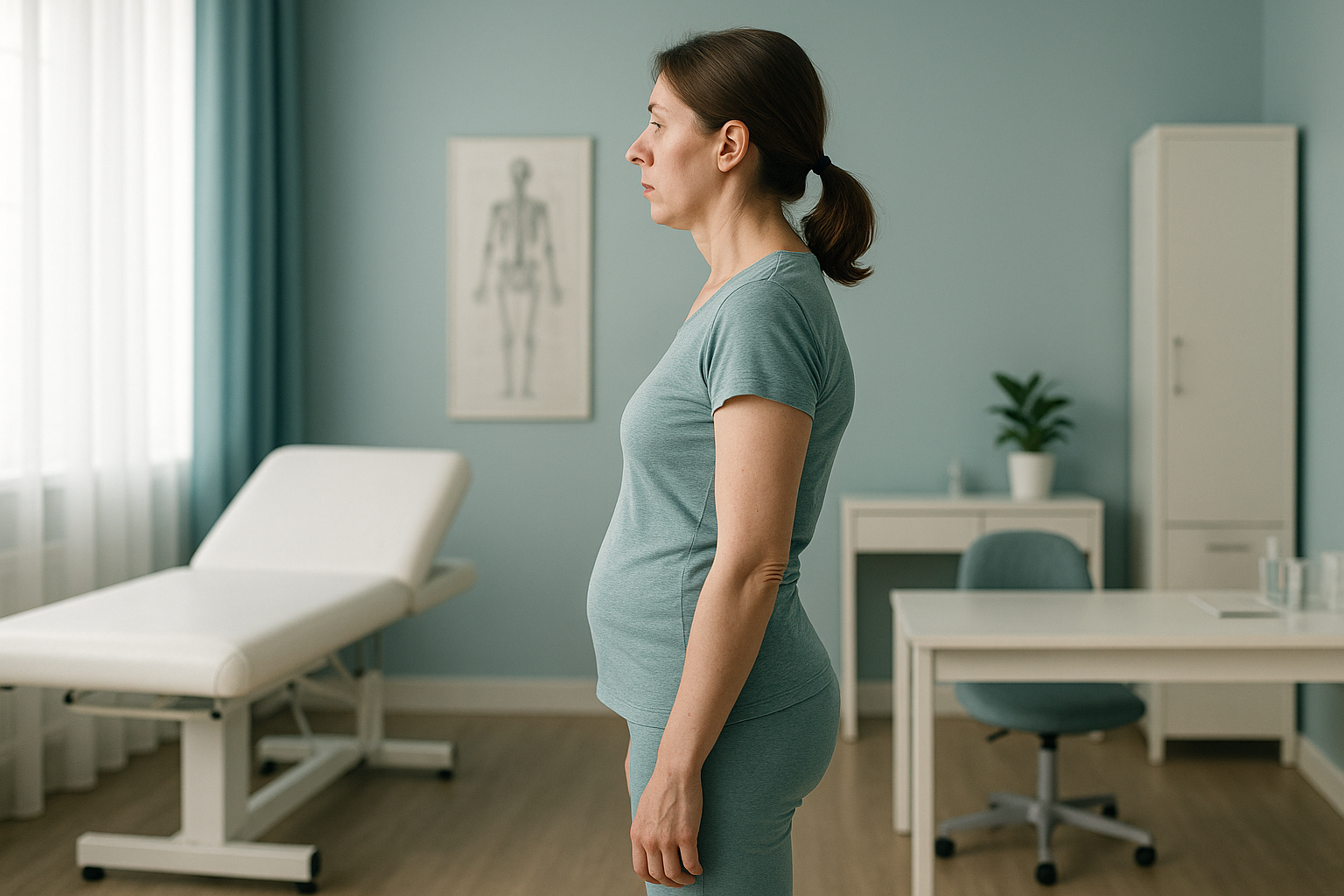
This pattern is different from an arched back posture (sometimes called hyperlordosis), where the lower back curves too much inward. With sway back, the lower curve actually flattens. People sometimes mix the two up because both involve the pelvis. But the direction of the tilt and the shape of the spine are quite different.
How do you know if you have sway back posture?
You may notice some of these everyday signs. None of them is proof on its own. But several of them together are a strong hint that your alignment needs a closer look.
If you also have numbness, weakness in the legs, or loss of bladder or bowel control, please get urgent medical help. Contact your doctor straight away or go to your nearest emergency department. These are red-flag symptoms that need to be checked immediately.
What causes sway back posture?
Sway back posture develops when certain muscle groups weaken or tighten over time, pulling the pelvis out of its balanced position. It is rarely caused by a single event. The most common factors are listed below.
Your body works as a connected chain from your feet to your head. When the pelvis shifts forward, the spine, knees and even neck adjust to keep you balanced. That is why sway back posture often causes pain far from where the real problem sits.
Why does sway back posture need a standing scan?
Most imaging, including standard X-rays, CT and MRI, is done while you are lying down. When you lie flat, gravity no longer pulls on your skeleton and your muscles relax. The misalignment that causes your symptoms can then disappear for a while. The scan may come back "normal", even though you are clearly in discomfort when upright.
A standing, weight-bearing scan captures your skeleton the way it actually works, under gravity, with your muscles engaged. EOS whole-body imaging does this in a single low-dose scan from head to toe. It uses about 90% less radiation than a standard X-ray, around ten times less. That means a clear, full-length picture of your alignment without unnecessary exposure.
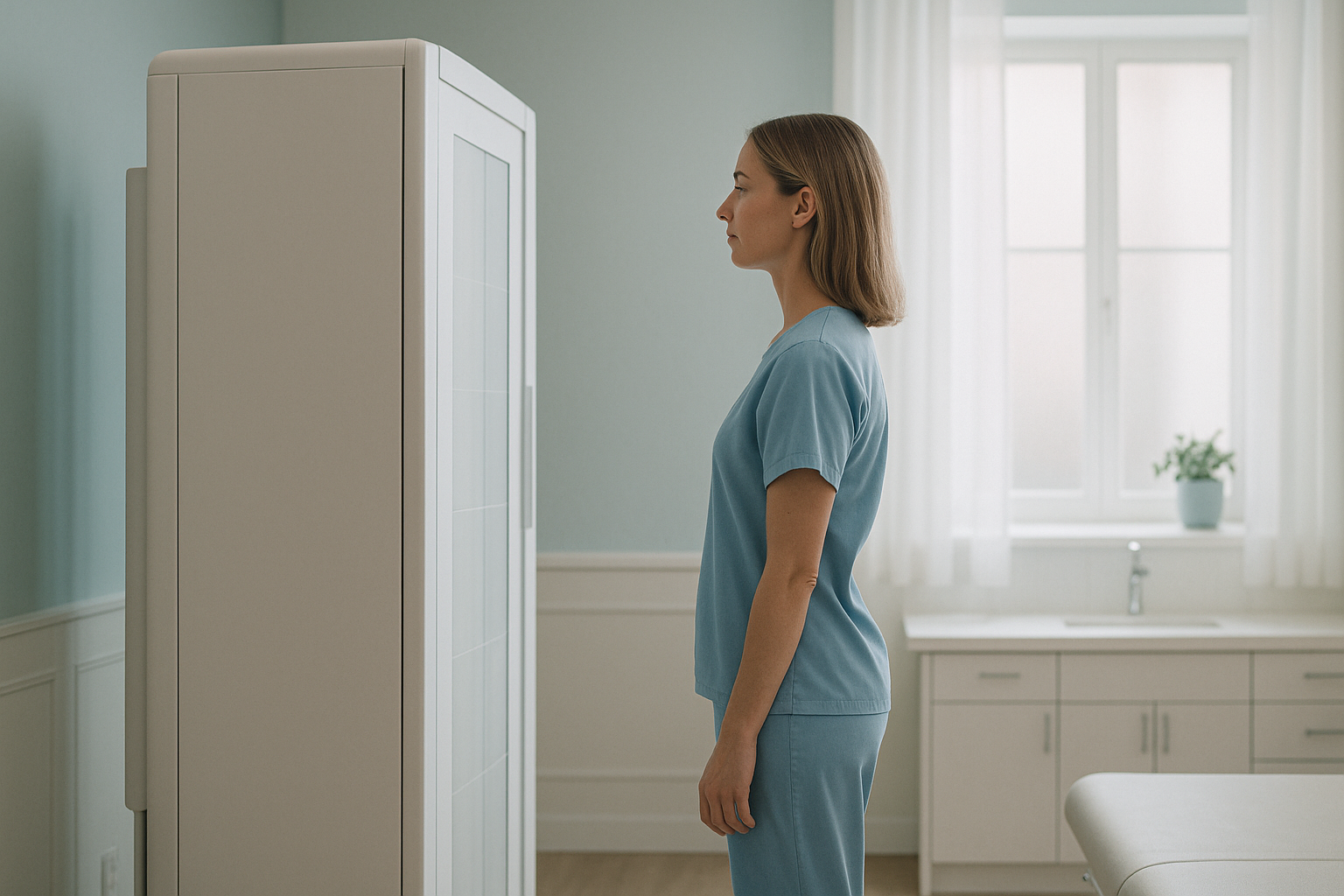
The EOS scan covers your whole skeleton in one image. So the radiographer and your clinician can see exactly how far your pelvis has shifted, how your spine is compensating, and whether your knees or hips are taking uneven load. Imaging of a single area misses this full-chain view.
Not sure if a standing scan is right for you? Talk to us first by video, at no cost, before you plan your trip.
Book a free video consultationWhat is the difference between sway back and flat back posture?
Both patterns involve a flattened lower back, but they are not the same thing. In flat back posture, the pelvis tucks under and the whole spine straightens, so you stand very upright but stiff. In sway back posture, the pelvis pushes forward while the upper body leans backward. The result is an S-shaped slouch rather than a straight line. The difference matters, because each pattern loads different joints and responds to different approaches.
How is sway back posture usually managed?
ScanAlign is a diagnostic imaging clinic, not a treatment provider. We provide the detailed alignment picture that helps your physiotherapist, osteopath or surgeon plan the right approach. In general, managing sway back posture may include targeted strengthening of the core and glutes, stretching of tight hip flexors, posture retraining, and sometimes manual therapy. The exact plan depends on what the imaging and clinical assessment show.
What matters most is getting an accurate, whole-body picture first. Without it, exercises risk treating the symptom rather than the underlying alignment problem. A standing scan gives your treating clinician the information they need to tailor your programme properly.
When MRI is the better tool. EOS is excellent at showing bones, joints and whole-body alignment. If your clinician suspects a disc problem, nerve compression or soft-tissue injury, MRI is usually the better choice. The two scans answer different questions and often work well together.
Before you start treatment, or change the one you are on, it is worth getting a detailed diagnosis. Knowing whether the cause sits in the pelvis, the legs or the spine changes what will actually help.
Frequently asked questions about sway back posture
Yes. The forward shift of the pelvis flattens the natural curve of the lower spine. This puts extra stress on the joints and ligaments. Over time it can lead to chronic lower back stiffness and pain, especially after standing or walking.
No. An arched back (hyperlordosis) has an exaggerated inward curve in the lower spine. Sway back actually flattens that curve and pushes the hips forward. They are different patterns with different causes, even though both involve the pelvis.
It can. When the pelvis shifts forward, the legs angle differently to keep you balanced. This changes the load on the hip and knee joints and can add to pain in those areas over time.
An EOS scan captures your full skeleton while you stand under gravity. It shows exactly how the pelvis, spine, hips and knees relate to each other. It reveals the compensations that lying-down imaging misses. Learn more about how EOS whole-body imaging works.
EOS uses about 90% less radiation than a standard X-ray, around ten times less. You can find more details on safety and what to expect on our FAQs page.
No. ScanAlign is a private, self-pay clinic. You can refer yourself directly. We recommend starting with a free video consultation, so we can check that a standing scan is the right next step for you.
The price for patients travelling from abroad is confirmed during the free video consultation. You can also read more on our FAQs page.
Many people see improvement with targeted strengthening and posture work, guided by an accurate picture of their alignment. ScanAlign provides the diagnostic imaging. Your physiotherapist or specialist then uses the results to plan your management.
Standard X-rays usually focus on one area (for example, the lower back) and are often taken lying down. When you lie flat, gravity is removed and the posture shift disappears. A standing, full-body image captures what is actually happening when you are upright.
ScanAlign is at 19 Harley Street, London, inside The Harley Street Hospital. You can book a free video consultation first, so you know exactly what to expect before you travel.
Related alignment topics
Ready to see the full picture?
A free video consultation lets you discuss your symptoms with our team from home and find out whether a standing alignment scan is the right next step.
Book a free video consultationSources
- Roussouly P, Pinheiro-Franco JL. Biomechanical analysis of the spino-pelvic organisation and adaptation in pathology. European Spine Journal. 2011;20(Suppl 5):609-618.
- NHS. Back pain: causes, symptoms and treatments. nhs.uk/conditions/back-pain.
- Deschênes S, Charron G, Beaudoin G, et al. Diagnostic imaging of spinal deformities: reducing patients' radiation dose with a new slot-scanning X-ray imager. Spine. 2010;35(9):989-994.
Written by Abbas Dhami (Specialist Diagnostic Radiographer)
This page is general information and not a diagnosis.
ScanAlign is the trading name of CoreMed Solutions Ltd and operates under The Harley Street Hospital's CQC licence.