
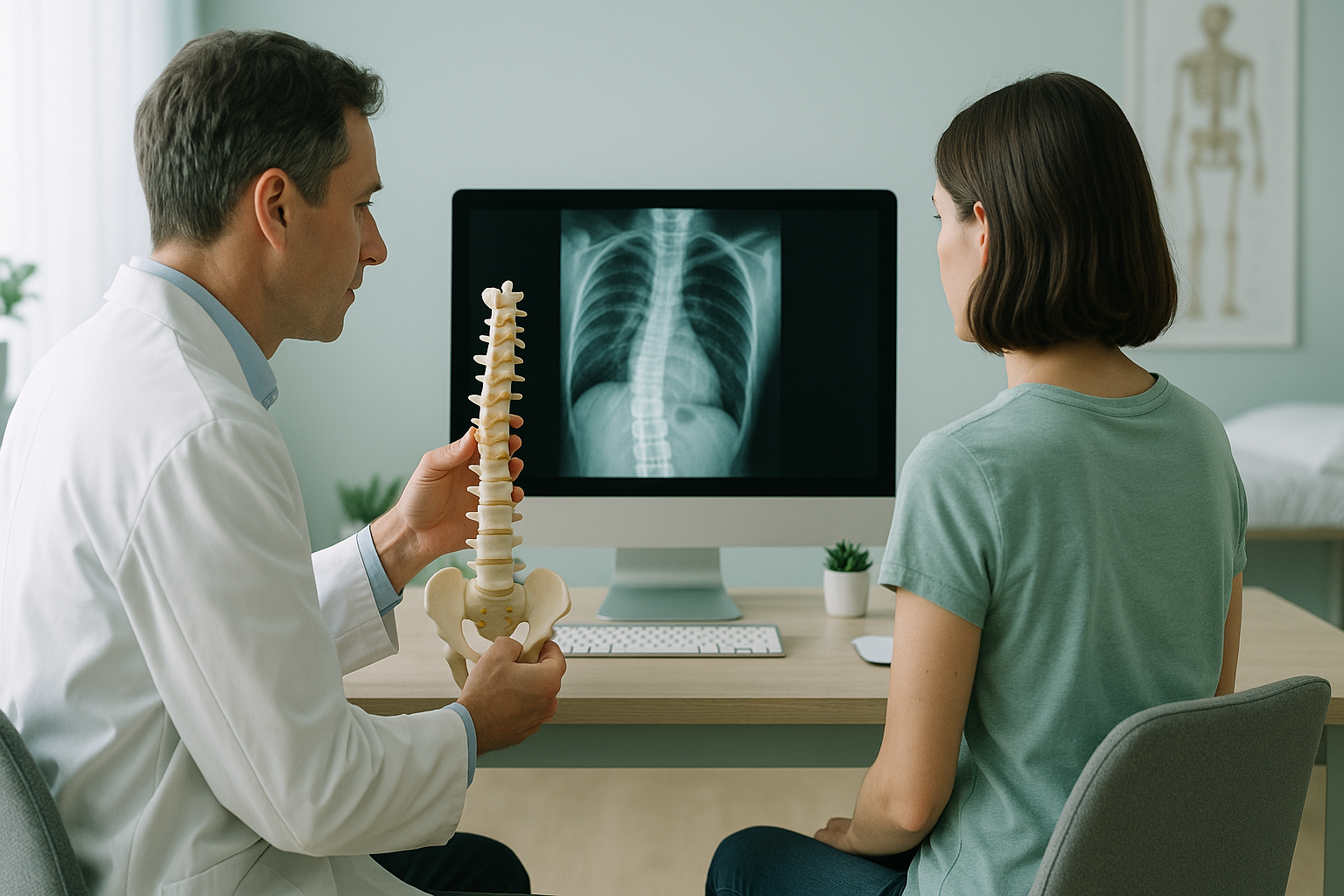
How Fast Does a Scoliosis Curve Progress?
How fast scoliosis progresses depends on three things: your age, how large the curve already is, and whether your skeleton is still growing. In adults who have finished growing, most curves change slowly, typically by a small amount each year. Larger curves tend to progress faster. Regular monitoring is the only reliable way to know if your curve is changing.
Key takeaways
- Scoliosis progression is not the same for everyone. Curve size and skeletal maturity are the biggest factors.
- In adults, larger curves are more likely to get gradually worse over time.
- Lying-down scans can underestimate a curve because gravity is removed. Standing imaging shows the curve under real weight-bearing load.
- Accurate, repeatable measurement is essential for tracking change over time.
- No scan or specialist can guarantee a curve will stay the same forever.
What does scoliosis progression actually mean?
Scoliosis progression means a sideways curve in your spine is getting larger over time. Your curve is measured with a standard method called Cobb angle measurement. If a follow-up scan shows the curve has grown by more than normal measurement error, the curve is said to have progressed.
It is important to know that small changes between scans can sometimes come from measurement variation, not real progression. That is why the same imaging technique and the same body position matter so much.
How do you know if your scoliosis is getting worse?
You might not feel a curve progressing at first. Over months or years, though, some changes can become visible, or you may feel them in your body.
One shoulder or hip starts to sit clearly higher than the other. Uneven shoulders are a common early sign.
Your trunk may lean to one side, or your clothes may hang unevenly.
A raised area on one side of the back when you bend forward, known as a rib hump, can become easier to see.
In adults, worsening stiffness or aching, especially after standing for long periods, may come with a progressing curve.
What makes a scoliosis curve more likely to progress?
Several factors affect whether a curve stays stable or gets worse. No single factor decides the outcome on its own, but certain combinations raise the risk.
Larger curves carry a greater risk of progression, whatever your age.
Curves found while the skeleton is still growing are in the highest-risk period. Once growth ends, the rate usually slows.
Thoracic (mid-back) curves and double curves tend to progress more easily than single lumbar curves.
In adults, wear and tear on the discs and joints can make the spine less stable, allowing a curve to increase gradually.
Does scoliosis keep getting worse in adults?
Yes, it can. Many people believe scoliosis only progresses during growth, but this is misleading. Research shows that many adult curves continue to increase, although usually more slowly than during the teenage years.
In adults, the main driver is not growth but degenerative change. As discs lose height and facet joints wear unevenly, the spine can shift. When a new curve appears later in life, this is sometimes called degenerative or de novo scoliosis.
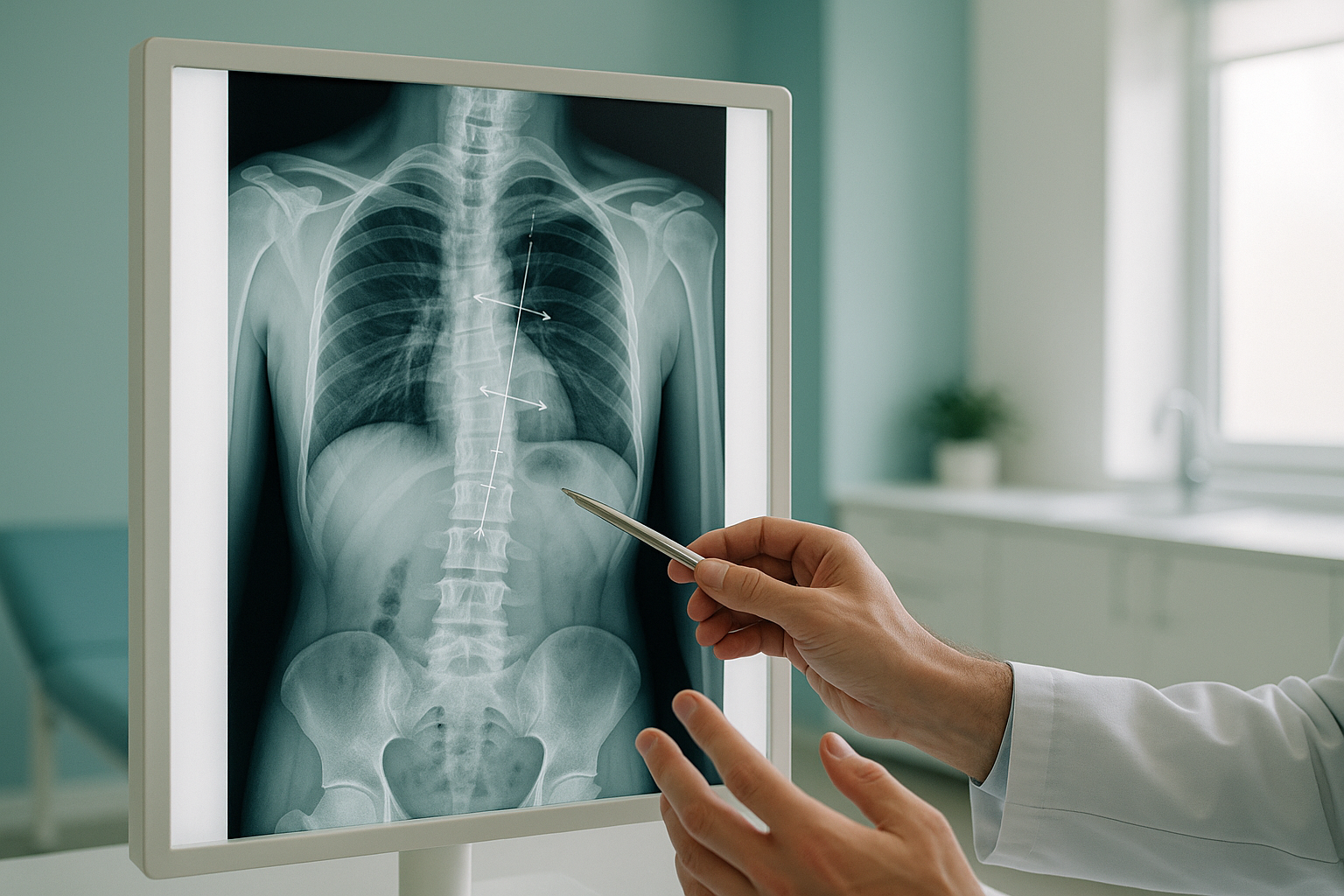
Not every adult curve gets worse. Smaller, well-balanced curves in otherwise healthy spines may stay stable for decades. That is why tracking your curve with consistent imaging matters more than any single prediction.
Why does standing imaging show scoliosis more accurately?
Standing imaging captures your spine under the real forces it deals with every day: gravity and your own body weight. When you lie down for a conventional scan, your muscles relax, gravity is removed, and the curve can look smaller than it really is. This can hide real progression, or make a curve look stable when it is not.
ScanAlign standing EOS imaging takes a full-length image of your spine from head to pelvis while you stand. Because the position is the same every time, measurements are more consistent and easier to compare over months or years. EOS also uses about 90% less radiation than a standard X-ray, around ten times less. That makes it practical for the repeat scans that scoliosis monitoring needs.
Worried your curve may be changing? A standing scan gives you a clear baseline that later scans can be compared with.
Book a free video consultationA note on MRI and soft tissue. EOS is ideal for measuring bone alignment and tracking curve size over time. If your specialist needs to look at the discs, nerves or the spinal cord itself, MRI is usually the better tool. The two scans answer different questions and often work well together.
How is scoliosis progression monitored over time?
Monitoring means comparing accurate measurements from the same type of scan, taken in the same position, at regular intervals. The aim is to spot meaningful change early, before it becomes a bigger problem.
Baseline scan
A full standing image records the current size and pattern of your curve. This becomes the reference point.
Report and explanation
Your report includes a clear measurement of the curve. You can share it with your doctor, physiotherapist or surgeon at home.
Follow-up scan
A repeat scan, using the same standing method, is compared with the baseline. Any change is clearly identified.
Informed decisions
With objective data, you and your clinical team can decide on next steps, whether that is continued observation or referral for treatment.
If you would like to set a baseline, you can book a curve measurement scan without a referral from your doctor.
Can you slow scoliosis progression?
ScanAlign is a diagnostic imaging clinic, not a treatment provider. We cannot advise on specific treatments. However, it is widely understood that keeping the muscles around your spine strong and flexible can support your posture. Many adults with scoliosis benefit from guided physiotherapy or exercise programmes suited to their curve pattern.
The most important thing you can do is know where your curve stands right now. Without accurate data that can be compared over time, no specialist can tell you whether intervention is needed or whether watchful waiting is the right approach.
When should you seek urgent medical help?
If you develop sudden numbness, weakness in your legs, or any loss of bladder or bowel control, get urgent medical help straight away. Contact your doctor or go to the nearest emergency department. These symptoms need rapid assessment, not a planned scan.
If you are thinking about starting treatment, or changing the one you are on, it is worth getting a detailed diagnosis first. Knowing whether the cause sits in the pelvis, the legs or the spine changes what will actually help.
Frequently asked questions
Not necessarily. Some adult curves stay stable for many years, especially smaller ones. Others progress slowly. The only way to know for certain is to have scans that can be compared, taken at intervals.
Research suggests many adult curves increase by a small amount each year, but this varies widely. Curve pattern, size and overall spinal health all play a role. No single number applies to everyone.
Yes. In teenagers, rapid skeletal growth drives progression and can cause significant change in a short time. In adults, progression is usually slower and driven by degenerative changes in the discs and joints.
When you lie flat, gravity no longer pulls on your spine and your muscles relax. This can let the curve partly straighten, giving a measurement that does not reflect how your spine behaves when you are upright and bearing weight.
An EOS scan uses about 90% less radiation than a standard X-ray, around ten times less. This matters especially for scoliosis monitoring, because you may need repeat scans over the years.
No. You can refer yourself. The process starts with a free video consultation, where a specialist radiographer reviews your concerns and confirms whether a standing scan is suitable for you.
There is no single rule. Your specialist or radiographer can advise based on your curve size and clinical picture. Some adults have it checked every year, others less often. The key is using the same imaging method each time.
ScanAlign provides diagnostic imaging, not treatment. There is evidence that specific exercise programmes can help manage scoliosis, but any exercise plan should be guided by a qualified physiotherapist or specialist who knows your curve.
For patients travelling from abroad, the price is confirmed during the free video consultation.
You receive a detailed report with clear measurements. You can share it with your doctor, surgeon or physiotherapist at home. ScanAlign does not provide treatment, but the report gives your clinical team the data they need to advise you.
Worried your curve is changing?
A standing EOS scan gives you a clear, measurable baseline. Start with a free video consultation from Pakistan to find out if it is right for you before you plan your trip to London.
Book a free video consultationSources
- Weinstein SL, Dolan LA, Spratt KF, et al. Health and function of patients with untreated idiopathic scoliosis: a 50-year natural history study. JAMA. 2003;289(5):559-567.
- Scoliosis Research Society. Patient information on adult scoliosis. srs.org
- NHS. Scoliosis overview. nhs.uk/conditions/scoliosis
Written by Abbas Dhami (Specialist Diagnostic Radiographer)
This page is general information and not a diagnosis.
ScanAlign is the trading name of CoreMed Solutions Ltd and operates under The Harley Street Hospital's CQC licence.