
How Accurate Are Posture Measurements, Really?
How accurate a posture measurement is depends a lot on the method used, who takes the measurement, and whether you are standing or lying down. Visual checks and phone apps are the least reliable. Calibrated, weight-bearing imaging, such as an EOS scan, gives the most repeatable results that can be checked. This is because it captures your whole skeleton in a standardised standing position.
Key Takeaways
- Every way of measuring posture has a margin of error. The question is how large that margin is.
- Skin markers, soft tissue movement and different observers are the main causes of variation.
- A measurement only matters if the change it picks up is larger than the method's own error range.
- Standing, weight-bearing imaging gives more consistent and clinically relevant results than lying-down scans or visual checks.
- Reliable baseline measurements make later comparisons far more useful.
You may have had your posture checked by a physiotherapist, by a chiropractor, or even with a phone app. Each time, you probably got a slightly different answer. That is not unusual. Posture is well known to be hard to measure in a way that gives the same result twice. Knowing why helps you make better decisions about your own care.
How is posture measured in practice?
Posture is measured with a range of tools, from a simple visual check to full-body X-ray imaging. Each method sits somewhere on a scale of accuracy and repeatability.
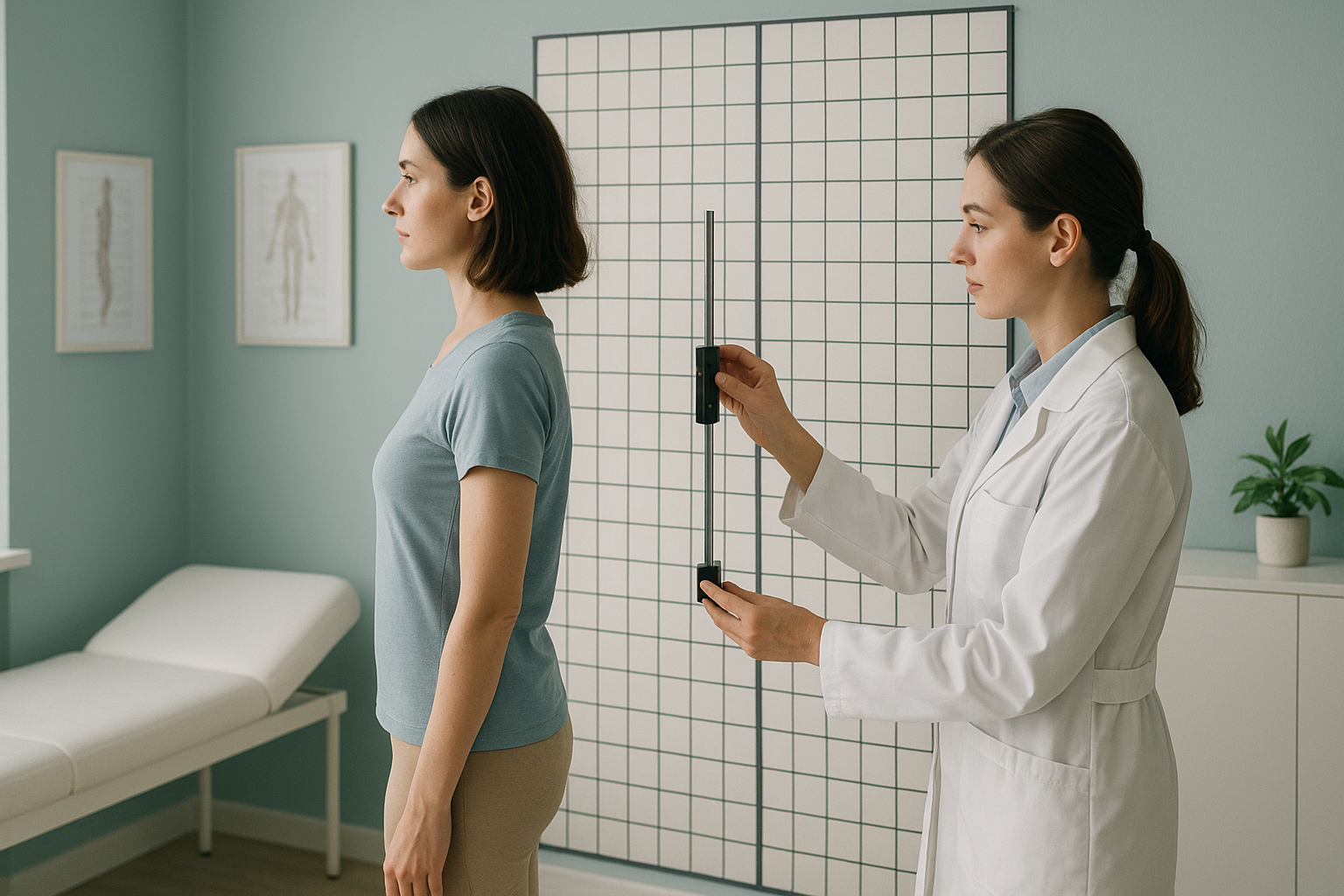
The plumb line posture test is one of the oldest clinical tools. A weighted string hangs next to you, and a clinician checks whether certain landmarks line up. It is simple and free. But the result depends on where the clinician places markers on your skin. Soft tissue, body build and even the time of day all affect the outcome.
Why do posture measurements vary so much?
Posture measurements vary because of a mix of differences between observers, marker placement and real day-to-day changes in your body. These sources of error stack on top of each other.
Intra-observer variation
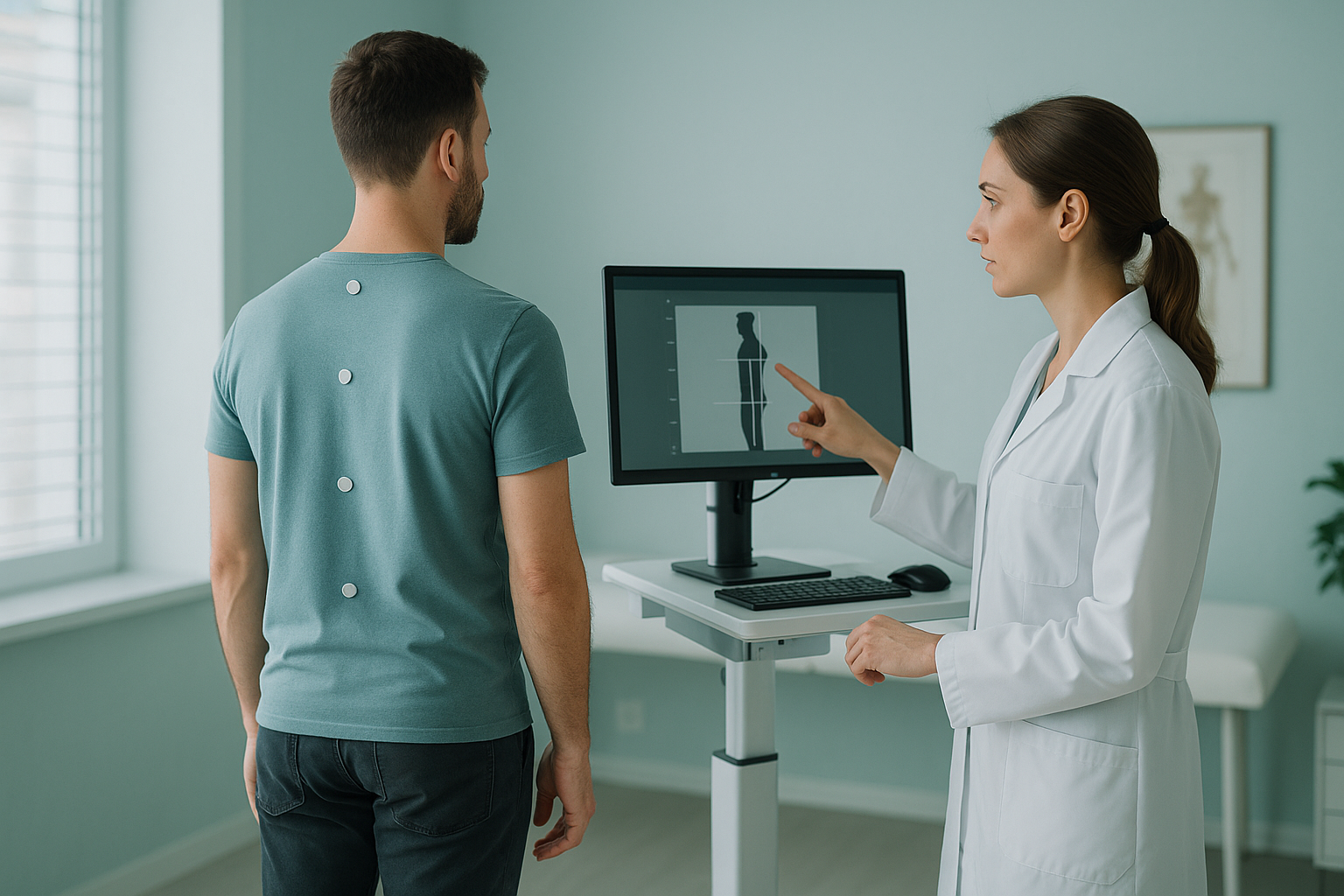
This is when the same person measures you twice and gets two different numbers. Even an experienced clinician placing skin markers on your shoulders or hips may put them in a slightly different place each time. That small shift changes the measurement.
Inter-observer variation
This is when two different people measure you and disagree. Studies on clinical posture assessment consistently show that agreement between different observers is only moderate, even when they follow the same protocol. With some methods, the disagreement can be large enough to make the measurement clinically meaningless.
Soft tissue and marker error
Many posture checks rely on placing markers on the skin over bony landmarks. The problem is that skin moves. It slides over the bone beneath, especially around the pelvis and shoulders. The thicker the soft tissue, the larger the possible error. So the marker on the outside may not show the true position of the bone underneath.
Day-to-day variability
Your posture really does change through the day. Disc height falls slightly as you bear weight, muscles tire, and you compensate differently depending on pain levels or tiredness. A morning measurement and an afternoon measurement of the same person can give truly different results, even if the measuring tool is perfect.
How does standing imaging make posture measurement more accurate?
Standing, weight-bearing imaging improves accuracy by removing the two biggest sources of error: guesswork about soft tissue and the unnatural position of lying down.
When you lie on a table for a standard X-ray, CT scan or MRI, gravity no longer pulls through your skeleton the way it does when you are upright. Your spine straightens slightly, your pelvis settles differently, and your muscles relax. The image you get is real, but it does not show how your body actually carries load. This is why alignment problems and compensations can be missed completely on lying-down scans.
Standardised positioning. You stand in a consistent, calibrated position. The machine, not the observer, sets the geometry. This greatly reduces inter-observer variation.
Bone-to-bone measurement. The image shows your skeleton directly, so there is no skin marker error. The software measures from bone landmarks, not from stickers on your skin.
Full kinetic chain. Your whole body, from feet to skull, is captured in one image. This shows how each region relates to the next, including compensations that images of a single area miss.
Gravity removed. Lying flat removes the forces that shape your everyday posture. Curves flatten, tilts reduce, and the image may look more "normal" than your standing alignment really is.
Single-region view. A standard X-ray or MRI usually focuses on one area. It cannot show whether your hip tilt is affecting your lower back, or whether your knee alignment is compensating for something higher up.
Still valuable for soft tissue. MRI is the gold standard for discs, nerves and soft tissue. It answers a different question from alignment imaging.
An EOS scanner is a calibrated, low-dose X-ray system that captures your full skeleton while you stand. It uses about 90% less radiation than a standard X-ray, around ten times less. The calibrated software then gives measurements directly from your bones, with high repeatability. You can read more about how EOS scan results are reported.
For measurements like the Cobb angle measurement, which is used to assess spinal curvature, standing imaging is especially important. The same curve can look quite different depending on whether you are standing under load or lying flat.
When MRI is the better tool. EOS shows bones, joints and alignment. For soft-tissue problems like disc bulges, nerve compression or ligament injuries, MRI is usually the better choice. The two often work together rather than compete.
What counts as a real change in posture measurements?
A meaningful change is one that is larger than the method's own margin of error. If the method varies more than the change it is trying to pick up, the finding may not be real.
This idea is very important. Say a posture grid naturally varies by several units between checks. Then any change smaller than that could just be measurement noise, not a real shift in your alignment. You cannot know whether you have improved or got worse unless your tool is precise enough to tell the difference.
Calibrated imaging systems have much tighter repeatability. So even smaller changes between a baseline scan and a follow-up scan can be picked up with confidence. This makes calibrated imaging especially useful for tracking progress over time, for example before and after surgery, or during a rehabilitation programme.
A reliable baseline is the starting point for any meaningful follow-up. See how EOS scan results are reported to understand what your measurements mean.
Without a standardised baseline, follow-up measurements are less useful, because you cannot be sure both checks were done the same way. ScanAlign standing EOS imaging gives you that standardised, repeatable starting point.
Before you start treatment, or change the one you are on, it is worth getting a detailed diagnosis. Knowing whether the cause sits in the pelvis, the legs or the spine changes what will actually help.
Frequently asked questions about how accurate posture measurements are
A plumb line test gives a general idea of alignment. But it depends on where the observer places the line and which landmarks they choose. Agreement between different clinicians is often only moderate, and the same clinician may get slightly different results on different days.
Phone apps can give a rough idea. But they estimate joint positions from a photo or sensor data instead of measuring bone landmarks directly. Camera angle, clothing and lighting all affect the result, so repeatability is low.
Intra-observer variation means the same person measures you twice and gets two different numbers. Inter-observer variation means two different people measure you and disagree. Both types of error exist in every measurement method, but calibrated imaging keeps both much smaller.
Lying down takes gravity out of the picture. Your muscles relax, your spine settles differently, and your pelvis tilts less. The measurement you get may not show how your body actually carries load and compensates when you are upright and weight-bearing.
An EOS scan captures your full skeleton while you stand in a standardised position. Calibrated software then measures directly from bone landmarks instead of skin markers. This gives much higher repeatability and removes the guesswork of surface-based methods.
Yes. An EOS scan uses about 90% less radiation than a standard X-ray, around ten times less. It is a quick, well-established imaging system used in hospitals worldwide.
No. ScanAlign is a self-referral clinic, so you can book directly without a letter from your doctor. You start with a free video consultation, where a specialist radiographer goes through your concerns and confirms whether a scan is suitable for you.
The price for patients travelling from abroad is confirmed during the free video consultation, which you can arrange on our book a measured posture assessment page.
A meaningful change is one that is larger than the measuring tool's own margin of error. If the method varies more than the change it picks up, the finding could be noise rather than a real shift. Calibrated imaging has a much tighter margin, so smaller real changes can be picked up with confidence.
Yes, as long as the baseline and follow-up measurements are taken with the same standardised method. A calibrated standing scan gives a reliable reference point. So any change seen on a later scan is more likely to show a real improvement or progression rather than measurement noise.
Get measurements you can trust
A free video consultation with a specialist radiographer will help you decide, before you travel to London, whether standing whole-body imaging is right for your situation.
Book a free video consultationWritten by Abbas Dhami (Specialist Diagnostic Radiographer)
Sources
- Fortin, C. et al. (2011). "Clinical methods for quantifying body segment posture: a literature review." Disability and Rehabilitation, 33(5), 367-383.
- Illés, T. & Somoskeöy, S. (2012). "The EOS imaging system and its uses in daily orthopaedic practice." International Orthopaedics, 36(7), 1405-1411.
- NHS England. "Diagnostic imaging: guidance on clinical indications for radiographic examinations." NHS Clinical Guidelines.
This page is general information and not a diagnosis.
ScanAlign is the trading name of CoreMed Solutions Ltd and operates under The Harley Street Hospital's CQC licence.