
Can a Posture Analysis App or Photo Really Check Your Alignment?
A posture analysis app can be a useful place to start. It uses your phone camera to point out imbalances you can see. But it only sees the surface of your body. It does not see the bones and joints underneath. For a reliable, measured check of how your skeleton is aligned, standing whole-body imaging such as EOS gives information an app simply cannot.
Key points
- Posture apps estimate your body position from a photo or video. They measure the skin surface, not the skeleton.
- Camera angle, clothing and soft tissue all affect how accurate an app is and how repeatable its results are.
- Apps work well as a casual screening tool for general awareness.
- For persistent pain or a clinical decision, measured imaging at the level of the bone gives the detail needed.
- Standing whole-body imaging captures your alignment while your body carries its real weight.
How does a posture analysis app work?
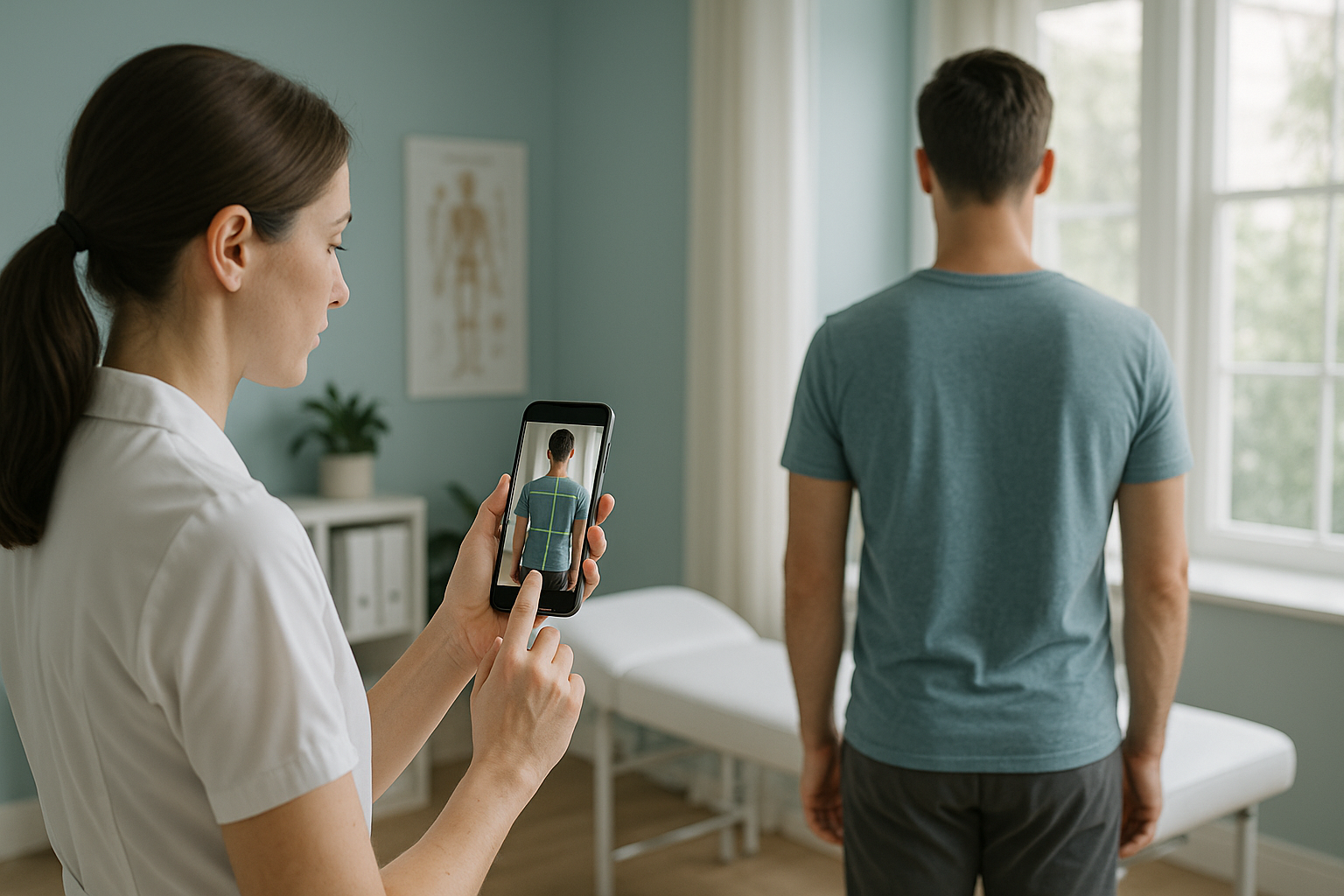
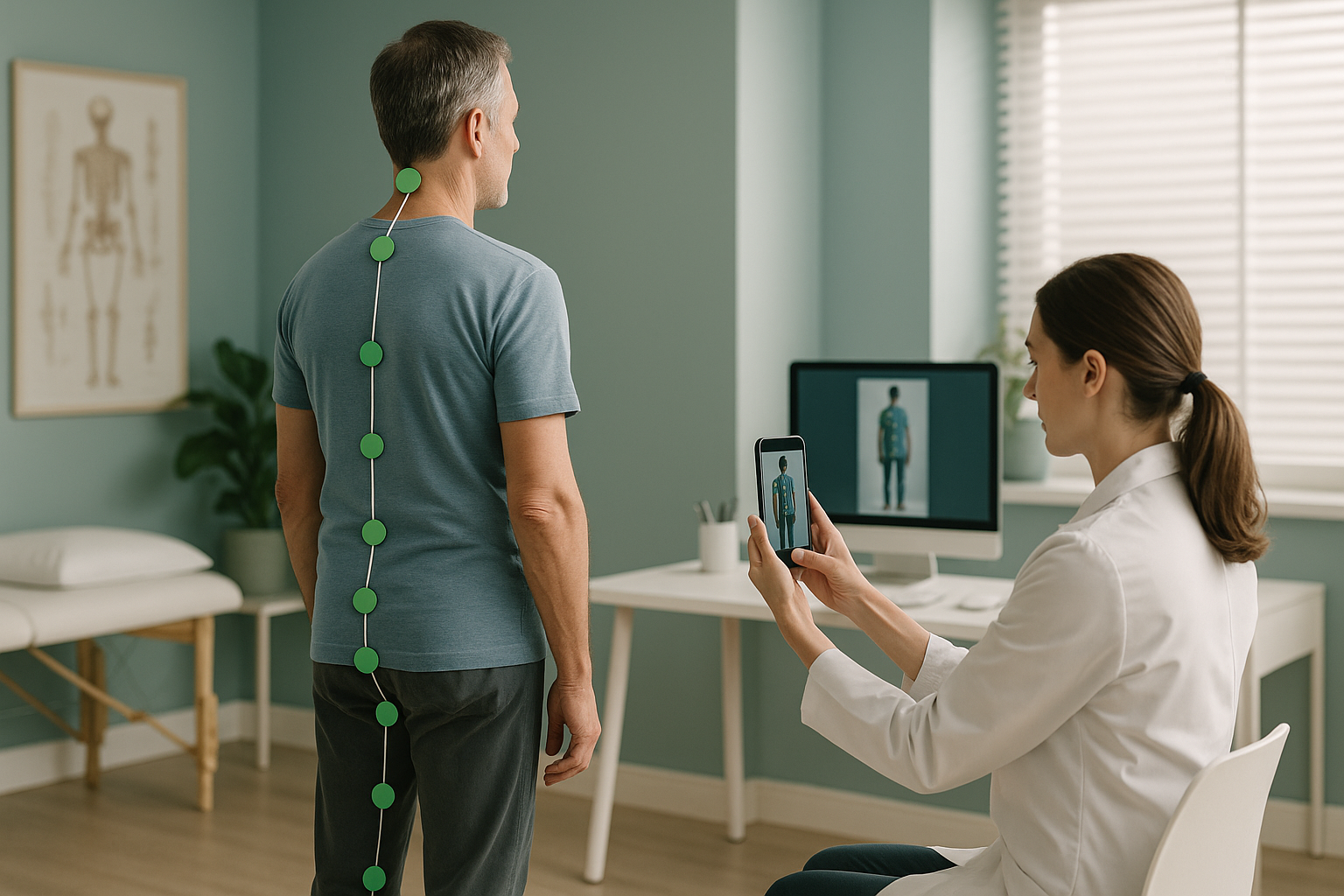
A posture app uses your phone camera to take a photo or short video of you standing. The software then places markers on body landmarks it can see, such as your ear, shoulder, hip, knee and ankle. It then works out the angles between them. Some apps use AI to do this automatically. Others ask you to tap the landmarks yourself.
The result is usually a colour-coded summary: green for good alignment, red for areas that look off. It is quick, free or cheap, and you can do it at home.
Why is a posture app's accuracy limited?
The main limit is simple: an app sees skin and clothing, not bone. Several everyday factors cause measurement errors. These can make the results unreliable.
None of this makes apps useless. It simply means the numbers they give are estimates, not measurements. Knowing the difference matters when decisions about treatment depend on those numbers.
When is a free posture check good enough?
For general awareness, an app is a perfectly reasonable place to start. You may be curious about your posture. You may want to check how your desk is set up. Or you may want a rough before-and-after comparison during an exercise programme. For all of these, a posture app does the job well.
- Have no pain, or only mild discomfort that started recently
- Want a general sense of your posture habits
- Are tracking progress during exercise
- Need a quick screening before deciding on next steps
- Have persistent or unexplained pain
- Need measured data for a surgeon or specialist
- Want to understand why one area keeps flaring up
- Have already tried treatment without lasting improvement
How is standing whole-body imaging different from a posture app?
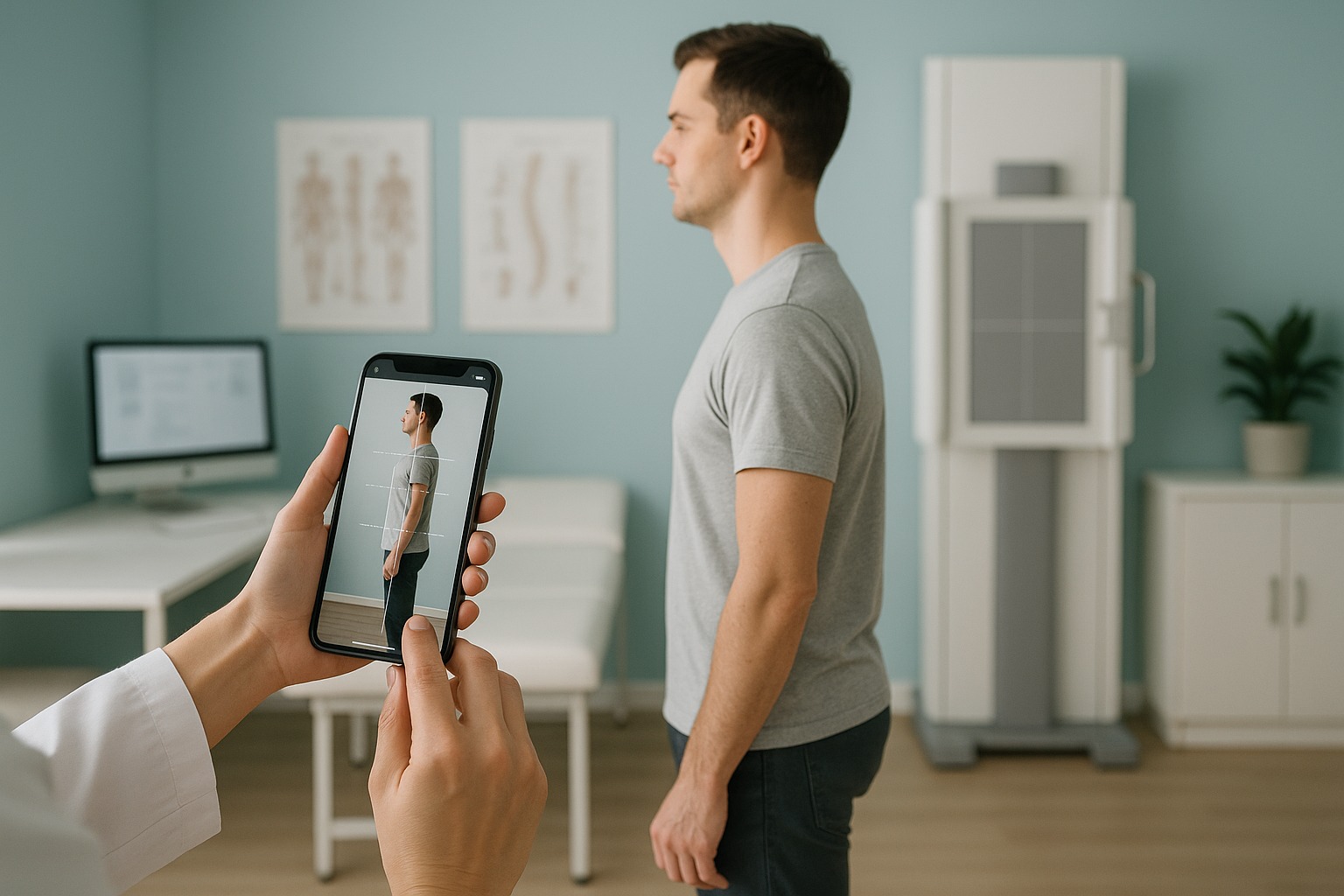
Standing whole-body imaging, such as an EOS scan, captures your whole skeleton in one image. You stand naturally, carrying your own body weight. It measures the actual position of your bones, your joint angles and the curves of your spine directly. It does not estimate them from the skin surface.
This matters because your body works as a connected chain. A tilt in the pelvis can change how the spine curves above it and how the knees carry load below it. A posture app might flag "forward head". But it cannot tell you whether the real issue starts in your thoracic spine, your pelvis, or even a difference in leg length. ScanAlign standing EOS imaging captures all of these links in a single standing exposure, with about 90% less radiation than a standard X-ray, around ten times less.
A consultant radiologist reports the scan results, with precise, repeatable measurements. Learn more about how EOS scan results are reported.
What is the difference between screening and diagnosis?
Screening is a quick look for possible problems. Diagnosis is a measured, clinical confirmation of what is actually happening. Posture apps belong firmly in the screening group. They are good at saying "something looks off here". They are not designed to tell you exactly what, where or why.
What it sees: the skin surface, the outline of your clothing, and estimated joint centres.
Repeatability: variable. Camera angle, lighting and how hard you try to hold your posture all affect the results.
Best for: general curiosity, tracking progress at the gym, and deciding whether to seek a professional assessment.
What it sees: actual bone positions, joint spaces, spinal curves, the position of the pelvis and leg alignment, all while your body carries its natural weight.
Repeatability: high. Standard positioning, calibrated equipment and precise measurements, such as a Cobb angle measurement for spinal curves.
Best for: looking into persistent pain, planning surgery, tracking changes in structure over time, and giving your specialist the data they need.
A note on soft tissue. EOS shows bones, joints and alignment beautifully. For soft tissue such as discs, nerves, ligaments or cartilage, MRI is usually the better tool. The two work well together, and your treating clinician can advise which one you need.
Before you start treatment, or change the treatment you are on, it is worth getting a detailed diagnosis. Knowing whether the cause sits in your pelvis, your legs or your spine changes what will actually help.
Not sure whether your posture concern needs a proper assessment? Find out what to expect at an alignment assessment, or talk it through with us first.
Book a free video consultationFrequently asked questions
They give a rough estimate of surface alignment. But camera angle, clothing and body shape all affect their accuracy. They are useful for general awareness, not for clinical measurement.
Not for clinical decisions. AI assessments work from photos and can flag imbalances you can see. But they cannot see bone positions, disc spaces or joint angles. For persistent problems, a professional assessment gives you the detail you need.
It cannot show what is happening inside your body: the shape and position of each vertebra, the position of your pelvis, true differences in leg length, or whether a joint space is narrowing. These need imaging.
Gravity and body weight affect how your spine curves and how your joints carry load. When you lie down for a standard scan, your muscles relax and your alignment changes. Standing imaging captures your skeleton as it actually works in daily life.
Yes. An EOS scan uses about 90% less radiation than a standard X-ray, around ten times less. It captures a full-body image in a single low-dose exposure.
No. ScanAlign is a self-referral clinic. You can book directly without a letter from your doctor. If you already have a referral, you are welcome to bring it with you.
For patients travelling from abroad, the price is confirmed during the free video consultation, which you can have first before you book a measured assessment.
Absolutely. An app can help you decide whether you want to take things further. If the app flags a problem and you have symptoms, a clinical assessment adds the bone-level detail you can act on.
A photo shows the outer surface of the body. An X-ray, or a standing EOS scan, shows the bones and joints directly. This means precise, repeatable measurements that can guide clinical decisions, instead of surface estimates.
These are serious symptoms. Please get urgent medical help by contacting your doctor, calling your local emergency number, or going to the nearest emergency department. Do not wait for a scan appointment.
Ready for answers an app cannot give you?
A free video consultation lets you discuss your concern with a specialist radiographer from home, before you commit to anything or plan a trip to London.
Book a free video consultationWritten by Abbas Dhami (Specialist Diagnostic Radiographer)
Sources
- Hazar Z, Karabicak GO, Tiftikci U. Reliability of photographic posture analysis of adolescents. Journal of Physical Therapy Science, 2015;27(10):3123-3126.
- Illés TS, Somoskeöy S. The EOS imaging system and its uses in daily orthopaedic practice. International Orthopaedics, 2012;36(7):1405-1411.
- NHS. Back pain: overview. nhs.uk, 2023. Available at: https://www.nhs.uk/conditions/back-pain/
This page is general information and not a diagnosis.
ScanAlign is the trading name of CoreMed Solutions Ltd and operates under The Harley Street Hospital's CQC licence.