

Piriformis Syndrome or Sciatica: How Do You Tell the Difference?
Piriformis syndrome and sciatica both cause buttock pain that spreads down the leg. But the source is different. Sciatica usually starts from a compressed nerve root in the lower spine. Piriformis syndrome happens when the piriformis muscle in the buttock irritates the sciatic nerve at that spot. Telling them apart matters, because the right treatment depends on the right diagnosis.
Key points
- Piriformis syndrome is a muscle problem in the buttock. Sciatica is usually a problem with a spinal nerve root.
- The symptoms overlap a lot. This is why many people are misdiagnosed.
- Scans done lying down can miss alignment problems that play a part in both conditions.
- A standing, weight-bearing image of the spine and pelvis shows how your body really takes load when upright.
- Accurate imaging helps your clinician choose the right way forward.
A note on MRI. EOS imaging is excellent at showing bone alignment, joint position and pelvic balance under load. For soft-tissue detail of the piriformis muscle, the discs or the nerves themselves, MRI is usually the better tool. The two scans work together. They do not compete.
Important. If you have sudden numbness in both legs, loss of bladder or bowel control, or weakness that is getting worse quickly, get urgent medical help. Contact your doctor or go to the nearest emergency department straight away.
What is piriformis syndrome?
Piriformis syndrome is a neuromuscular condition. The piriformis muscle, a small flat muscle deep in the buttock, presses on or irritates the sciatic nerve as it passes through the deep gluteal space. It is sometimes grouped under the wider term "deep gluteal syndrome". This covers any structure in that area that can trap the nerve.
The piriformis muscle runs from the front of the sacrum (the triangular bone at the base of your spine) across to the top of the thigh bone. Its job is to help turn your hip outward. When it becomes tight, swollen or goes into spasm, it can squeeze the sciatic nerve. The nerve runs just beneath the muscle, or in some people, right through it.

Sciatica, on the other hand, is a symptom rather than a diagnosis on its own. It describes pain along the path of the sciatic nerve. It is most often caused by a compressed or irritated nerve root in the lumbar spine. Common spinal causes include disc bulges, narrowing of the spinal canal, or bony changes that press on the nerve root where it leaves the spine. You can read more in our guide to sciatica or a spinal alignment problem.
What are the symptoms of piriformis syndrome?
The main symptom is a deep, aching pain in the buttock that can spread down the back of the thigh. It often feels very like sciatica. That is exactly why the two are so often confused.
A constant ache or sharp pain deep in one buttock. It is often hard to point to the exact spot.
Sitting on hard surfaces compresses the piriformis. This makes the pain clearly worse after a few minutes.
Buttock pain that spreads down the leg, sometimes reaching the calf or foot, just like true sciatica.
Turning the hip inward, or crossing the affected leg over the other knee, often brings the pain on.
You may also notice tenderness when you press into the middle of the buttock, or discomfort when climbing stairs. Some people find the pain eases with walking but flares up when they stop and sit down.
How do you tell the difference between piriformis syndrome and sciatica?
The key difference is where the sciatic nerve is being irritated. In spinal sciatica (often called lumbar radiculopathy), the nerve root is compressed as it leaves the lumbar spine. In piriformis syndrome, the nerve is squeezed further down, in the buttock itself.
Where the pain starts: Deep in the buttock, often on one side.
What makes it worse: Long periods of sitting, crossing the legs, turning the hip inward.
Back pain: Usually absent or minimal.
Clinical clue: Tenderness over the middle of the buttock. Pain brought on by the FAIR test (flexion, adduction, internal rotation of the hip).
Imaging findings: Spine imaging often looks normal. The problem is in the muscle, not the spine.
Where the pain starts: Lower back, spreading into the buttock and down the leg.
What makes it worse: Bending forward, coughing, sneezing, long periods of standing.
Back pain: Usually present along with the leg pain.
Clinical clue: Positive straight-leg raise test. A specific nerve-root pattern of numbness or weakness.
Imaging findings: Disc bulge, narrowing of the spinal canal, or bony changes visible where the nerve root exits.
There is a third possibility worth knowing about. The pain may come from the sacroiliac joint, which sits right next to the piriformis. SI joint dysfunction can cause very similar buttock and thigh pain. This makes the picture even more complex. Buttock pain linked to sitting can also come from ischial bursitis, an inflamed bursa under the sitting bone.
Because the symptoms overlap so much, a clinical examination alone may not give a clear answer. That is where imaging plays a vital role.
What causes piriformis syndrome?
The piriformis can become tight, inflamed or go into spasm for several reasons. Often it is not one single event but a mix of factors. Many of these relate to how your body is aligned under load.
Desk work or long drives press the piriformis against the sciatic nerve for hours at a time.
A tilted or rotated pelvis forces one piriformis to work harder than the other. This leads to overload.
Running, climbing, or a direct fall onto the buttock can inflame the muscle and trigger spasm.
In some people, the sciatic nerve passes through the piriformis rather than beneath it. This makes the nerve more vulnerable.
How the body compensates is important here. Your body is a connected chain from your feet up to your head. Your pelvis may sit unevenly, perhaps from a small difference in leg length or a rotated sacrum. Then the piriformis on one side works overtime to keep you stable. Over weeks and months, that overworked muscle tightens, and the sciatic nerve running beneath it starts to suffer. The pain you feel in your buttock or leg may actually be driven by an alignment problem somewhere else entirely.
How does a standing scan help diagnose piriformis syndrome?
A standing, weight-bearing scan shows your skeleton the way it really works: upright and under gravity. This is its key advantage over imaging done lying down.
When you lie down for a usual X-ray, CT or MRI, your muscles relax and your pelvis settles into a neutral position. A mild pelvic tilt or rotation that loads one piriformis more than the other can simply disappear from the image. You get a scan that looks reassuringly normal, while the mechanical cause of your pain is missed.
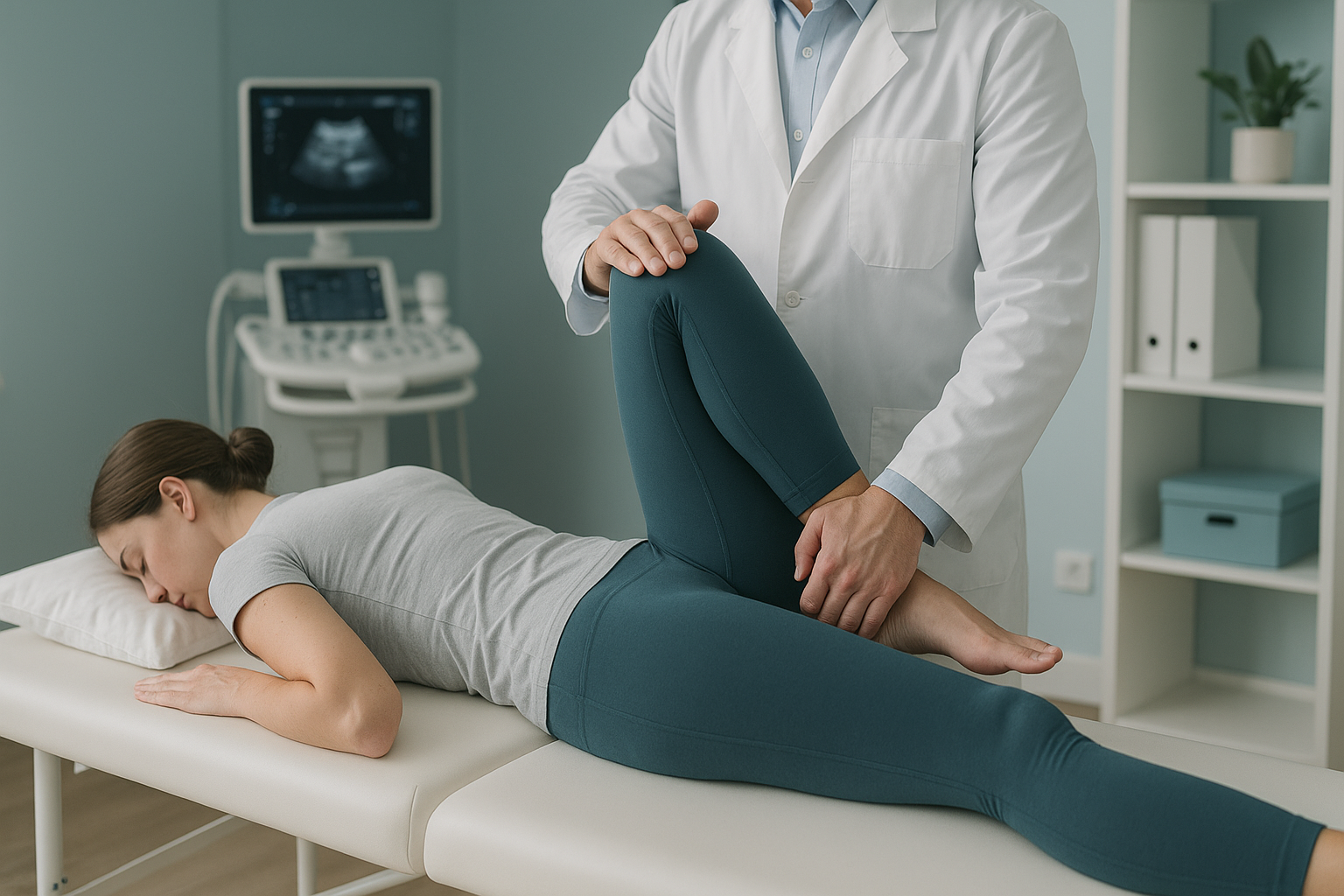
At ScanAlign, whole-body standing imaging, an EOS scan captures your full skeleton from head to ankles in a single upright image. It uses about 90% less radiation than a standard X-ray, around ten times less. This means your radiographer and clinician can see your spinal curves, pelvic rotation, hip alignment and leg length all at once, in the upright, loaded position that actually reproduces your symptoms.
If the scan shows a level pelvis and a normal lumbar spine, your clinician can focus with confidence on the piriformis itself. They can then guide you towards the right soft-tissue tests or treatment. If it shows a tilt, a rotation, or a spinal cause for nerve compression, that changes the plan entirely. Either way, you leave with a clearer picture.
Wondering whether your buttock pain comes from your spine, your pelvis or the piriformis muscle? A standing alignment scan at our London clinic can help narrow it down.
Book a free video consultationWhat helps manage piriformis syndrome?
Management depends entirely on confirming that the piriformis is the real source of the problem, not the spine or the SI joint. Once the diagnosis is clear, your treating clinician may consider a range of approaches.
- Targeted stretching. A piriformis stretch is commonly recommended to ease tightness. In this stretch, you gently pull the knee of the affected side across towards the opposite shoulder. Your physiotherapist can tailor a programme for you.
- Changing your activities. Avoiding long periods of sitting, using a cushion to reduce direct pressure, and taking regular breaks to move can all help reduce flare-ups.
- Physiotherapy. Strengthening the hip stabilisers and improving pelvic control may reduce the load on the piriformis over time.
- Addressing alignment. A standing scan may show a pelvic tilt or rotation that is overloading the piriformis. If so, correcting that underlying imbalance may form part of the treatment plan your clinician recommends.
Before you start treatment, or change the treatment you are on, it is worth getting a detailed diagnosis. Knowing whether the cause sits in the pelvis, the legs or the spine changes what will actually help.
ScanAlign does not provide treatment. It provides the diagnostic imaging that helps your clinician understand what is happening in your body's structure, so they can choose the most suitable way forward. If you would like to book a standing spine and pelvis scan in London, we start with a free video consultation to make sure a scan is right for you.
Frequently asked questions
Not exactly. Sciatica describes pain along the sciatic nerve. It is usually caused by a problem in the lower spine. Piriformis syndrome causes similar symptoms, but the nerve is irritated by the piriformis muscle in the buttock, not by a spinal problem.
Most people describe a deep, dull ache in one buttock that gets worse with sitting. Pain may spread down the back of the thigh and sometimes into the calf. It often flares up when you cross your legs or turn your hip inward.
Piriformis syndrome is mainly a clinical diagnosis. A standard X-ray taken lying down usually looks normal. MRI can sometimes show inflammation or swelling in the piriformis muscle. A standing EOS scan is most useful for ruling out spinal or pelvic alignment causes of the same symptoms.
When you sit, especially on a hard surface, your body weight presses the piriformis muscle directly against the sciatic nerve. The longer you sit, the more pressure builds. This is why many people feel worse after desk work or long drives.
Deep gluteal syndrome is a wider term that includes piriformis syndrome. It covers any condition where the sciatic nerve is trapped or irritated in the deep gluteal space. This may be caused by the piriformis muscle, scar tissue, a band of fibrous tissue, or another structure in the area.
Yes, it can contribute. A tilted or rotated pelvis changes the load on the hip muscles. The piriformis on the lower side often has to work harder to keep the joint stable. Over time, this can lead to tightness, spasm and nerve irritation.
No referral is needed. ScanAlign is a private, self-pay clinic. You start with a free video consultation, so your radiographer can confirm whether a scan is suitable for your situation.
An EOS scan uses about 90% less radiation than a standard X-ray, around ten times less. It captures a full standing image of your skeleton in a single low-dose pass.
For patients travelling from abroad, the price is confirmed during the free video consultation.
A commonly recommended piriformis stretch is done lying on your back. Bend both knees, then gently pull the knee of the affected side across towards the opposite shoulder. Hold for around 30 seconds. However, it is important to have the correct diagnosis first. If the real cause is in the spine, stretching the piriformis alone will not address the problem.
Not sure if it is the piriformis or your spine?
A free video consultation with our specialist radiographer can help you decide whether a standing alignment scan in London is the right next step.
Book a free video consultationWritten by Abbas Dhami (Specialist Diagnostic Radiographer)
Sources
- Hopayian K, Danielyan A. Somatic dysfunction and piriformis syndrome: a systematic review. Journal of Back and Musculoskeletal Rehabilitation. 2018;31(4):661-672.
- Martin HD, Reddy M, Gómez-Hoyos J. Deep gluteal syndrome. Journal of Hip Preservation Surgery. 2015;2(2):99-107.
- NHS. Sciatica. nhs.uk. Available at: https://www.nhs.uk/conditions/sciatica/
This page is general information and not a diagnosis.
ScanAlign is the trading name of CoreMed Solutions Ltd and operates under The Harley Street Hospital's CQC licence.