
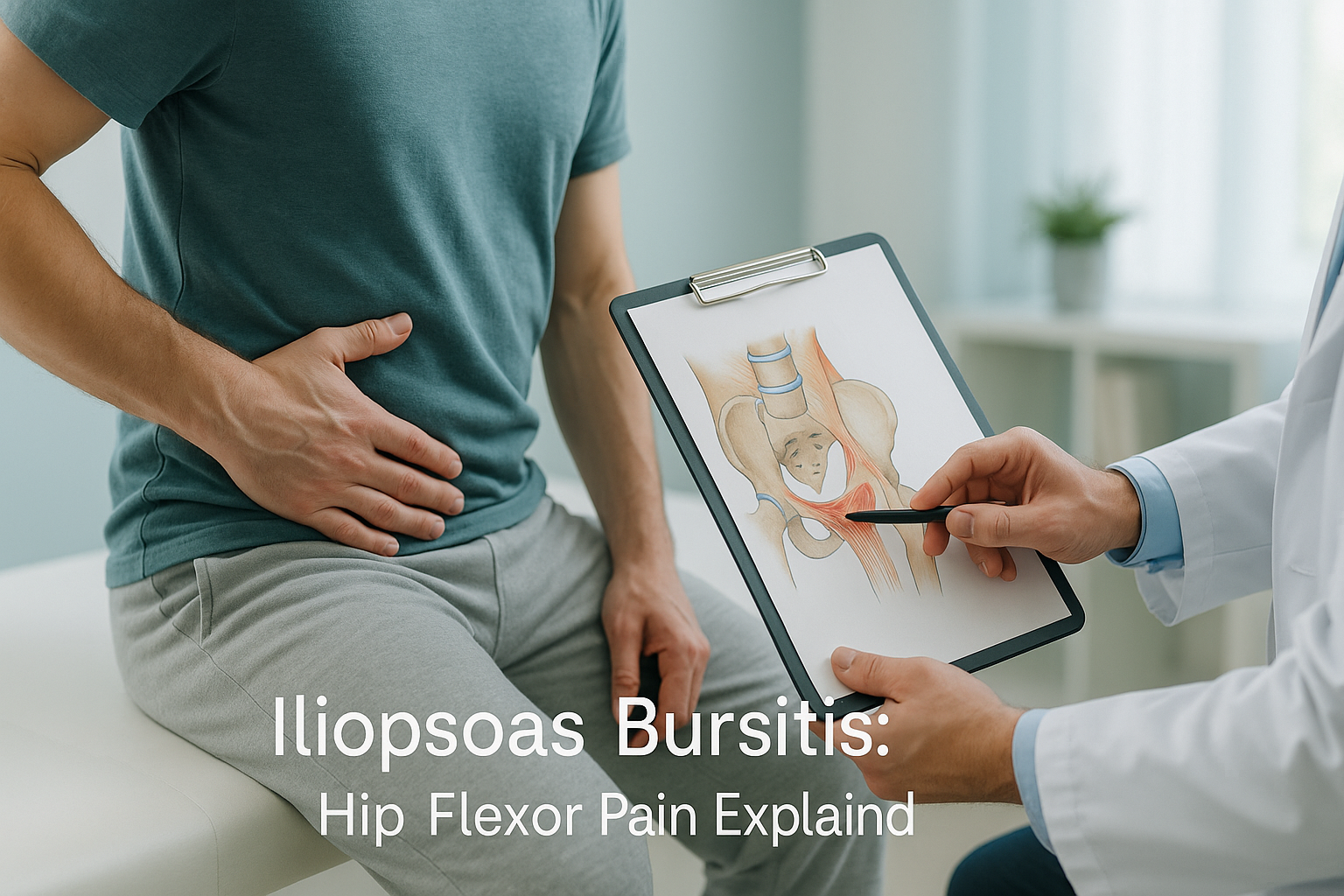
Iliopsoas Bursitis: What Is It and Why Does Your Hip Flexor Hurt?
Iliopsoas bursitis is inflammation of a small sac filled with fluid. This sac sits between the iliopsoas muscle and the front of the hip joint. It causes a deep ache or sharp pain in the groin or the front of the hip. Walking, climbing stairs or sitting for a long time often makes it worse. It is sometimes linked to snapping hip syndrome or iliopsoas tendinitis.
Key points
- Iliopsoas bursitis causes pain at the front of the hip, not the side or the back.
- It often develops along with iliopsoas tendinitis or snapping hip syndrome.
- Scans taken lying down can miss alignment problems that add to the strain.
- A standing whole-body scan shows how your pelvis, spine and legs work together under load.
- ScanAlign provides diagnostic imaging only, not treatment.
The iliopsoas is a strong hip flexor muscle. It runs from the lower spine, through the pelvis, and attaches to the top of the thigh bone. A bursa (a thin, slippery cushion) sits between the muscle's tendon and the bone to reduce friction. When that bursa becomes irritated and swollen, the result is iliopsoas bursitis.
This condition is sometimes called hip flexor bursitis. It can overlap with iliopsoas tendinitis, where the tendon itself is inflamed. It can also overlap with iliopsoas syndrome, a broader term for pain from the muscle, tendon or bursa. In some people, the tendon flicks over a bony prominence and makes a click you can hear. This is called snapping hip syndrome.
What does iliopsoas bursitis feel like?
Iliopsoas bursitis usually causes a deep, nagging ache in the groin or the front of the hip. The pain is often hard to point to with one finger. It can be sharp when you first stand up after sitting. It may then settle into a dull throb as you keep moving.
A deep ache that feels as if it comes from inside the joint. It is often worse after rest.
Lifting the knee against gravity loads the iliopsoas and presses on the inflamed bursa.
A snap you can hear as the tendon catches over the front of the hip. This is sometimes called snapping hip syndrome.
The hip flexor shortens while you sit. Standing up stretches the inflamed area and triggers pain.
When to get urgent help. If you develop sudden severe hip pain with numbness, weakness in the leg, or any loss of bladder or bowel control, contact your doctor or go to the nearest emergency department straight away. These symptoms need medical attention immediately.
What causes iliopsoas bursitis?
Iliopsoas bursitis is usually caused by repeated friction between the iliopsoas tendon and the front of the hip joint. Anything that increases that friction can trigger it. This includes overuse, an alignment imbalance, or a change to the joint itself.
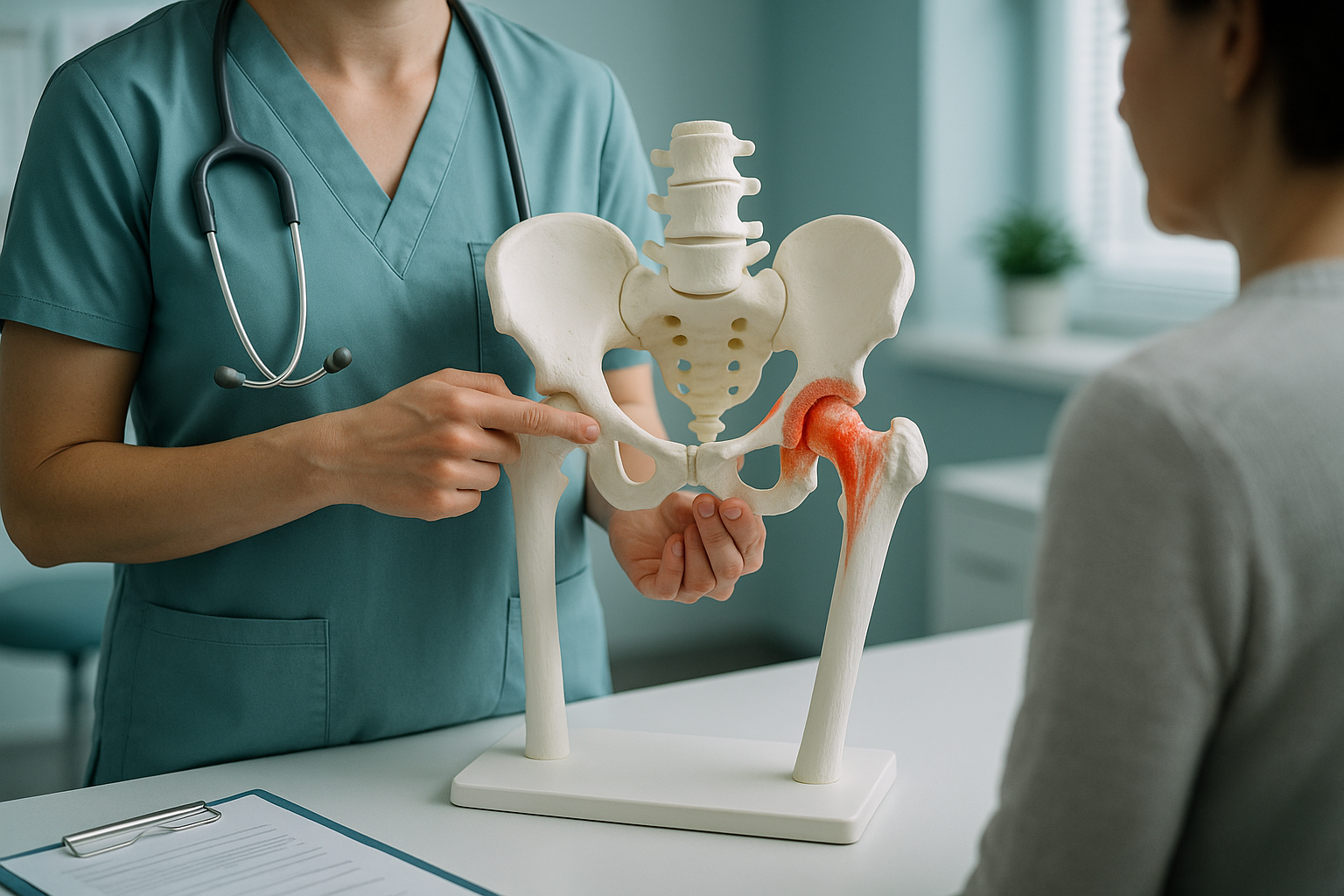
Running, cycling, dancing or any exercise that bends the hip again and again can irritate the bursa over time.
A tilted pelvis or a curved spine can put extra load on one hip flexor. This increases friction on the bursa.
Hours in a chair shorten the iliopsoas. When you stand, the tight muscle pulls harder on the bursa.
Surgery changes the shape of the joint. This can change how the tendon moves over it, and sometimes causes iliopsoas bursitis after hip replacement.
The iliopsoas crosses both the spine and the hip. So problems higher up or lower down the body can play a part. A difference in leg length, a stiff lower back or a rotated pelvis can all change how the muscle takes load during movement. That is why looking at one area on its own sometimes misses the bigger picture.
How does a standing scan help with pain at the front of the hip?
A standing, weight-bearing scan shows your bones and joints upright, under the load your body carries every day. When you lie down for a normal X-ray or CT scan, gravity is taken away, the muscles relax and small alignment shifts can disappear. This means the scan may look normal even when something is clearly wrong once your body is upright and under load.
EOS imaging captures a full-length view from your ankles to your skull in a single standing exposure, using about 90% less radiation than a standard X-ray, around ten times less. The image shows how your spine, pelvis, hips and legs relate to each other under real load.
For someone with iliopsoas bursitis, this whole-body view matters. A pelvic tilt may be putting extra strain on one hip flexor. A small difference in leg length may be forcing one side to overwork. These patterns show up on a standing scan. A scan of the hip alone, taken lying down, may miss them completely.
ScanAlign uses EOS technology at 19 Harley Street, London, to provide this kind of full-body standing assessment. You do not need a referral.
Book a free video consultationEOS and MRI do different jobs. EOS shows bones, joints and alignment very clearly. For soft tissue detail, such as the bursa itself, tendons or nerves, MRI is usually the better tool. Your clinician may recommend both, depending on your situation.
What can be done about iliopsoas bursitis?
Treatment for iliopsoas bursitis is managed by your doctor, physiotherapist or orthopaedic specialist. ScanAlign does not provide treatment. What it does provide is detailed alignment information that helps these clinicians make better decisions.
Common approaches include physiotherapy to stretch and strengthen the hip flexor, changing activities to reduce irritation, and sometimes guided injections. If the bursitis has developed because of an underlying alignment problem, dealing with that root cause is often key to lasting improvement.
For people who have iliopsoas bursitis after hip replacement, a standing alignment scan can help the surgical team check whether the position of the new joint is adding to the tendon irritation. An X-ray taken lying down may not capture this information accurately.
Knowing how your whole body lines up, from your feet through your knees, hips, pelvis and spine, gives your treatment team a clearer starting point. Pain at the front of the hip does not always start at the hip. Learn more about how hip alignment assessment works.
Before you start treatment, or change the treatment you are on, it is worth getting a detailed diagnosis. Knowing whether the cause lies in the pelvis, the legs or the spine changes what will actually help.
Frequently asked questions about iliopsoas bursitis
Bursitis is inflammation of the bursa, the cushion filled with fluid near the tendon. Tendinitis is inflammation of the tendon itself. They often happen together, because irritation of one tends to affect the other. The term iliopsoas syndrome is sometimes used to cover both.
They are closely related. Snapping hip syndrome happens when the iliopsoas tendon catches over a bony prominence at the front of the hip. That repeated snapping can inflame the bursa underneath, which leads to bursitis. Some people have the snap without pain, while others develop significant discomfort.
Sitting shortens the iliopsoas muscle. When you stand, the muscle stretches and the tendon pulls across the inflamed bursa. This can cause a sharp jolt of pain. Pain after sitting for a long time is one of the typical signs of iliopsoas bursitis.
Yes. After hip replacement surgery, the shape of the joint changes. This can change how the iliopsoas tendon moves over the front of the hip, and sometimes increases friction on the bursa. A standing alignment scan can help check whether the position of the implant is playing a part.
No. ScanAlign is a private, self-pay clinic. You can book directly, without a referral from your doctor or a consultant. You start with a free video consultation to discuss whether the scan is right for you.
EOS uses about 90% less radiation than a standard X-ray, around ten times less. It is one of the lowest-dose skeletal imaging options available. You can find more detail on the FAQs and safety page.
ScanAlign is a private, self-pay service. The price for patients travelling from abroad is confirmed during the free video consultation, and you can read more on the cost and FAQs page.
An image taken lying down removes gravity. The muscles relax and the skeleton settles into a position it does not hold in real life. A standing scan captures your alignment under your full body weight. It shows tilts, shifts and compensations that only appear when you are upright. Learn more about how EOS whole-body imaging works.
Yes. The iliopsoas attaches to the lower spine and crosses the hip. If the lower back is curved too much or the pelvis is tilted, the muscle may be held in a shortened or overloaded position. That extra strain increases friction on the bursa. A full standing image of the spine and pelvis together can show this link.
EOS is excellent at showing bones, joints and whole-body alignment. The bursa itself is a soft-tissue structure that is best seen on MRI or ultrasound. However, EOS can show the alignment factors that may be causing the bursa to become irritated in the first place.
Find out what is behind your hip flexor pain
A free video consultation lets you discuss your symptoms with our team from home. You can find out whether a standing alignment scan in London is the right next step for you.
Book a free video consultationSources
- NHS, "Hip pain in adults," nhs.uk (accessed 2024).
- Domb BG, Shindle MK, McArthur B, et al. "Iliopsoas impingement: a newly identified cause of labral pathology in the hip." HSS Journal, 7(2), 2011.
- Illés T, Somoskeöy S. "The EOS imaging system and its uses in daily orthopaedic practice." International Orthopaedics, 36(7), 2012.
Written by Abbas Dhami (Specialist Diagnostic Radiographer)
This page is general information and not a diagnosis.
ScanAlign is the trading name of CoreMed Solutions Ltd and operates under The Harley Street Hospital's CQC licence.