
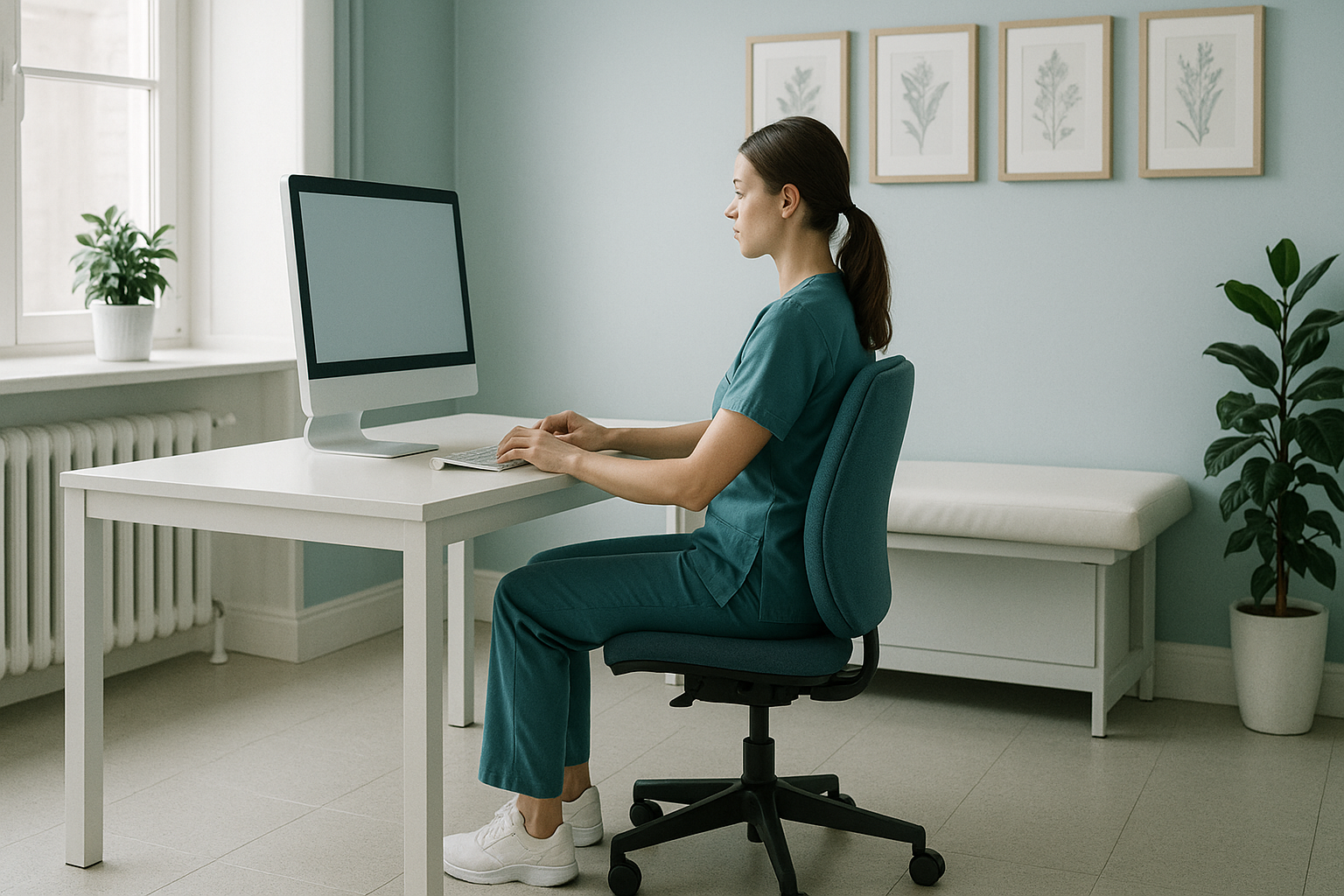
How Should You Really Sit at a Desk?
Good sitting posture in a chair means a neutral spine, feet flat on the floor, the screen at eye level and elbows bent at about a right angle. But the best sitting position is the one you change often. No single position protects you if you hold it for hours without moving.
Key points
- When you sit, aim for a neutral spine, not a stiff, ramrod-straight one.
- Screen height, seat depth and lower back support all affect your posture.
- Changing position every 20 to 30 minutes matters more than finding one "perfect" position.
- Aches that keep coming back despite a good desk setup may point to an underlying alignment problem.
- Standing scans can show alignment problems that sitting or lying-down scans miss.
Most of us sit for more than seven hours a day. If your posture in the chair is off, your muscles and joints have to make up for it for a long time. The problem is that advice on correct sitting posture often feels confusing, or seems to contradict itself. This page gives you clear, practical steps you can use today.
What does correct sitting posture really look like?
Correct sitting posture is a relaxed, neutral spine. Your head, ribcage and pelvis sit stacked above each other without effort. It is not about sitting "perfectly still." It is about starting from a supported position, so your body does not have to work overtime.
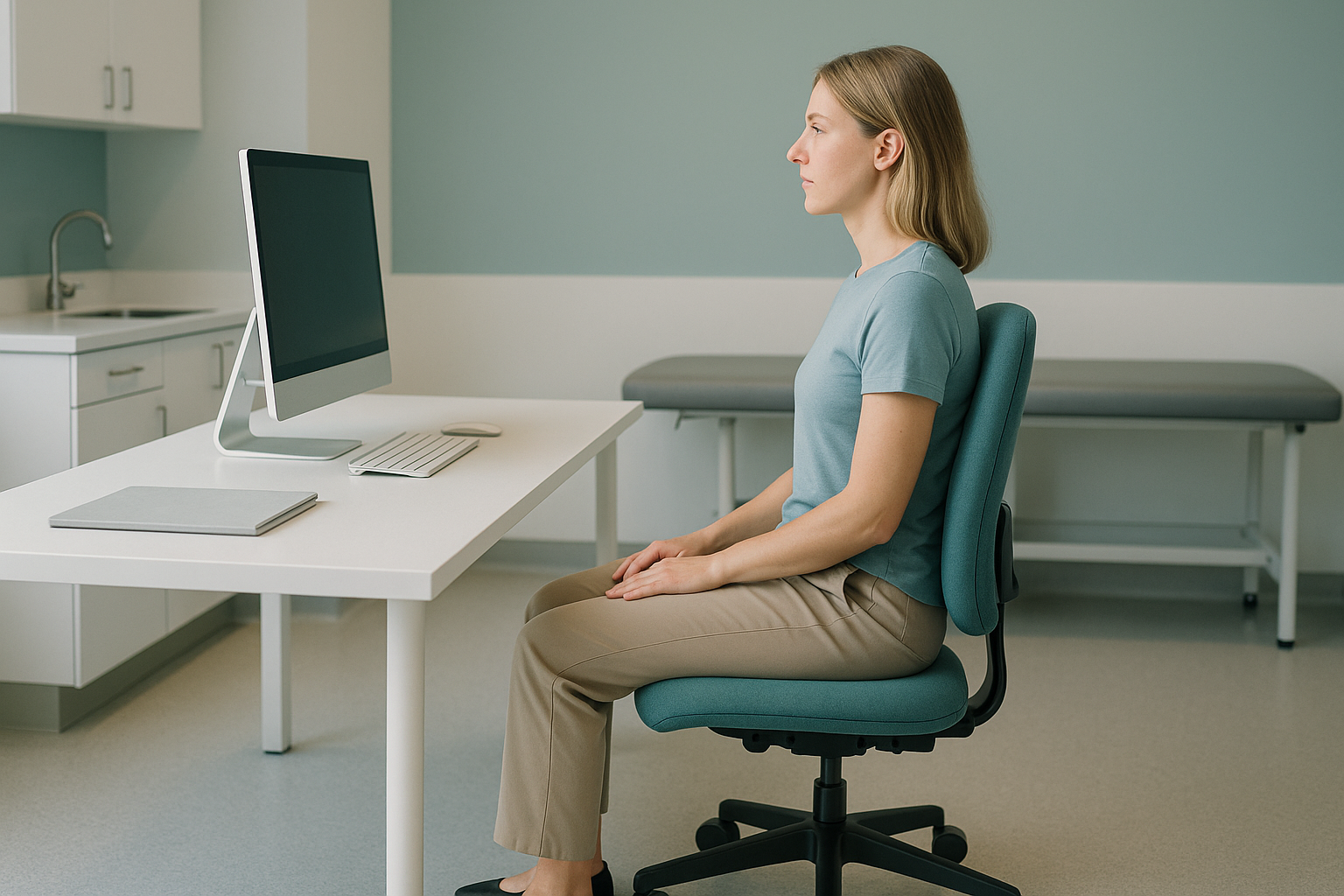
Your desk setup checklist
The top of your screen should be at or just below eye level, about an arm's length away.
The back of your office chair should follow the natural curve of your lower back. If your chair has no built-in lumbar support, a small cushion works.
Keep your elbows close to your body and bent at about 90 degrees. Your forearms should rest comfortably on the desk or keyboard tray.
Keep your feet flat on the floor. Leave a small gap between the front edge of the seat and the backs of your knees. Use a footrest if you need one.
What are the signs your desk posture is causing problems?
The most common sign is a dull ache in your neck, shoulders or lower back. It builds through the working day and eases at weekends. Other signs include tension headaches, stiffness when you stand up and clenching your jaw.
Slouching, or perching on the edge of your seat, often leads to forward head posture, where your head drifts in front of your shoulders. Over time, this puts extra strain on the neck and upper back. In the same way, slumping into the back of your chair can push you into a posterior pelvic tilt, which flattens the natural curve of your lower back.
If you often sit cross-legged or twist to one side, you may create an imbalance through the pelvis and spine. Slowly, this can become a pattern your body treats as "normal," even though it is not balanced. Some people develop a sway back posture without noticing, where the hips push forward and the upper back curves to make up for it.
Does sitting cross-legged at your desk matter?
Yes, it can. Sitting cross-legged tilts the pelvis unevenly and rotates the lower spine. Doing it now and then is unlikely to cause harm. But if it becomes your usual position for hours every day, your muscles and joints start to adapt to that imbalance.
The same applies to leaning on one armrest, holding a phone between your ear and shoulder, or always reaching for your mouse on the same side. Small habits, repeated thousands of times, become structural patterns.
Switch which leg you cross. Use a keyboard tray so both arms rest evenly. Put your phone on speaker or use a headset. Small changes for balance reduce strain that builds up over time.
A sit-stand desk helps because it encourages you to vary your posture. Aim to switch between sitting and standing every 30 to 45 minutes, rather than standing all day, which brings its own problems.
How often should you move when working at a desk?
Ideally, every 20 to 30 minutes. Even standing up for 30 seconds resets your posture and restores blood flow. Movement breaks do not need to be long. A short walk to the kitchen, a few shoulder rolls or simply shifting your weight from one foot to the other all count.
Research consistently shows that sitting still for long periods is a bigger risk factor for muscle and joint pain than the exact angle of your chair. Your body is designed to move, and no perfect desk setup can replace that basic need.
Still getting aches despite a good setup? An underlying alignment problem, which only shows when you are standing and bearing weight, could be the missing piece.
Book a free video consultationHow is posture checked when you are standing up?
A standing, weight-bearing X-ray shows your skeleton in the position it really works in. When you lie down for a standard X-ray, CT scan or MRI, gravity is taken away, muscles relax and alignment problems can disappear from the image. That is why many people get "normal" scan results but still feel pain at their desk.
At ScanAlign, an EOS scan captures your whole body, from head to feet, in a single standing image using about 90% less radiation than a standard X-ray, around ten times less. This whole-body view lets clinicians see the connected chain. For example, a slight shift in the pelvis might be forcing your lower back to curve more than it should, which in turn pushes your head forward.
Because the body compensates as a linked system, the place where you feel pain is often not where the problem starts. A full standing assessment can show these hidden links, so treatment is aimed at the real cause.
Before you start any treatment, or change the one you are on, it is worth getting a detailed diagnosis. Knowing whether the cause lies in the pelvis, the legs or the spine changes what will really help.
When MRI is the better choice: EOS shows bones, joints and alignment clearly. For soft-tissue problems such as disc bulges, nerve compression or ligament injuries, MRI is usually the better tool. Your clinician can advise which scan suits you.
Frequently asked questions
A neutral spine with gentle lower back support, feet flat on the floor and elbows at about 90 degrees. Change position often. No single position is ideal for hours at a time.
Now and then, it is fine. As a daily habit that lasts hours, it tilts the pelvis and can lead to muscle imbalances over time. Try to switch sides or keep both feet on the floor.
The top of the screen should be at or just below your eye level. If you use a laptop, a separate stand or riser with an external keyboard helps stop you looking down all day.
A fully adjustable office chair helps, but it is not essential. The key features are adjustable seat height, good lower back support and a seat depth that does not press into the backs of your knees. A small lumbar cushion can improve most ordinary chairs.
A sit-stand desk encourages you to vary your posture, which is good for you. Switch between sitting and standing every 30 to 45 minutes, rather than standing all day.
A good desk setup helps, but it cannot fix an underlying structural alignment problem. If your pelvis, spine or hips are out of balance, those problems stay whatever chair you use. A standing whole-body assessment can show what standard scans miss.
An EOS scan captures your whole skeleton in a single standing image. It uses about 90% less radiation than a standard X-ray, around ten times less. Because you are upright, it shows your alignment under real weight-bearing conditions.
No. You can book yourself, without a referral from your doctor. The process starts with a free video consultation, where a specialist looks at your concerns and confirms whether an EOS scan is right for you.
Yes. The EOS system delivers about 90% less radiation than a standard X-ray, around ten times less. It is one of the lowest-dose imaging options available for checking the skeleton.
ScanAlign is a private, self-pay clinic. The price for patients travelling from abroad is confirmed during the free video consultation.
Desk pain that will not go away?
If changes to your desk setup have not solved the problem, a standing whole-body assessment at our London clinic can show what is really going on. Start with a free video consultation from home.
Book a free video consultationSources
- NHS. "How to sit correctly." nhs.uk, 2023.
- Health and Safety Executive (HSE). "Display screen equipment (DSE) workstation checklist." hse.gov.uk.
- Claus AP, Hides JA, Moseley GL, Hodges PW. "Is 'ideal' sitting posture real? Measurement of spinal curves in four sitting postures." Manual Therapy, 2009; 14(4): 404-408.
Written by Abbas Dhami (Specialist Diagnostic Radiographer)
This page is general information and not a diagnosis.
ScanAlign is the trading name of CoreMed Solutions Ltd and operates under The Harley Street Hospital's CQC licence.