

How Is Adult Scoliosis Different From the Teenage Kind?
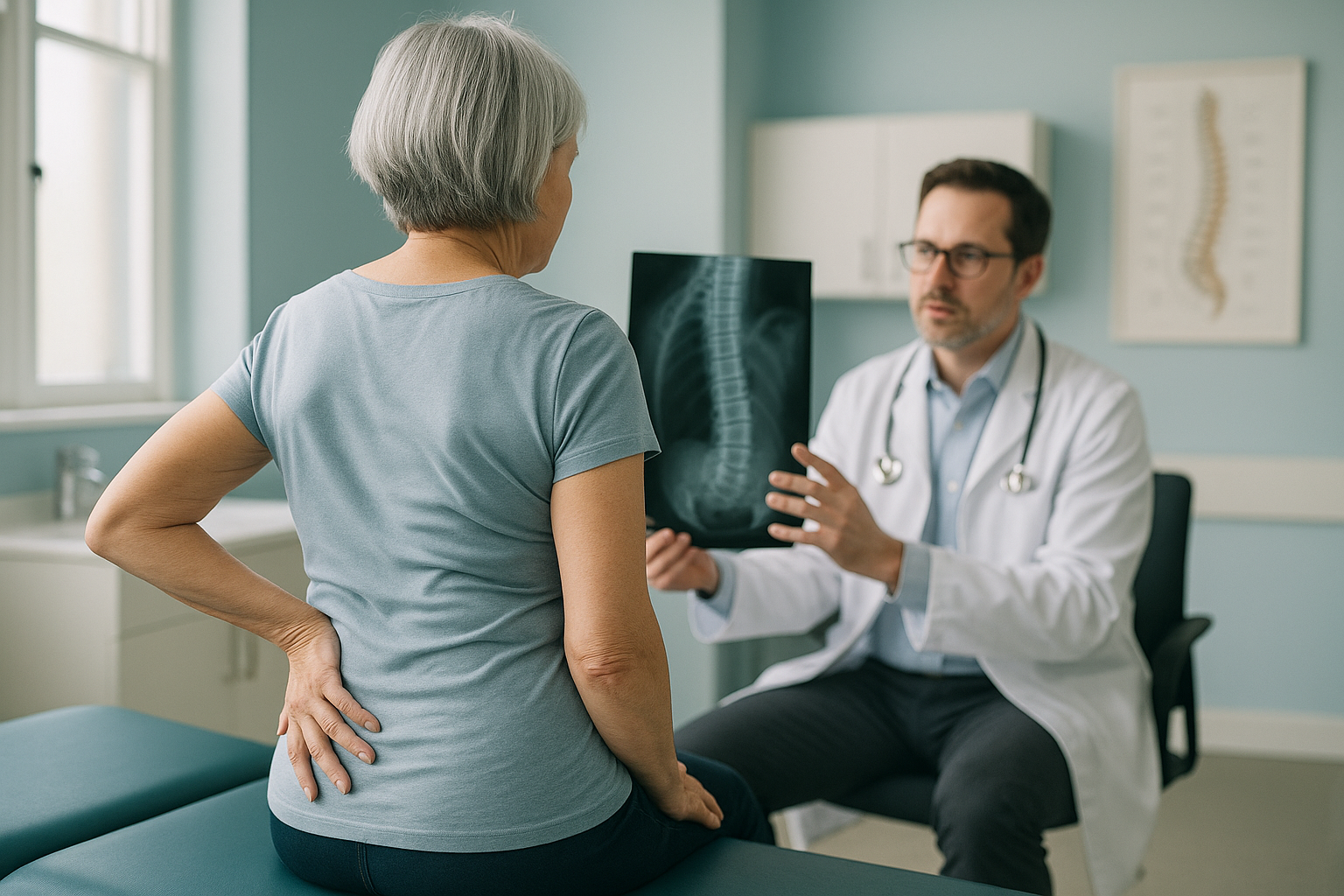
Adult scoliosis is a sideways curve of the spine that develops or gets worse after the skeleton has fully matured. The teenage form usually appears during a growth spurt, with no clear cause. Adult scoliosis is different. It is most often driven by wear and tear in the discs and joints. It tends to cause more pain, stiffness and balance problems than scoliosis in teenagers.
Key points
- Adult scoliosis is commonly caused by age-related wear in the discs and joints, not by growth.
- Pain, stiffness and changes in balance are far more common in adults than in teenagers.
- Standing, weight-bearing imaging shows how severe the curve is and your overall balance. Lying-down scans can miss this.
- Treatment decisions depend on accurate whole-body alignment data, not on curve size alone.
- An EOS scan uses about 90% less radiation than a standard X-ray, around ten times less.
What exactly is adult scoliosis?
Adult scoliosis is any lateral (sideways) curve of the spine present after the skeleton has finished growing, usually after age 25. Some adults have a curve that first appeared in their teens. Others develop a completely new curve later in life. This is often called de novo or degenerative scoliosis. Either way, its effect on daily life tends to be quite different from what a teenager goes through.
In teenagers, scoliosis is usually painless and found by chance. The main worry is whether the curve will get worse during growth. In adults, the picture changes. Pain, tiredness and changes in balance become the main issues. The underlying cause is usually wear rather than growth.
What are the different types of adult scoliosis?
There are two main types, and they behave quite differently.
Progressed adolescent scoliosis means the curve began in the teenage years and has slowly got worse over decades. These curves tend to be smoother and larger. Many people live with them for years without major symptoms. Then, as the spine ages, they notice more stiffness, tiredness or a visible shift of the trunk.
De novo (degenerative) scoliosis develops entirely in adulthood, usually after age 40 or 50. It is driven by uneven wear of the discs and facet joints in the lumbar spine. These curves are usually shorter and smaller. Even so, they can cause significant pain, nerve compression and balance problems, because they develop in a spine that is already stiff and arthritic.
In both types, understanding how the whole body balances around the curve is at least as important as measuring the curve itself. That is where Cobb angle measurement comes in. It measures the curve, but balance and alignment tell the real story.
What symptoms does adult scoliosis cause?
Pain is the main reason adults seek help for scoliosis. Teenagers with scoliosis rarely have pain. Adults almost always do. The symptoms tend to build slowly and may include the following.
Urgent symptoms. If you develop sudden numbness or weakness in your legs, or lose bladder or bowel control, get medical help straight away. Contact your doctor, call your local emergency number, or go to the nearest hospital emergency department. These symptoms need urgent assessment, not a routine scan.
What causes scoliosis to develop or get worse in adults?
Degenerative scoliosis is caused by uneven wear in the discs and facet joints of the spine. Over time, one side of a disc loses height faster than the other, and the vertebra above tilts. When this happens at several levels, a new curve forms.
If you already had a teenage curve, it can get worse slowly through adult life, as these same wear changes build on top of the existing curve. This tends to be gradual, sometimes less than a degree per year, but over decades it adds up.
Why does a standing scan matter for adult scoliosis?
A standing, weight-bearing image shows how your spine really behaves under gravity. This is essential, because adult scoliosis is as much about balance as it is about the curve itself.
When you lie down for a standard X-ray, CT or MRI, gravity is taken away and the muscles relax. The curve can then look smaller or straighter than it really is. Your body may look aligned on a lying-down scan, while in fact you lean a lot to one side when upright. Specialists call this your coronal and sagittal balance. It is one of the strongest predictors of how much scoliosis affects your quality of life.
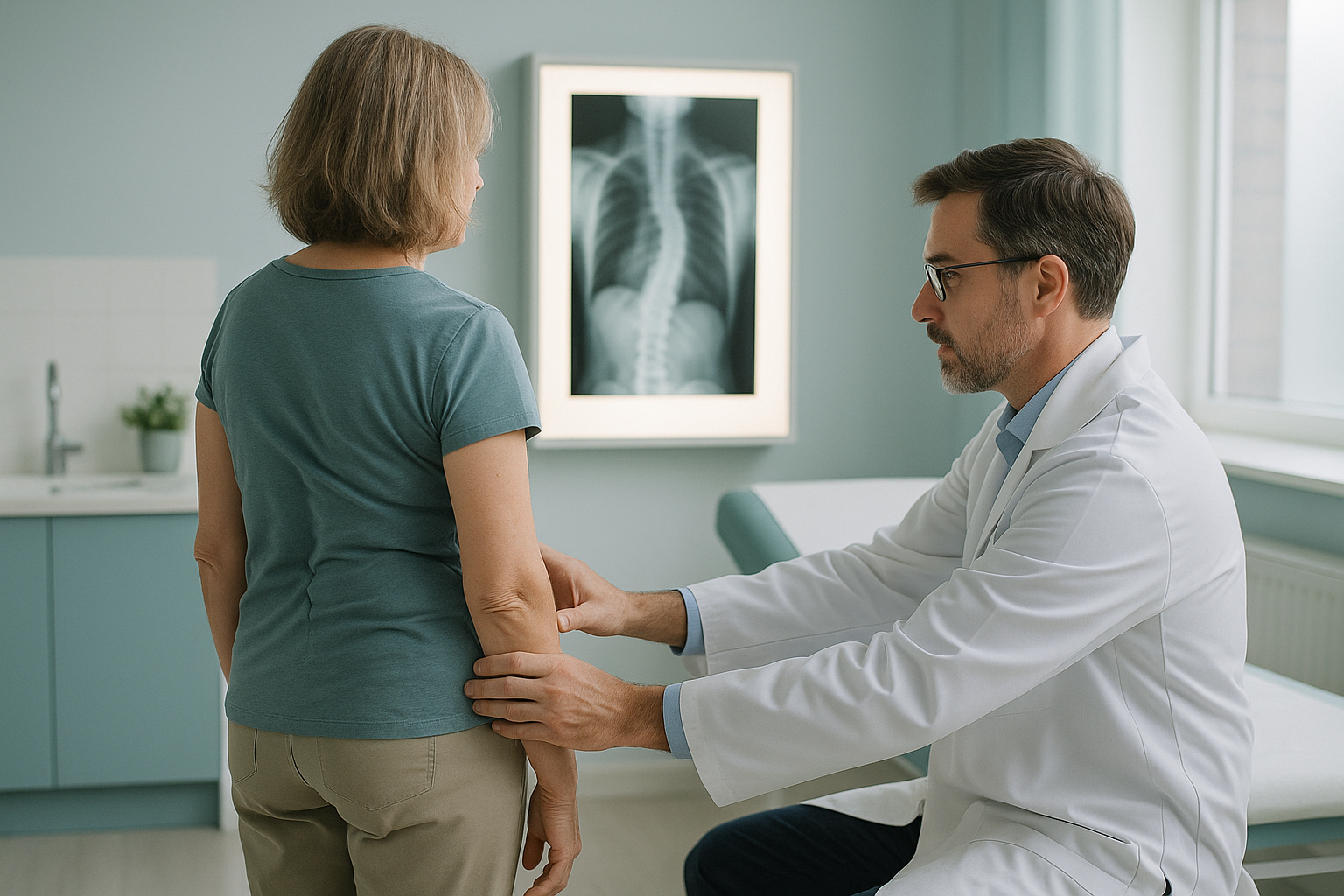
An EOS scan captures the whole skeleton from head to feet in a single standing image, using about 90% less radiation than a standard X-ray, around ten times less. That low dose matters, because checking scoliosis often needs repeat imaging over the years. Read more about why standing imaging matters in scoliosis.
Your body is a connected chain from feet to head. If your spine curves to one side, your pelvis, hips and even knees adjust to keep you upright. A scan of the lumbar spine alone cannot show those adjustments. ScanAlign standing EOS imaging captures the full picture in one visit to Harley Street, London. This gives your specialist the alignment data they need to plan the right next step.
When MRI is the better choice. EOS shows bones, joints and whole-body alignment. For soft-tissue detail, such as compressed nerves, disc herniations or spinal cord problems, MRI is usually the better tool. Many adults with scoliosis benefit from both types of imaging, as each answers a different question.
What helps manage adult scoliosis?
The right approach depends on how severe the curve is, how much imbalance there is, the level of pain and how much it affects daily life. ScanAlign is a diagnostic imaging clinic, not a treatment centre. We focus on giving the precise alignment data that helps your specialist make informed decisions.
Broadly, options discussed with the clinician treating you may include physiotherapy and targeted exercise, pain management or, in some cases, corrective surgery. All of these work best when based on accurate, standing alignment data, rather than a lying-down image that may understate the problem.
Before you start treatment, or change the one you are on, it is worth getting a detailed diagnosis. Knowing whether the cause sits in the pelvis, the legs or the spine changes what will actually help.
Wondering whether a standing alignment scan could help make your scoliosis clearer? You can book a standing scoliosis scan, or start with a free video consultation to talk through your situation first.
Book a free video consultationFrequently asked questions about adult scoliosis
Yes. Degenerative or de novo scoliosis can develop entirely in adulthood, usually after age 40 or 50. It is caused by uneven wear in the discs and joints of the spine, not by growth.
Not always, but pain is far more common in adults than in teenagers with scoliosis. Back pain, leg pain and tiredness are the usual reasons adults seek assessment.
Many adult curves get worse slowly, sometimes less than a degree per year. Regular standing imaging helps track any change before it becomes a bigger problem.
When you lie down, gravity is taken away and the muscles relax. The curve can look smaller than it really is. A standing scan shows the true curve and your overall balance in real-life conditions.
An EOS scan uses about 90% less radiation than a standard X-ray, around ten times less. This matters especially for scoliosis patients who may need repeat imaging over time.
No. ScanAlign accepts self-referrals. You can book directly without a letter from your doctor or consultant. You are also welcome to bring a referral if you have one.
The price for patients travelling from abroad is confirmed during the free video consultation.
EOS is excellent at showing bone alignment, joint position and overall balance. For soft-tissue detail such as nerve compression or disc herniations, MRI is usually the better tool. Many scoliosis patients benefit from both.
You stand naturally inside the EOS scanner while it takes a full-length image of your skeleton from head to feet. It takes less than a minute and there is no closed tunnel.
Surgery is considered when pain and disability are severe and non-surgical options have not helped. Many adults manage well without surgery. Accurate standing imaging data helps both you and your specialist decide whether surgery is worth considering.
Understand your scoliosis, standing up
A free video consultation lets you talk through your symptoms from home and find out whether a standing EOS scan in London is the right next step for you.
Book a free video consultationSources
- Aebi, M. "The adult scoliosis." European Spine Journal, 14(10), 2005, pp. 925–948.
- Schwab, F. et al. "Adult scoliosis: prevalence, SF-36, and nutritional parameters in an elderly volunteer population." Spine, 30(9), 2005, pp. 1082–1085.
- Scoliosis Research Society (SRS). "Adult Scoliosis." srs.org.
Written by Abbas Dhami (Specialist Diagnostic Radiographer)
This page is general information and not a diagnosis.
ScanAlign is the trading name of CoreMed Solutions Ltd and operates under The Harley Street Hospital's CQC licence.