
How Does Whiplash Affect Neck Alignment Long Term?
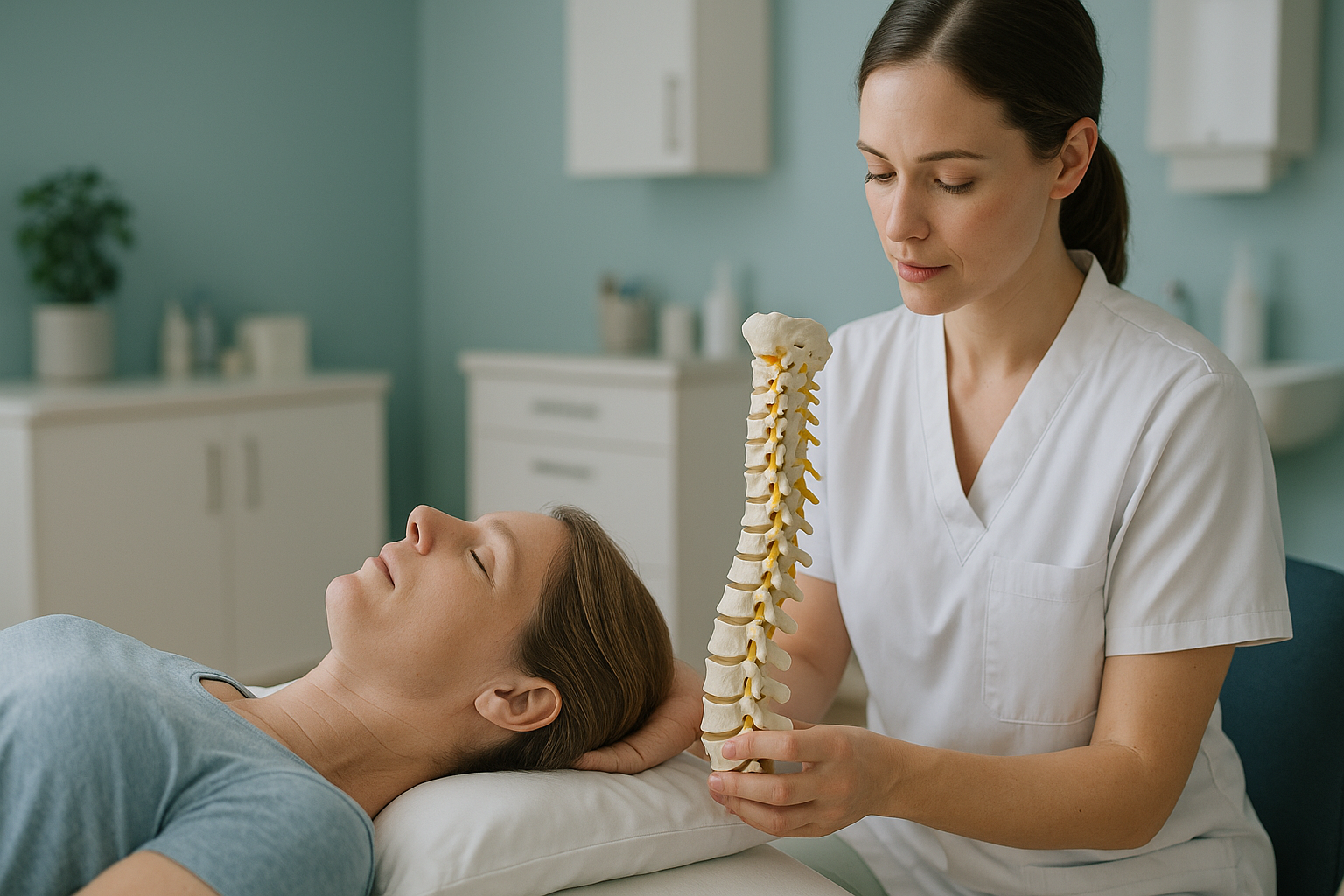
Whiplash can permanently change how your neck curves and balances. The sudden back-and-forth force stretches ligaments and upsets muscle control. This often flattens or reverses the neck's natural curve. These alignment changes may not show up on a scan taken lying down. They become clear when you are scanned standing upright, under your full body weight.
Key Points
- A whiplash injury can change your cervical lordosis for months or years after the original incident.
- Chronic whiplash pain is often driven by alignment changes that standard lying-down scans can miss.
- Standing, weight-bearing imaging shows how gravity loads your injured neck in real life.
- Whiplash is a diagnostic finding, not a treatment. Understanding your alignment is the first step to the right care plan.
Important. If you have recently been in a collision and have numbness, weakness in your arms or legs, difficulty walking, or any loss of bladder or bowel control, get urgent medical help. Go to your nearest emergency department or call your local emergency number straight away. Do not wait to book a private scan.
What is whiplash and why does it cause lasting problems?
Whiplash is a neck injury caused by a sudden, forceful back-and-forth movement of the head. It most often happens when a car is hit from behind. It can also come from collisions in sport, falls, or any sudden slowing down.
At the moment of impact, the muscles and ligaments that hold your cervical spine in its natural curve are stretched beyond their normal range. The deep neck flexor muscles, which keep your head steady on your spine, are especially at risk. When these structures are damaged, they may heal shorter or weaker than before. This changes the resting position of your neck.
Clinicians call the range of symptoms that follow whiplash associated disorder. It goes from mild neck stiffness to chronic pain, headaches, reduced range of movement and ongoing changes in posture. Many people recover within a few weeks. But a significant number still have symptoms months or even years later.

What are the signs of chronic whiplash pain?
Chronic whiplash symptoms are those that last more than three months after the injury. They often feel different from the early, acute phase. They can be confusing, because they may seem unrelated to the original accident.
Tightness or limited movement that never fully clears, especially in the morning or after sitting for long periods.
Tension headaches that spread upward from the neck, often on one side, and are sometimes mistaken for migraines.
Muscle guarding around the shoulders and trapezius area as your body makes up for the injured neck.
A feeling of unsteadiness or difficulty focusing, linked to altered proprioception in the upper cervical spine.
If you have neck pain years after a car accident, you are not imagining it. These symptoms often point to structural alignment changes that have not been found.
How does whiplash change your neck alignment over time?
Whiplash disrupts the neck's natural forward curve, known as cervical lordosis. After injury, this curve can flatten or even reverse. When the curve is lost, the weight of your head, roughly the weight of a bowling ball, is no longer well balanced over your spine. Your muscles must work harder to hold your head up. This leads to fatigue, guarding and pain.
Loose ligaments let the vertebrae settle into a straighter or kyphotic (reversed) position.
The deep neck flexors weaken while the surface muscles tighten, pulling the head forward.
The head may tilt to one side, creating a cervical tilt that loads one side unevenly.
Over months and years, these changes can speed up wear on the discs and facet joints. This may contribute to early cervical spondylosis. Your body is a connected chain. A change at the neck can shift the balance of the mid-back, lower back and even the pelvis, as each area adjusts for the one above.
Why does a standing scan show more than a lying-down scan?
Most scans after whiplash are done while you lie flat on a table. In that position, gravity is taken off your spine and your muscles relax. The vertebrae settle into a position they never take in daily life. As a result, alignment problems can be hidden.
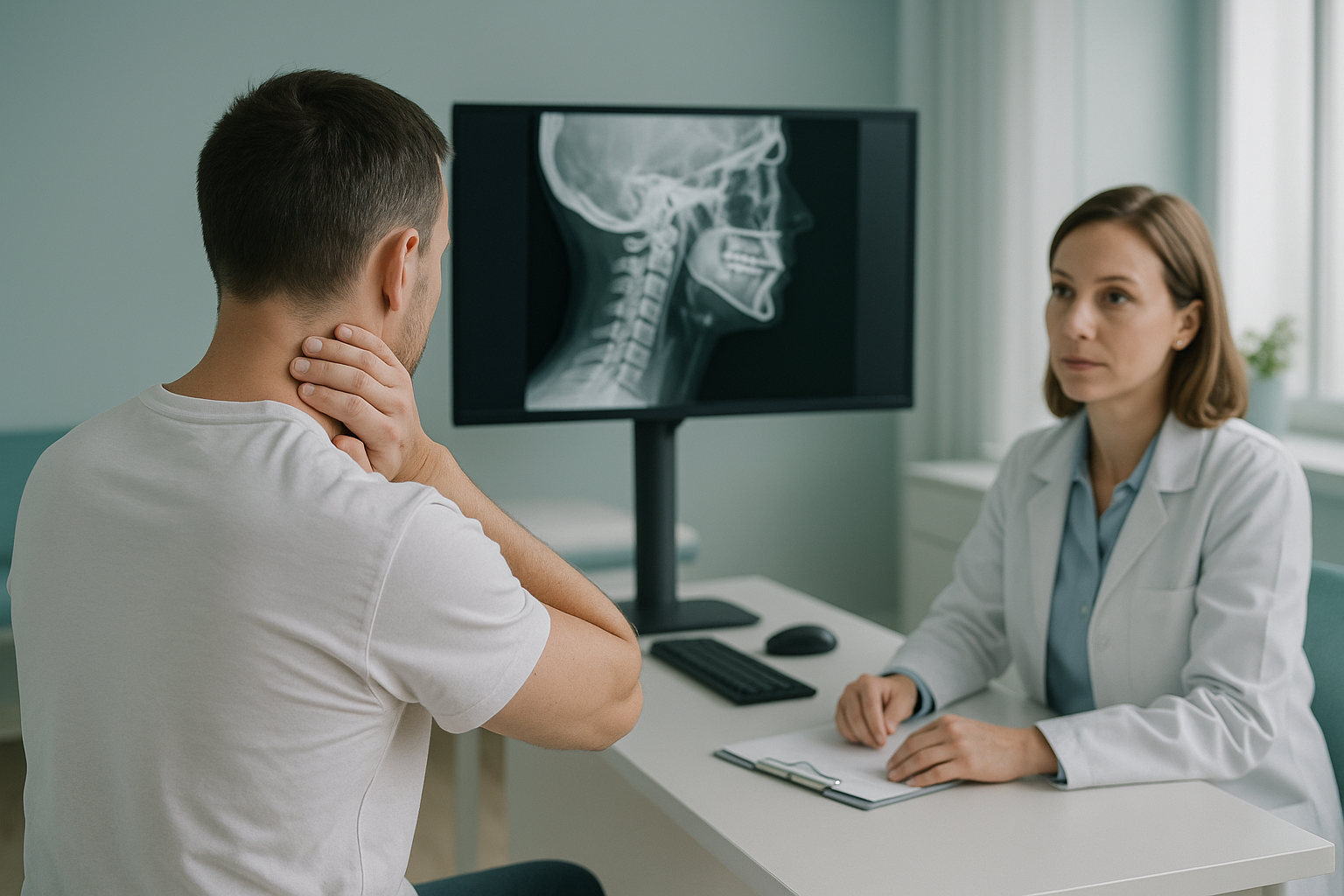
A standing EOS scan captures your whole spine and posture while you bear your real body weight. It shows exactly how gravity loads your injured neck, whether your head sits forward, and how the rest of your spine has adapted. This is the picture your clinician needs to plan the right approach.
ScanAlign standing EOS imaging uses about 90% less radiation than a standard X-ray, around ten times less. The scan takes only a few seconds and needs no preparation.
Lying-down X-rays, CT and MRI relax the muscles and remove the effect of gravity. They are excellent for spotting fractures or recent soft-tissue damage. But they may not show how your neck alignment has shifted under the real load of standing upright.
When MRI is the better tool. EOS shows bones, joints and alignment. If your clinician suspects a disc herniation, nerve compression or soft-tissue damage, MRI is usually the better choice. Many people with chronic whiplash benefit from both types of imaging, as each answers a different question.
What helps with long-term whiplash recovery?
Recovery from chronic whiplash is possible. But it starts with understanding exactly what has changed in your neck. Without clear alignment data, treatment can turn into a cycle of trial and error.
Current evidence supports a gradual return to movement, guided by a physiotherapist or rehabilitation specialist. Targeted exercises to retrain the deep neck flexor muscles and restore the neck curve are commonly recommended. Some people also benefit from manual therapy, pain management strategies, or a mix of approaches.
ScanAlign does not provide treatment. We provide the standing diagnostic imaging that gives your clinician the full alignment picture, so they can plan the most suitable care for you.
Before you start treatment, or change the one you are on, it is worth getting a detailed diagnosis. Knowing whether the cause sits in your pelvis, your legs or your spine changes what will actually help.
Worried about ongoing whiplash symptoms? A standing neck and spine scan can show alignment changes that lying-down scans may have missed.
Book a free video consultationA note on medico-legal reports. If you need imaging specifically for a legal claim or personal injury case, please contact us directly to discuss what you need. Standard self-referral bookings are designed for clinical investigation, not medico-legal reporting.
Frequently asked questions about whiplash and neck alignment
Yes, in some cases. Whiplash can permanently stretch ligaments and change how muscles work. This leads to lasting changes in how your cervical spine curves and balances. These structural changes can last for years if they are not found and managed.
Chronic whiplash pain often comes from alignment changes that were never picked up on the first scans. Loss of the neck's natural curve forces the muscles to overwork. This causes ongoing stiffness, headaches and discomfort.
Whiplash associated disorder is a clinical term for the range of symptoms that follow a whiplash injury. It is graded from mild neck pain and stiffness up to neurological signs. The term recognises that whiplash affects more than just one structure.
Many people recover from acute whiplash within a few weeks to three months. However, research suggests that a significant proportion still have symptoms beyond six months, particularly if alignment changes are present.
Standard lying-down X-rays may show the bones but often miss the alignment changes caused by whiplash, because gravity is removed. A standing scan captures your neck while it bears your real body weight, giving a more accurate picture.
An EOS scan uses about 90% less radiation than a standard X-ray, around ten times less. You simply stand still for a few seconds. It is very well tolerated and does not involve any uncomfortable positions.
No. ScanAlign accepts self-referrals. You can book a standing neck and spine scan directly, without a letter from your doctor.
Yes. Your body is a connected chain. When the neck loses its curve, the mid-back and lower back often adapt to keep your head balanced over your pelvis. This compensation can cause pain in areas well away from the original injury.
The price for patients travelling from abroad is confirmed during your free video consultation.
No. They answer different questions. EOS shows bone alignment under gravity. MRI is better for soft tissue such as discs, nerves and ligaments. Many clinicians find that both types of imaging together give the fullest picture after whiplash.
Still dealing with whiplash symptoms?
A free video consultation can help you decide whether a standing alignment scan in London is the right next step for your neck.
Book a free video consultationWritten by Abbas Dhami (Specialist Diagnostic Radiographer)
Sources
- Sterling M. Physiotherapy management of whiplash-associated disorders (WAD). Journal of Physiotherapy. 2014;60(1):5-12.
- NHS. Whiplash. nhs.uk. Available at: https://www.nhs.uk/conditions/whiplash/ (Accessed 2024).
- Spitzer WO, et al. Scientific monograph of the Quebec Task Force on Whiplash-Associated Disorders. Spine. 1995;20(8 Suppl):1S-73S.
This page is general information and not a diagnosis.
ScanAlign is the trading name of CoreMed Solutions Ltd and operates under The Harley Street Hospital's CQC licence.