
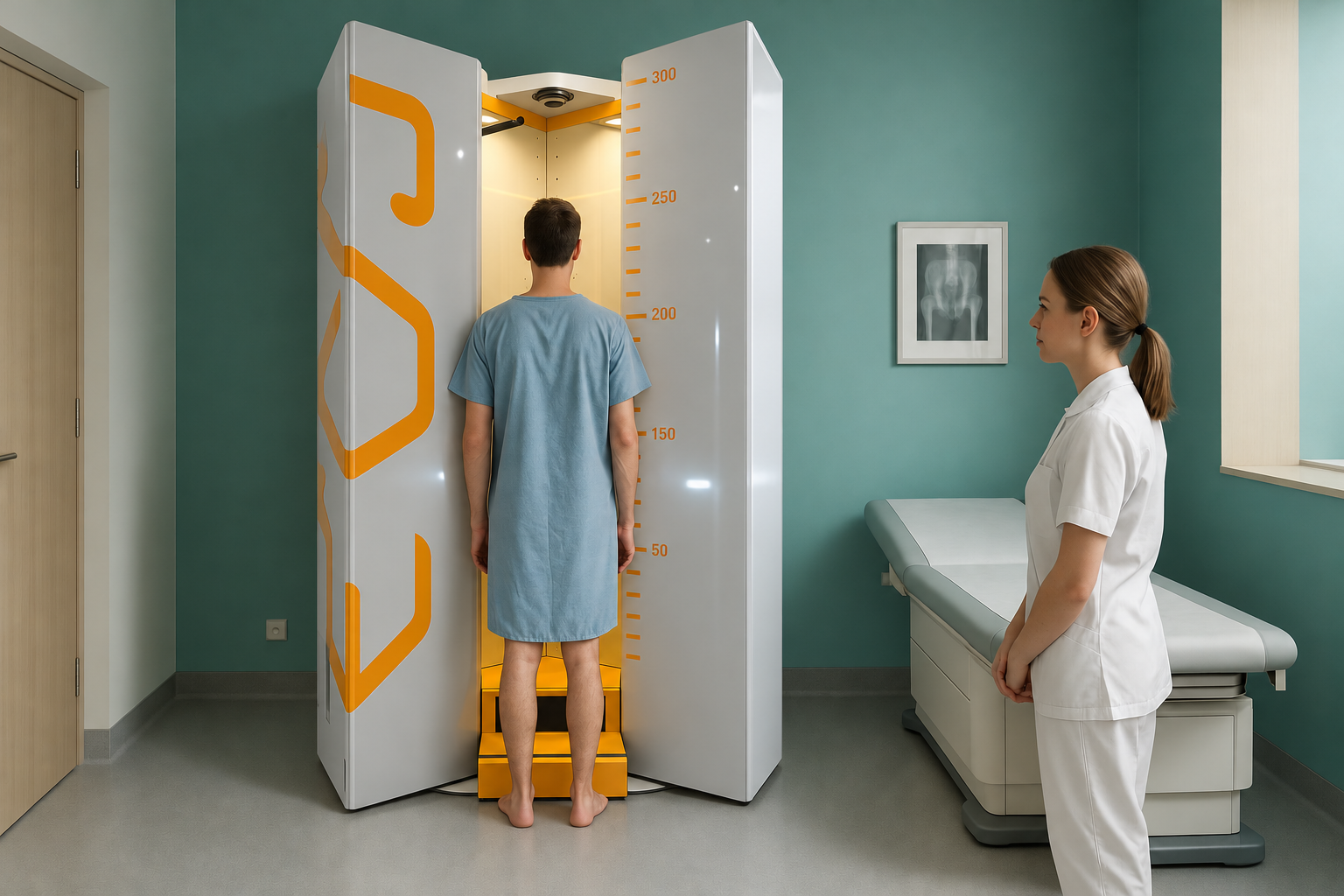
What Should You Wear and How Do You Prepare for an EOS Scan?
Wear loose, comfortable clothes with no metal fastenings. Avoid zips, underwire bras, belts and jewellery in the scan area. You stand still for a few seconds while the EOS system takes a full-body image. There are no injections, no fasting and very little preparation is needed.
Key points
- Choose clothes without metal: no zips, no underwire, no belt buckles.
- Remove jewellery, hair clips, coins and anything metal from your pockets.
- No fasting, no injections and no special preparation needed.
- The scan itself takes only a few seconds while you stand upright.
- EOS uses about 90% less radiation than a standard X-ray, around ten times less.
An EOS scan is one of the simplest imaging appointments you can have. There is no tunnel to lie in, no contrast dye and no long wait on a table. You stand upright in an open booth. The machine moves from head to toe, and it is done in seconds. The only thing that needs a little thought is what you wear.
This page explains exactly what to wear, what to leave behind, and what happens when you arrive at ScanAlign, standing EOS imaging in Harley Street.
What should you wear for an X-ray or EOS scan?
Wear soft, loose clothes that have no metal in them. Metal fastenings show up as bright marks on the image. These can hide the detail your clinician needs. The simplest outfit is a plain cotton t-shirt, tracksuit bottoms or leggings, and sports shoes or flat shoes with no metal eyelets.
- Plain t-shirt or vest with no decorated prints
- Leggings or tracksuit bottoms with an elastic waist
- Sports bra without underwire or metal hooks
- Flat shoes or sports shoes without metal buckles
- Loose cotton shorts
- Jeans or trousers with metal zips and buttons
- Underwire bras or bras with metal clasps
- Belts with metal buckles
- Clothes with metallic prints, studs or sequins
- Shoes with steel toe caps or metal decorations
If you arrive wearing something with metal, do not worry. You will be given a private changing area and a gown if needed. But choosing the right clothes in advance makes everything quicker and more comfortable.
Do you need to remove jewellery for an X-ray?
Yes. Any metal in the scan area can block the image. Before your EOS scan, you will be asked to remove the following items.
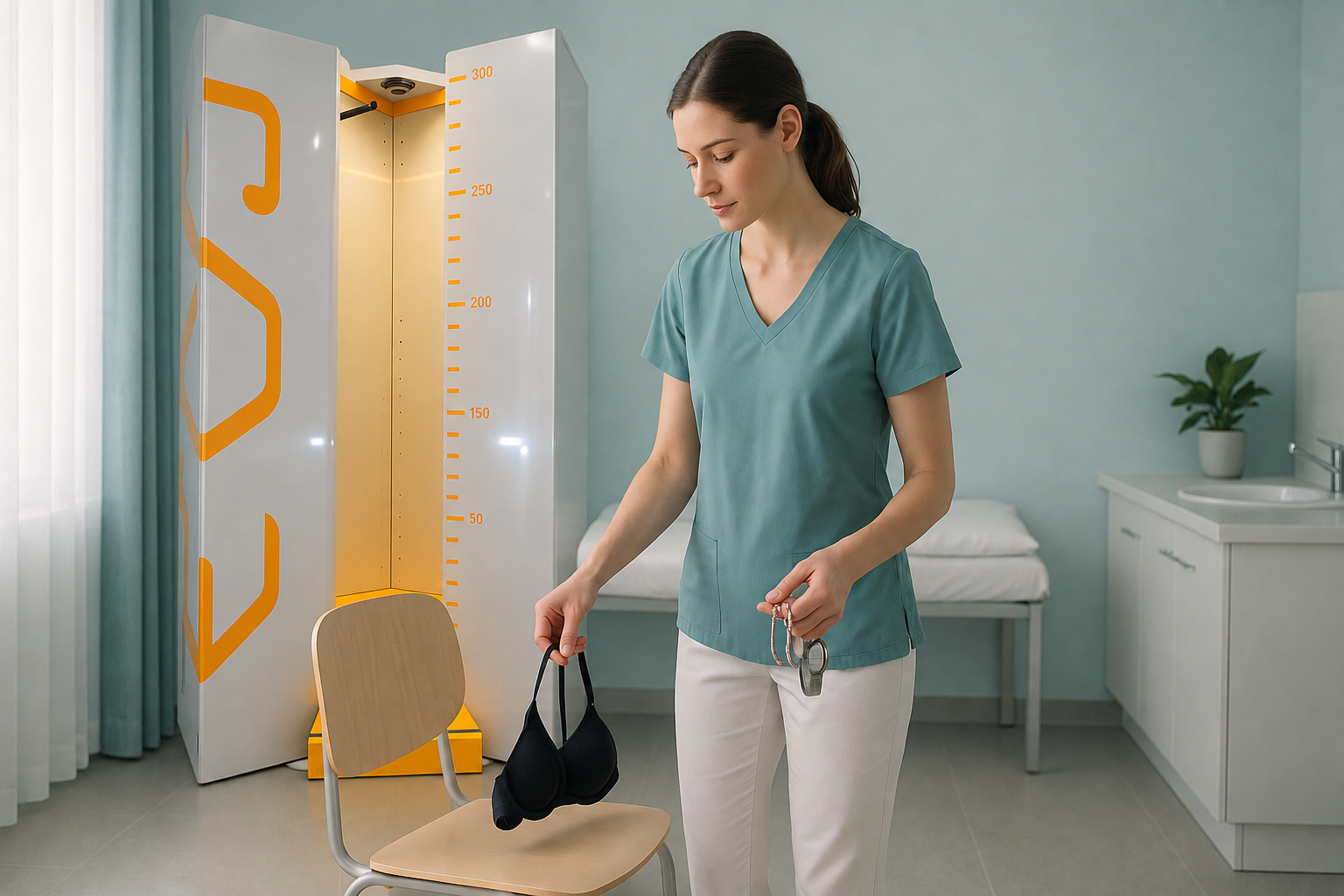
This includes rings, necklaces, earrings, bracelets, watches, hair clips, piercings and body jewellery. Empty your pockets of coins, keys and your phone. Your things will be stored safely during the appointment.
If you have metal implants inside your body, such as a hip or knee replacement, that is completely fine. Internal metalwork does not need to be removed. The radiographer will take it into account when positioning you.
Can you wear a bra for an X-ray?
You can wear a bra if it has no metal in it. A soft sports bra or crop top without underwire, hooks or metal adjustment sliders is ideal. If your bra has underwire, you will need to remove it before the scan. A private changing area and a gown are available.
How should you prepare on the day of your scan?
There is very little to do. You can eat, drink and take your usual medicines as normal. No fasting is needed, and there is no injection or contrast dye.
What are the steps from booking to results?
The process is simple. Here is what to expect from start to finish.
A short call to talk about your symptoms and confirm the scan is right for you. You can join from home. No obligation, no charge.
Check in at 19 Harley Street, London. Store your things, change into metal-free clothes if needed, and remove jewellery.
You stand still in the open EOS booth. The scanner moves from head to toe. It takes seconds and uses about 90% less radiation than a standard X-ray, around ten times less.
A specialist radiographer studies your whole-body alignment images. The report is sent to you and, if you wish, to the clinician who referred you. Read more about what to expect at an alignment assessment.
When MRI is the better choice: EOS is excellent for bones, joints and whole-body alignment. If your clinician needs to see soft tissues, discs or nerves, MRI is usually the better tool. Your radiographer can tell you which scan suits your situation during your free consultation.
For a full overview of what happens during an EOS scan, including how the standing position shows alignment that lying-down scans can miss, see our detailed guide.
Before you start treatment, or change the one you are on, it is worth getting a detailed diagnosis. Knowing whether the cause sits in the pelvis, the legs or the spine changes what will actually help.
Have questions about what to wear or bring? Our team can talk you through everything before you travel.
Book a free video consultationFrequently asked questions
Wear loose, comfortable clothes with no metal. A plain t-shirt with tracksuit bottoms or leggings is ideal. Avoid jeans with zips, belts with buckles, and underwire bras.
Yes, as long as it has no metal. A sports bra or soft bralette without underwire or metal hooks is fine. If your bra has metal, you will be asked to remove it and a gown will be provided.
Not fully. If you arrive in metal-free clothes, you can be scanned in what you are wearing. If your clothes have metal in them, you will change into a gown in a private area.
Yes. Remove all jewellery in the scan area, including rings, necklaces, earrings, watches and piercings. Your things will be stored safely.
Yes. No fasting is needed. Eat, drink and take your regular medicines as normal before your appointment.
EOS uses about 90% less radiation than a standard X-ray, around ten times less. This makes it one of the lowest-dose imaging options available.
No. You can book directly yourself. If you do have a referral letter from a clinician, bring it with you, but it is not required.
The scan itself takes only a few seconds. Including check-in, changing and positioning, plan for around 15 to 20 minutes at the clinic in total.
Internal metalwork such as hip or knee replacements is completely fine. The radiographer will know it is there and take it into account. You only need to remove metal items on the outside of your body.
For patients travelling from abroad, the price is confirmed during the free video consultation, and you can find more answers on our frequently asked questions page.
Ready to book your scan?
Start with a free, no-obligation video consultation from home. We will confirm the right scan for you and answer any questions about what to wear or bring.
Book a free video consultationSources
- NHS. "X-ray: How to prepare." nhs.uk. Available at: https://www.nhs.uk/conditions/x-ray/preparation/
- Deschênes S, Charron G, Beaudoin G, et al. "Diagnostic imaging of spinal deformities: reducing patients radiation dose with a new slot-scanning X-ray imager." Spine, 2010;35(9):989-994.
- The Society of Radiographers. "Patient information: Having an X-ray." sor.org.
Written by Abbas Dhami (Specialist Diagnostic Radiographer)
This page is general information and not a diagnosis.
ScanAlign is the trading name of CoreMed Solutions Ltd and operates under The Harley Street Hospital's CQC licence.