
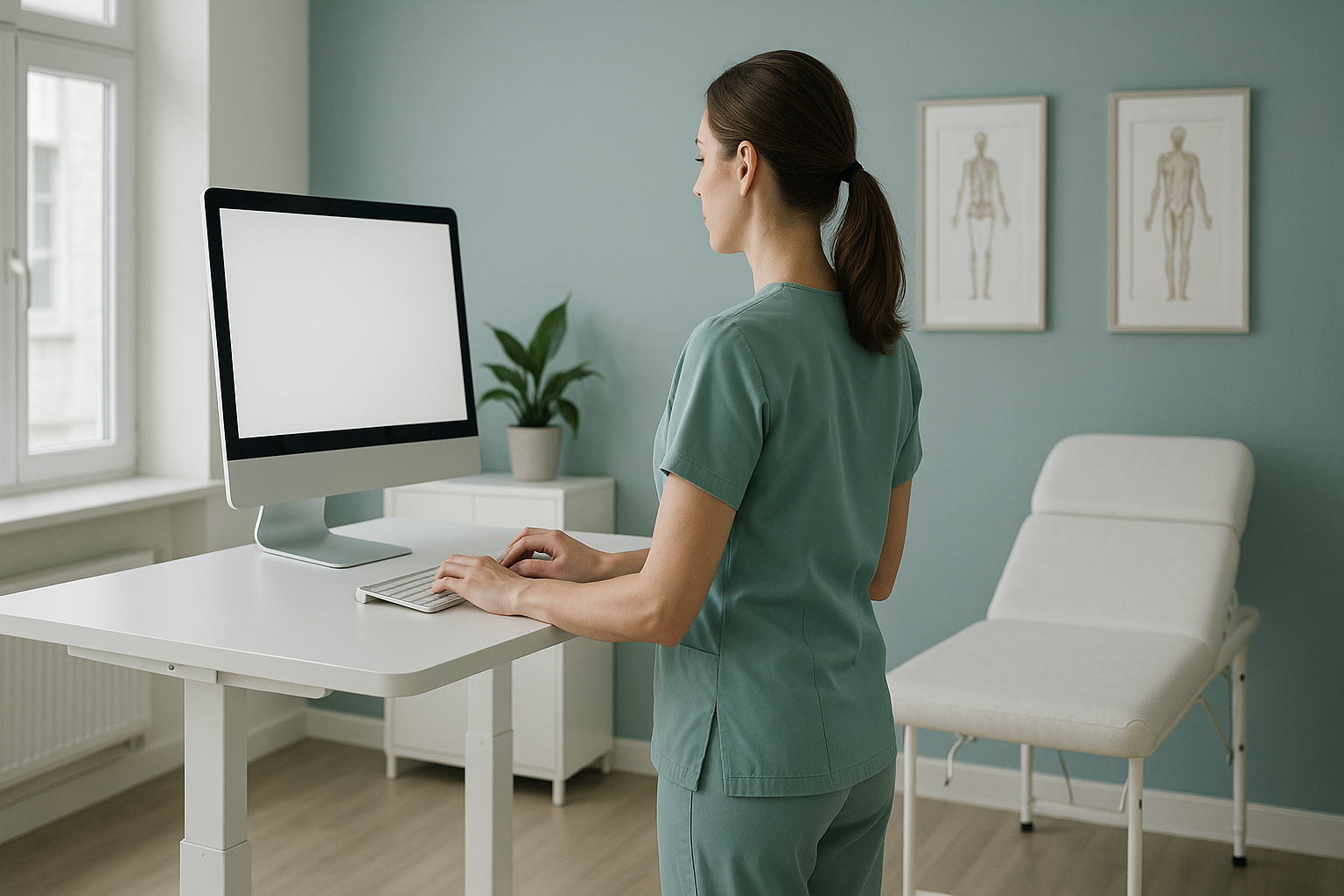
Do Standing Desks Really Improve Your Posture?
A standing desk can help reduce some of the strain on your posture that comes from sitting for long hours. But it will not fix your posture on its own. Standing still for hours brings its own problems. What matters most is moving regularly and knowing how your body is really aligned. A standing desk cannot tell you that.
Key points
- Standing desks cut down sitting time, but they do not correct underlying alignment problems.
- Movement matters more than position. Switching between sitting and standing is key.
- Poor standing posture can cause back pain, tired legs and joint strain.
- If pain carries on even with a good desk setup, a structural alignment problem may be the cause.
- A standing whole-body scan shows how your skeleton really lines up under gravity.
What happens to your body when you stand at a desk all day?
Standing for long periods puts load on your spine, hips and legs in a different way from sitting. The curve in your lower back can deepen, your pelvis may tilt forward, and the muscles in your calves and feet get tired. Over time, some people get swollen legs, sore knees or aching feet.
The real problem is this: swapping one fixed position for another does not challenge or strengthen the muscles that hold you upright. Your body needs variety. A sit-stand desk is a useful tool, but only if you really do switch between the two positions through the day.

If you already have an alignment problem, such as forward head posture or too much postural sway, standing at a desk may actually make your symptoms worse. This is because your muscles have to work harder to make up for it.
What are the signs a standing desk is not helping your back pain?
A standing desk should feel comfortable, not painful. If you notice any of the signs below after switching, your setup or your underlying alignment may need attention.
Pain that builds through the day and eases when you sit may point to too much load on the lower back.
Blood pooling in the lower legs during long spells of standing can cause heaviness and swelling.
If your monitor is at the wrong height, you may lean forward or look down. This strains your upper back.
Discomfort that carries on even after you adjust your desk suggests the problem may be structural, not about your desk setup.
How long should you stand at a standing desk?
Most workplace health advice suggests a ratio of about 30 minutes standing for every 30 minutes sitting, built up slowly. Start with just 15 to 20 minutes of standing per hour and increase over a few weeks. Listen to your body. If anything starts to ache, sit down.
There is no single perfect sit-stand ratio. The best approach is to keep moving. Shift your weight, take short walks, stretch. A standing desk does not replace regular movement through the day.
15 to 20 minutes standing per hour for the first week, then build up.
Aim for about equal sitting and standing across the day. Movement is the goal.
A cushioned mat reduces strain on your feet and joints while you stand. Supportive shoes help too.
How should you set up a standing desk for good posture?
Desk setup matters just as much when you stand as when you sit. A badly adjusted standing desk can push your head forward, round your shoulders, or make you lean on one hip.
- Monitor height: The top of your screen should be at or just below eye level, so you look straight ahead, not down.
- Elbow angle: Your forearms should be roughly parallel to the desk, with your elbows close to your sides.
- Feet: Stand with your weight spread evenly across both feet, hip-width apart. Avoid locking your knees.
- Shoes: Flat, supportive shoes are better than heels or very thin soles. Some people find an anti-fatigue mat helpful.
- Move: Shift your weight, step side to side, or take a short walk every 20 to 30 minutes.
If you do all of this and your back, hip or neck pain carries on, your problem may not be about the desk at all. It may be about how your body is aligned underneath.
Pain that carries on even with a good desk setup could point to an alignment problem that desk adjustments alone cannot solve. A standing whole-body scan can show what is going on.
Book a free video consultationWhy does posture need to be checked standing up?
Most scans, such as standard X-rays, CT and MRI, are done while you lie down. In that position, gravity is not pulling on your spine, your muscles relax, and your joints settle in a different way. Alignment problems that cause pain when you are upright may simply not show up on a lying-down scan.
Your body is a connected chain. If your pelvis is slightly tilted, your spine curves to make up for it. That shifts load into your shoulders and neck. Pain often shows up away from its real cause. A scan of just one area can miss this completely.
ScanAlign standing EOS imaging captures your full skeleton from head to feet in one upright image, with about 90% less radiation than a standard X-ray, around ten times less. Because you are standing, the image shows your real, weight-bearing alignment: the same alignment you use at a standing desk, while walking, and in daily life.
Before you start a treatment, or change the one you are on, it is worth getting a detailed diagnosis. Knowing whether the cause sits in your pelvis, your legs or your spine changes what will really help.
When MRI is the better choice: EOS shows bones, joints and alignment. For soft tissue, discs or nerves, MRI is usually the better tool. If your symptoms include numbness, weakness, or loss of bladder or bowel control, get urgent medical help from your doctor or your nearest emergency department rather than booking a scan.
Frequently asked questions about standing desks and posture
They can be, when used correctly. Switching between sitting and standing through the day reduces the strain of sitting for long hours. But standing still for hours is not the answer. Regular movement is what matters most.
A standing desk may ease discomfort caused by long periods of sitting, but it cannot fix an underlying structural problem. If your back pain carries on after you improve your desk setup and movement habits, the cause may be an alignment problem that needs a proper assessment.
Start with 15 to 20 minutes of standing per hour and build up slowly. A rough guide is 30 minutes standing, 30 minutes sitting. The key is to keep changing position rather than staying in one posture for too long.
Both cause problems. Standing all day can cause leg swelling, lower back strain and foot pain. The healthiest approach is to switch often and add short walks and stretches to your routine.
Supportive, flat-soled shoes are best. Avoid high heels or very thin soles that give no support. An anti-fatigue mat can also help reduce strain on your feet and joints while you stand.
This often happens when the monitor is too low. When you stand, your eye level rises. If the screen does not rise with it, you end up looking down and pushing your head forward. Adjusting your screen height usually helps. If the problem continues, it may be worth checking your overall alignment.
A standard X-ray usually covers one area while you lie down. EOS imaging captures your full skeleton while you stand, using about 90% less radiation than a standard X-ray, around ten times less. This shows how your bones and joints line up when they are really carrying your weight.
No. ScanAlign is a private self-pay clinic. You can book a posture assessment directly, without a referral. Your scan is reviewed by a specialist diagnostic radiographer.
ScanAlign is a self-pay service. The price for patients travelling from abroad is confirmed during the free video consultation. You can read more on the FAQs and cost page.
On its own, no. A standing desk is one useful tool, but good posture depends on muscle strength, how well your joints move, and how your skeleton is aligned. If you have a structural tilt, curve or imbalance, the desk cannot change that. A proper assessment gives you the full picture.
Still in pain despite your standing desk?
A free video consultation can help you understand whether a standing whole-body alignment scan in London is the right next step for you.
Book a free video consultationAuthor: Abbas Dhami (Specialist Diagnostic Radiographer)
Sources
- Karakolis, T. & Callaghan, J.P. (2014). The impact of sit-stand office workstations on worker discomfort and productivity: a review. Applied Ergonomics, 45(3), 799-806.
- NHS. (2024). How to sit correctly. NHS Live Well. Available at: nhs.uk/live-well/exercise/improve-posture.
- Shrestha, N. et al. (2018). Workplace interventions for reducing sitting at work. Cochrane Database of Systematic Reviews, Issue 6.
This page is general information and not a diagnosis.
ScanAlign is the trading name of CoreMed Solutions Ltd and operates under The Harley Street Hospital's CQC licence.