
Where Can You Get Sports Screening in London?
ScanAlign offers musculoskeletal sports screening at 19 Harley Street, London. It uses EOS standing whole-body imaging, with about 90% less radiation than a standard X-ray. The scan captures your full skeletal alignment under load. This gives a baseline measurement that helps medical staff spot asymmetry and structural risk factors before they cause injury.
Key points
- Standing imaging shows alignment problems that lying-down scans can miss.
- A whole-body baseline measurement makes it easier to track changes and support return-to-play decisions.
- The scan uses about 90% less radiation than a standard X-ray, around ten times less.
- No referral is needed. Individual athletes and clubs can book directly.
- ScanAlign is based at 19 Harley Street, in the heart of London's medical quarter.
What does musculoskeletal screening for athletes involve?
Musculoskeletal screening is a structured check of your bones, joints and alignment. It is designed to find structural risk factors before symptoms appear. For athletes, it records how your skeleton is aligned when you are bearing weight. This gives your medical staff a reference point for the season ahead.
Most sports medicine screening in London focuses on clinical tests, blood tests and heart checks. These are valuable, but they rarely include a full, standing image of your skeleton from head to feet. So asymmetry in the pelvis, legs or spine can go unrecorded, even during a thorough pre-season medical.
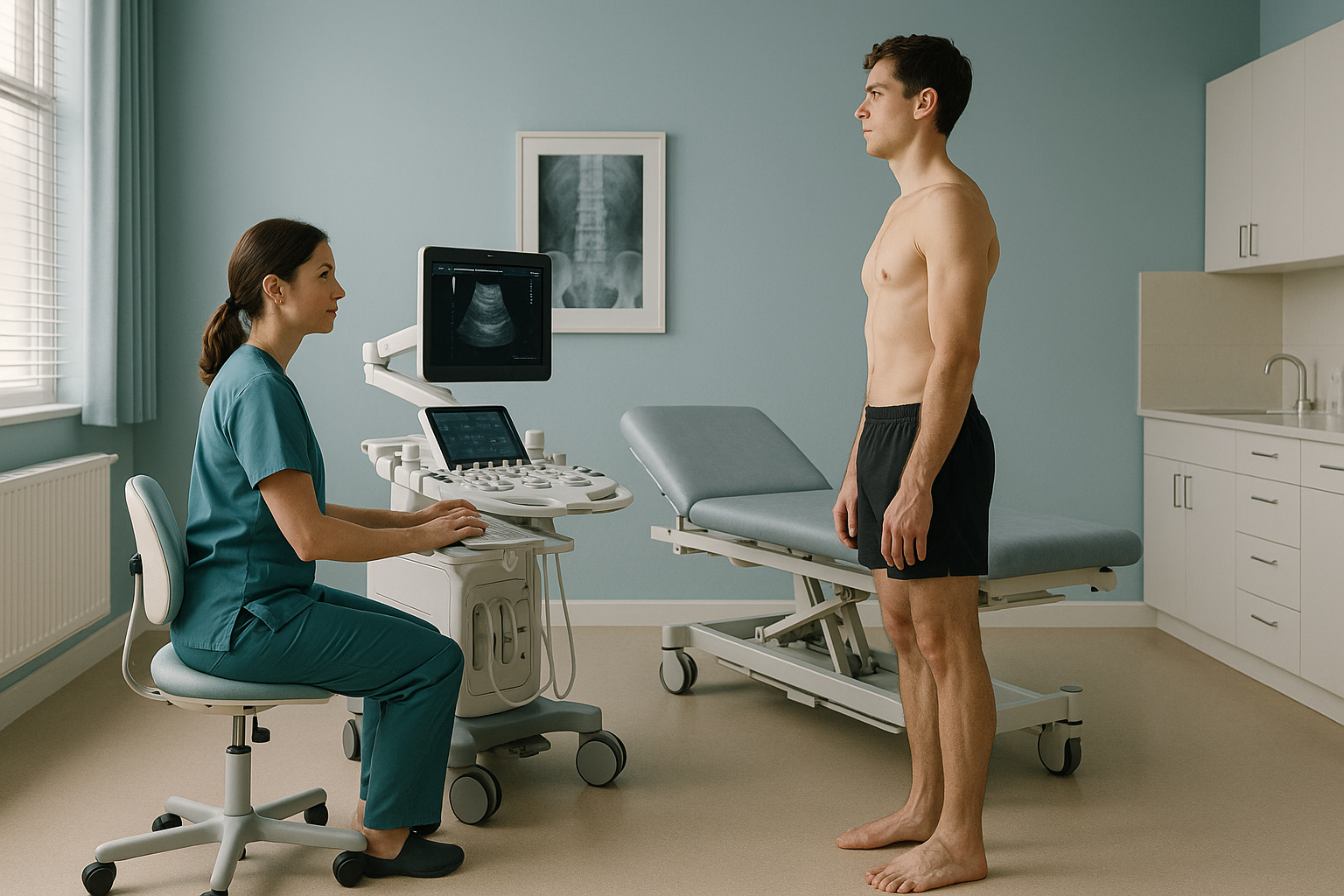
A review of injuries after the season often shows patterns that could have been caught earlier. A slight leg-length difference, a rotated pelvis or a curve in the spine may not cause pain on its own. But with the repeated demands of training and competition, these asymmetries can overload one side of the body and lead to injury over time. Understanding sports injury prevention starts with knowing what your body looks like under load.
Why does standing imaging matter for athlete screening?
Standing imaging matters because it shows your skeleton the way it actually works, under gravity and load. When you lie down for a usual X-ray, CT or MRI, your muscles relax, your joints decompress and your natural curves change. Alignment problems that are clear when you stand can disappear on a lying-down scan.
Weight-bearing and true to life. The EOS system captures your whole skeleton from head to feet in one upright image. Gravity acts on your joints just as it does when you train. So the scan shows true alignment, leg-length differences and pelvic tilt as they really are.
Because the whole body is in one image, your medical team can see how one area relates to another. For example, a hip asymmetry may cause the knee on the other side to compensate.
Relaxed and unloaded. Lying-down imaging is excellent for soft tissue detail, especially MRI. But it removes the effect of gravity. A pelvic tilt may flatten out, a leg-length difference may not show, and compensating curves in the spine may reduce. This can mean a clinician sees a "normal" result when the athlete's real alignment tells a different story.
Your body is a connected chain from your feet to your head. A structural problem at one level often causes compensation somewhere else, so the place that hurts may not be the source of the problem. Whole-body standing imaging captures that full picture. You can read more about preventing sports injury with 3D skeletal scans on our blog.
Who should consider sports screening in London?
Any adult athlete who wants a clear baseline of their skeletal alignment, whether for pre-season planning, return-to-play assessment or ongoing injury management.
- Individual athletes who want a structural baseline
- Club or academy medical staff planning pre-season screening
- Athletes coming back from a significant injury
- Runners, cyclists or team-sport players with niggles that keep coming back
- Coaches or physiotherapists supporting repeat screening over time
- Suspected ligament, tendon or disc injuries (MRI is usually better)
- Heart screening (needs a specialist cardiology assessment)
- Acute fractures or emergencies (go to your nearest emergency department)
- Athletes under 18 (this service is for adults)
When MRI is the better tool. EOS imaging shows bones, joints and alignment in superb detail. For soft tissue, discs or nerve problems, MRI is usually the better choice. If your screening raises soft-tissue questions, your clinician can arrange the right follow-up imaging.
Sports physiotherapists, osteopaths and sports medicine doctors who want to refer athletes regularly can register as a referring practitioner for a simpler process.
How does a screening appointment at ScanAlign work?
A screening appointment has four simple steps, from the first consultation to a detailed report your medical team can act on.
You speak with a specialist radiographer. They review your history, talk about your sport and goals, and confirm that EOS imaging is right for you. This also meets the clinical justification needed before any exposure to radiation.
You stand naturally in the EOS system while it captures your full skeleton from the front and side in one pass. The scan itself takes under a minute. No injections, no enclosed spaces, and about 90% less radiation than a standard X-ray, around ten times less.
A specialist reviews your images and assesses alignment, symmetry and any structural findings relevant to your sport. The report is written in clear language that your physiotherapist, coach or doctor can use directly.
Your scan becomes a baseline measurement. If you come back for repeat screening later, the two images can be compared side by side to track changes over time, whether after rehab, surgery or another season of training.
Squad bookings are available for clubs and academy medical staff who need to screen several athletes. Enquire about screening to discuss what you need.
Where is ScanAlign located in London?
ScanAlign, standing EOS imaging in London, is based at 19 Harley Street, in the heart of London's specialist medical quarter. The clinic is a short walk from Oxford Circus, Bond Street and Regent's Park underground stations, so it is easy to reach once you are in London, whether you are coming alone or with a team.
You do not need a referral from your doctor. Individual athletes can book for themselves, and club medical staff can book for their squad.
Before you start treatment, or change the one you are on, it is worth getting a detailed diagnosis. Knowing whether the cause sits in the pelvis, the legs or the spine changes what will actually help.
When should you seek urgent help instead?
If you have sudden severe pain, numbness, weakness in a limb, or any loss of bladder or bowel control, do not wait for a screening appointment. Contact your doctor or go to your nearest emergency department straight away. These symptoms need urgent medical attention.
Frequently asked questions about sports screening in London
No. You can book directly as an individual athlete. If you have a physiotherapist, osteopath or sports doctor who would like to refer you, they can, but it is not required.
Yes. The EOS system uses about 90% less radiation than a standard X-ray, around ten times less. This makes it well suited to repeat screening over many seasons, where the total dose matters.
Squad bookings are available. Medical staff can arrange a block of appointments for their athletes. Each scan is quick, so several athletes can be screened in one session.
The scan shows your full skeletal alignment under load. This includes leg-length differences, pelvic symmetry, spinal curves and joint angles throughout the body. It gives a structural baseline that helps identify asymmetry and areas of possible mechanical stress.
The scan itself takes under a minute. With preparation and positioning, you should allow a short appointment. Your radiographer will confirm the timing when you book.
No. EOS and MRI answer different questions. EOS excels at showing bones, joints and whole-body alignment under gravity. MRI is usually the better tool for soft tissue problems like ligament tears, disc injuries or nerve compression. They work well together.
ScanAlign is a private, self-pay clinic. The price for patients travelling from abroad is confirmed during your free video consultation.
Absolutely. Whether you are a weekend runner, a club cricketer or a gym regular, understanding your alignment can help you and your coach or physio make better decisions about training load and injury risk.
Every scan needs clinical justification under UK regulations, even screening for people without symptoms. During your free video consultation, your radiographer talks through your training history, past injuries and goals to confirm that imaging is right for you.
Your baseline scan gives medical staff a reference point. After injury or surgery, a follow-up scan can be compared side by side with the first one to check that alignment has been restored. This gives objective evidence to support return-to-play decisions.
Find out if standing screening is right for you
Start with a free video consultation, from wherever you are. Your radiographer will review your history, answer your questions and confirm whether EOS imaging is right for you.
Book a free video consultationWritten by Abbas Dhami (Specialist Diagnostic Radiographer)
Sources
- Ionising Radiation (Medical Exposure) Regulations 2017 (IR(ME)R), UK Government. Statutory framework requiring clinical justification for every medical radiation exposure.
- Deschênes S, Charron G, Beaudoin G, et al. "Diagnostic imaging of spinal deformities: reducing patients' radiation dose with a new slot-scanning X-ray imager." Spine, 2010;35(9):989-994.
- British Association of Sport and Exercise Medicine (BASEM). Guidelines on pre-participation screening in sport.
This page is general information and not a diagnosis.
ScanAlign is the trading name of CoreMed Solutions Ltd and operates under The Harley Street Hospital's CQC licence.