
Is There a Weight or Size Limit for Scanning?
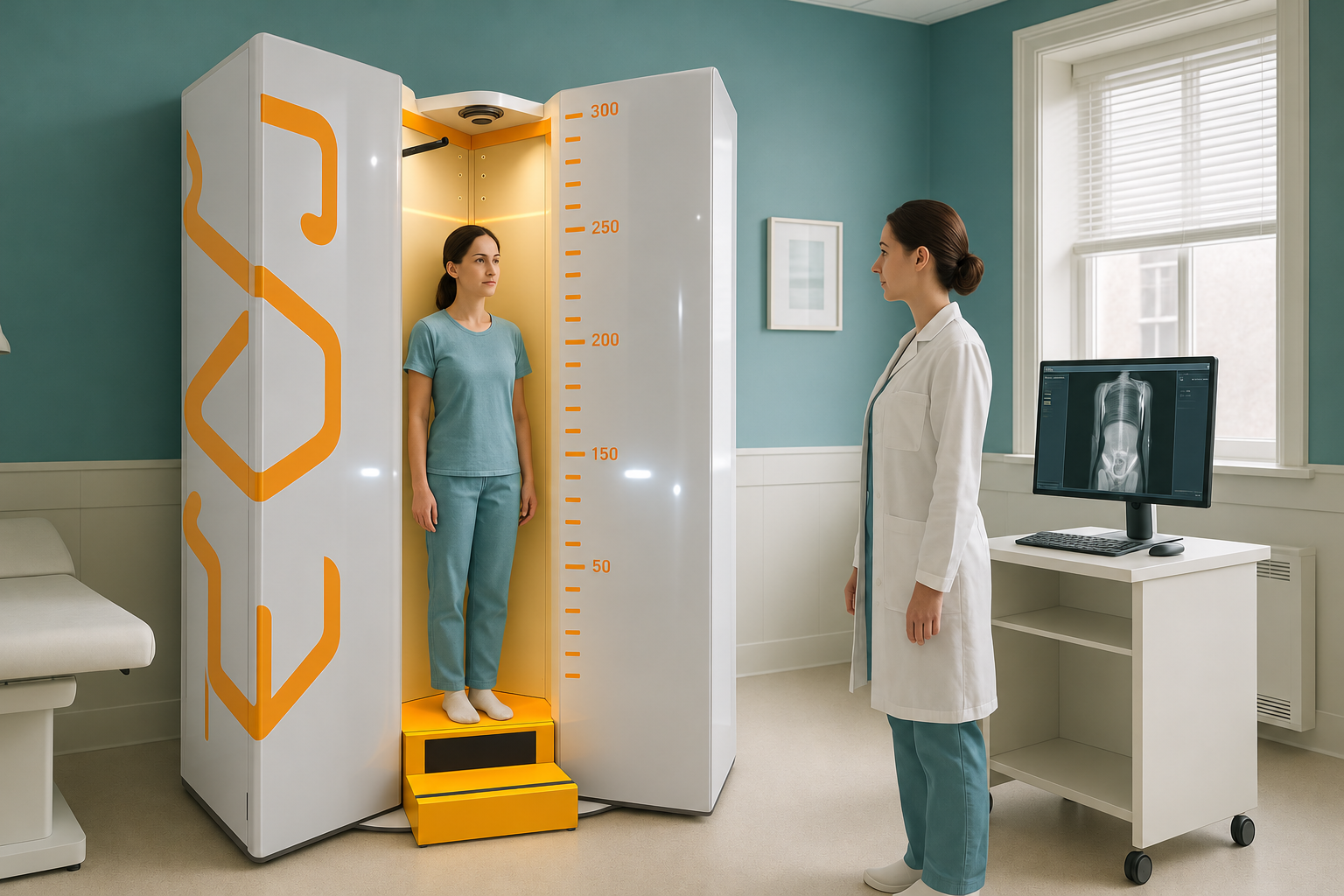
The EOS scanner at ScanAlign takes patients up to 250 kg (about 39 stone). You stand upright inside an open cabin, roughly 130 cm wide and 175 cm deep. There is no narrow tunnel to fit into. Most adults feel comfortable during the scan, which takes about 20 seconds.
Key points
- Weight limit: 250 kg (about 39 stone).
- Cabin width: roughly 130 cm. No closed tunnel.
- You stand upright the whole time. There is no table to lie on.
- About 90% less radiation than a standard X-ray, around ten times less.
- Not sure if the scan suits you? A free video consultation confirms this before you travel.
What are the exact weight and size limits for an EOS scan?
The EOS scanner at our Harley Street clinic in London has documented equipment specifications. These are the numbers that matter.
| Specification | Detail |
|---|---|
| Maximum patient weight | 250 kg (approx. 39 st / 551 lb) |
| Cabin width (inside) | Approx. 130 cm |
| Cabin depth (inside) | Approx. 175 cm |
| Patient position | Standing upright, bearing your own weight |
| Scan time (full body) | About 20 seconds |
| Radiation dose | About 90% less than a standard X-ray, around ten times less |
You stand inside an open cabin. So there is no table weight limit to worry about, and no closed tunnel to squeeze into. The cabin doors stay closed during the scan for shielding, but the space inside is open and well lit.
Why does standing during a scan matter for larger patients?
When you stand, your skeleton carries your real body weight, just as it does in daily life. This matters for everyone. It matters even more if you have a higher body weight.
When you lie on a table for a normal X-ray, CT or MRI, your spine, pelvis and joints settle into a relaxed position. Your muscles stop working. Alignment problems that come from upright posture and load, and that cause pain, may not show up at all. The EOS scanner records your full posture under load, from head to feet, in one image.
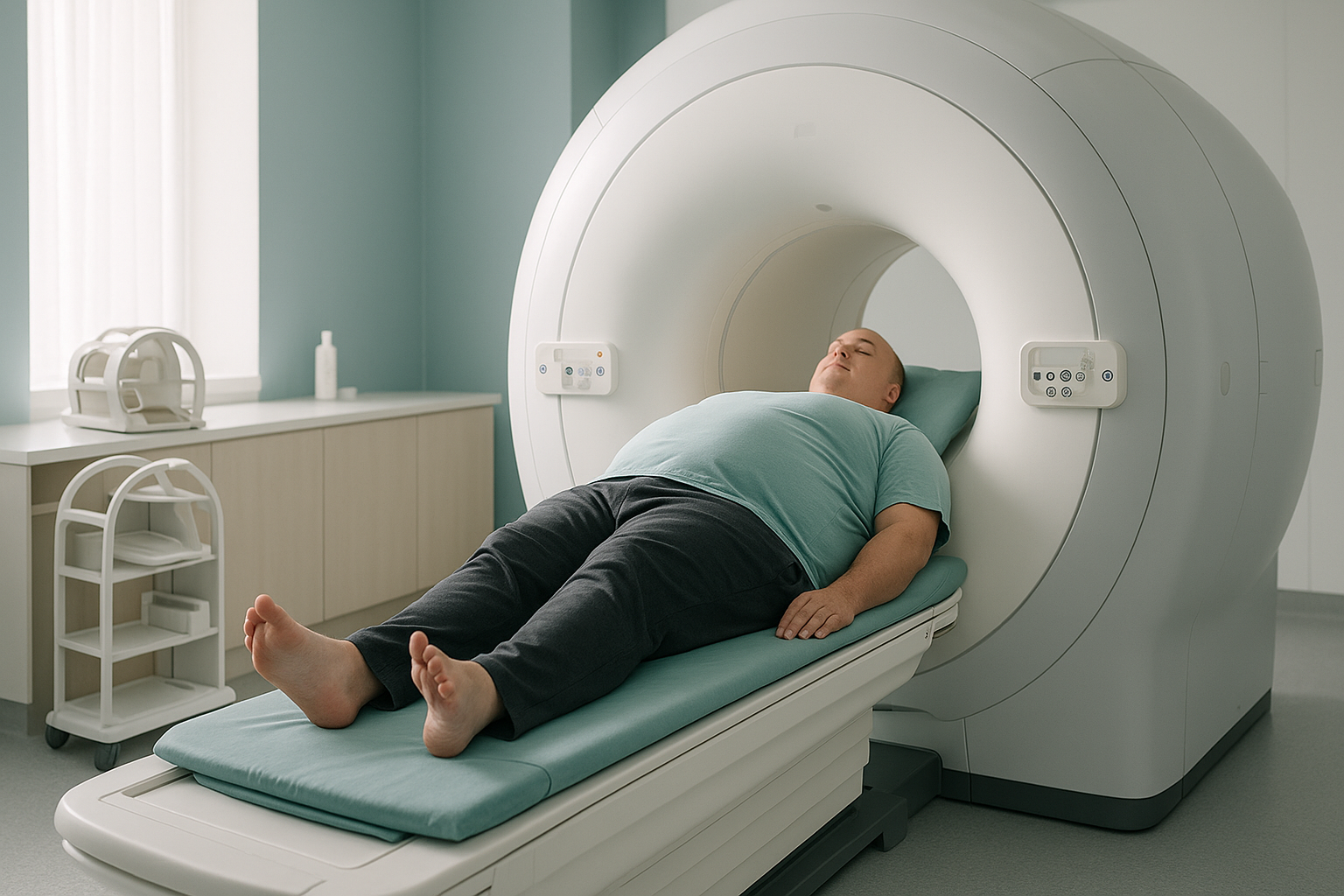
For larger patients, scanners where you lie down can also cause practical problems. Standard X-ray tables usually have weight limits between 150 and 205 kg. MRI tunnels are usually 60 to 70 cm wide. Many people find the closed tunnel uncomfortable, or simply cannot fit. The EOS cabin is open and you stand the whole time, so these problems do not apply.
You can read more about what to expect at an alignment assessment before your visit.
How does the EOS scan compare with MRI and CT for size limits?
Size and weight limits differ between scanners. The table below gives a general comparison. Exact figures depend on the machine at each hospital or clinic.
| Factor | EOS (ScanAlign) | Standard MRI | Standard CT |
|---|---|---|---|
| Patient position | Standing | Lying down | Lying down |
| Weight limit | 250 kg | Usually 120 to 230 kg | Usually 200 to 300 kg |
| Opening / tunnel | Open cabin, ~130 cm wide | Usually 60 to 70 cm tunnel | Usually 70 to 80 cm tunnel |
| Closed tunnel? | No | Yes | Partly |
| Shows alignment under load? | Yes | No | No |
This does not mean one scan is better in every way. Each one answers a different question. ScanAlign, standing EOS imaging in Harley Street, focuses on how your skeleton lines up under load. MRI and CT have other uses, and your clinician may suggest more than one type of scan.
How can I check if this scan will work for me?
We confirm that the scan suits you before you travel to London. This is how it works.
Free video consultation
You speak with our team from home. We ask about your height, weight and how well you move, so we can confirm the scanner suits you. There is no obligation.
Suitability confirmed
If all looks good, we book your appointment. If we think the EOS scan is not right for you, we will tell you and suggest other options.
Arrive and scan
You walk into the open cabin and stand still for about 20 seconds. Then the scan is done. You do not need a gown unless it is needed. Your privacy and dignity come first throughout.
Report and next steps
A specialist radiologist reviews your images and writes a detailed alignment report. You can share it with any clinician who treats you.
See who our scan is suitable for, or contact patient support if you have questions about access or comfort.
When MRI is the better choice. EOS imaging shows bones, joints and alignment under load. If your clinician needs to see soft tissue, discs or nerves, MRI is usually the better tool. The two scans answer different questions. One does not replace the other.
Before you start treatment, or change the one you are on, it is worth getting a detailed diagnosis. Knowing whether the cause sits in the pelvis, the legs or the spine changes what will actually help.
Frequently asked questions
The maximum patient weight is 250 kg. That is about 39 stone or 551 lb.
It is roughly 130 cm wide inside. It is an open, well-lit cabin, not a tunnel.
No. You stand upright the whole time. The scan shows your skeleton while it carries your normal body weight. This is one of its main advantages.
In many cases, yes. The 250 kg weight limit and open cabin suit most patients. We confirm suitability in a free video consultation before you book.
If you could not fit into an MRI tunnel, the open EOS cabin is a different experience. But EOS and MRI answer different questions. EOS shows skeletal alignment under load. MRI is needed for soft tissue, discs and nerves. If alignment imaging is what you need, EOS may be a good option.
About 90% less radiation than a standard X-ray, around ten times less.
No. ScanAlign is a private, self-pay clinic and you can refer yourself. A referral from your doctor or specialist is welcome but not required.
The EOS scanner gives diagnostic-quality images for a wide range of body types. In some cases, a higher body weight can slightly affect soft-tissue contrast. But the bone detail needed to assess alignment is usually well kept. Your suitability is confirmed before you book.
The price for patients travelling from abroad is confirmed during the free video consultation. You can check suitability and book through that consultation. It is free and without obligation.
Yes. The clinic is accessible and our team will help you. You do need to stand without support for about 20 seconds during the scan itself. If you are unsure, mention it in your video consultation and we will advise you.
Not sure if the scan suits you?
A free video consultation confirms your suitability before you travel. No obligation, no judgement.
Book a free video consultationWritten by Abbas Dhami (Specialist Diagnostic Radiographer)
Sources
- EOS imaging. Technical specifications, EOS system. EOS imaging (manufacturer documentation).
- Deschênes S, et al. Diagnostic imaging of spinal deformities: reducing patients' radiation dose with a new slot-scanning X-ray imager. Spine, 2010; 35(9): 989-994.
- NHS England. Guidance on diagnostic imaging services, 2023.
This page is general information and not a diagnosis.
ScanAlign is the trading name of CoreMed Solutions Ltd and operates under The Harley Street Hospital's CQC licence.