

What Causes Rounded Shoulders, and How Do You Fix Them?
Rounded shoulders happen when the muscles across the front of the chest get tight and the upper-back muscles get weak. This pulls the shoulder blades forward and rolls the shoulders inward. Long hours of sitting and desk work are the most common triggers. Fixing them starts with understanding the pattern. The next step is addressing the muscle imbalance behind it.
Key points
- Rounded shoulders are a posture pattern, not a disease. They can usually be improved.
- Tight chest muscles and weak upper-back muscles are the main drivers.
- The problem rarely stays in one place. It often travels up to the neck or down to the lower back.
- Standing imaging shows the full picture that lying-down scans can miss.
- A clear assessment is the first step before exercises or treatment.
What exactly are rounded shoulders?
Rounded shoulders are a forward resting position of the shoulder joints. Both shoulders drift forward and inward, instead of sitting back naturally. Clinicians sometimes call this scapular protraction. This means the shoulder blades have moved away from the spine and tilted forward.
It is one of the most common posture changes in adults who sit for long hours. Over time, the chest muscles (mainly the pectoralis minor) get shorter. At the same time, the muscles between and below the shoulder blades stretch and get weaker. This creates an imbalance. It holds the shoulders rolled forward, even when you stand up.
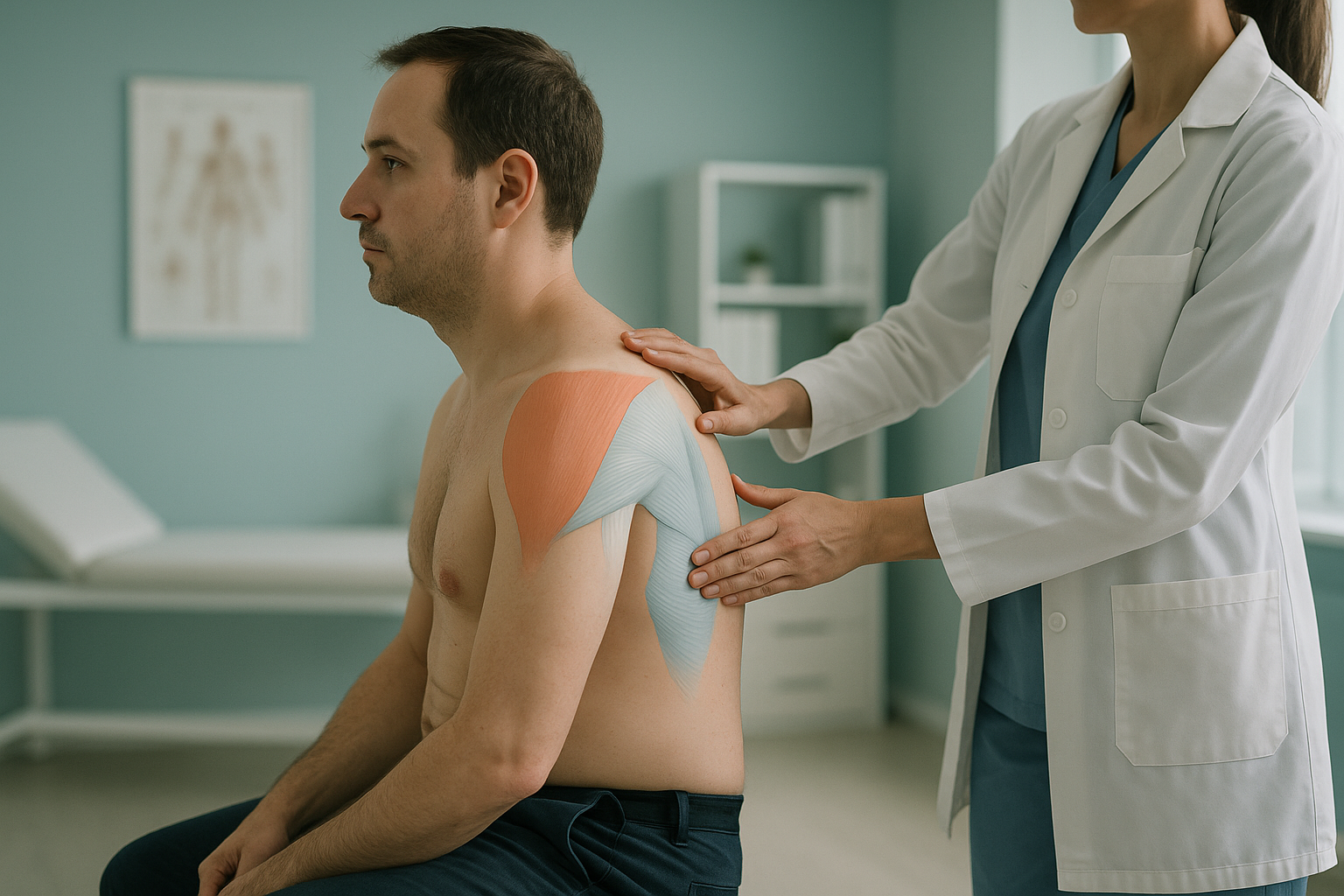
Rounded shoulders rarely happen on their own. They often come with forward head posture, where the head drifts ahead of the shoulders. Together, these patterns are sometimes called an upper crossed pattern. This is a recognised mix of tight and weak muscles around the neck, chest and upper back.
How do you know if you have rounded shoulders?
You can often spot it yourself. Stand sideways in front of a mirror with your arms relaxed. If your knuckles face forward (rather than to the side), your shoulders are likely rolled inward.
Seen from the side, the front of both shoulders sits ahead of your ears.
The overstretched upper-back muscles get tired and ache, especially after sitting for a long time.
Stretching your arms behind you feels restricted or uncomfortable.
Rounded shoulders often push the head forward. This increases strain on the neck.
What causes rounded shoulders posture?
The most common cause is habit. Hours of desk work, driving and phone use train the muscles at the front of the body to shorten. They train the muscles at the back to switch off. But habit is not the only factor.
Desk work, travel to and from work and screen time keep the chest closed and the upper back rounded.
A tight pectoralis minor and a weak lower trapezius or serratus anterior pull the shoulder blades forward.
A stiff upper back (increased thoracic kyphosis) pushes the shoulders forward structurally.
Years of posture you do not notice can lock the pattern in, so it feels normal.
For some people, the rounded position also develops after an injury, surgery or a period of inactivity. Whatever the trigger, the result is the same: a loop that feeds itself, where tight muscles get tighter and weak muscles get weaker.
How do rounded shoulders affect the rest of your body?
Your body is a connected chain from your feet to your head. When the shoulders roll forward, the upper back curves more. The head drifts forward to make up for it. The lower back then adjusts its curve to keep you balanced. This is exactly the kind of compensation pattern that makes pain appear far from its real source.
You might feel the strain in your neck, your lower back or between the shoulder blades. Yet the root of the problem could be the position of the shoulder blades and tightness in the chest. For a wider view of how these patterns connect, see our posture correction guide.
Weight-bearing and upright. When you stand, gravity acts on your whole skeleton exactly as it does in daily life. Rounded shoulders, a forward head and any compensating curves in the spine all show up clearly. This is because the muscles and joints are working under real-life load.
Muscles relax on the table. Lying flat takes gravity out of the picture. The shoulders may fall back into a neutral position that they never reach in real life. So a standard lying-down X-ray or MRI can understate how much the posture has changed. It can also miss the compensations your body makes while upright.
How is rounded shoulder posture assessed while standing?
A standing EOS scan captures your full skeleton in one upright image, from head to feet. Because you are weight-bearing, the scan shows the true position of your shoulder blades and the curve of your thoracic spine. It also shows how the rest of your skeleton compensates.
EOS uses about 90% less radiation than a standard X-ray, around ten times less. The scan takes seconds, needs no preparation and no referral. You can learn more about the technology on the ScanAlign standing EOS imaging page.
Want to see how your shoulders and spine line up under gravity? A standing EOS scan at our London clinic can show you the full picture.
Book a free video consultationWhen MRI is the better choice: EOS shows bones, joints and alignment. If your clinician suspects a disc problem, a rotator cuff tear or nerve involvement, MRI is usually the better tool for soft-tissue detail. The two scans work well together.
How do you fix rounded shoulders?
Fixing rounded shoulders means bringing back balance between the muscles at the front and back of your upper body. In most cases, improvement comes from a mix of stretching, strengthening and awareness. The details depend on how your body has adapted. That is why a clear assessment matters first.
General approaches that clinicians often recommend
- Stretching tight areas. The chest, the front of the shoulders and the neck muscles usually need regular, gentle stretching.
- Strengthening weak areas. The lower trapezius, rhomboids and serratus anterior often need targeted work to hold the shoulder blades in a better position.
- Posture awareness. Knowing what good alignment feels like is a surprisingly large part of the solution. Small reminders through the day can retrain habits.
- Ergonomic changes. Adjusting your screen height, chair and driving position cuts down the time you spend in a rounded posture.
ScanAlign does not provide treatment. It provides the diagnostic imaging that helps you and your clinician understand the pattern. That way, any exercises or therapy are based on a clear picture rather than guesswork. To book a posture assessment, start with a free video consultation.
Before you start treatment, or change the one you are on, it is worth getting a detailed diagnosis. Knowing whether the cause sits in the pelvis, the legs or the spine changes what will actually help.
Frequently asked questions
Yes, in most cases. The position is largely driven by muscle imbalance and habit. So regular stretching and strengthening can make a noticeable difference. How much you improve depends on how long the pattern has been there. It also depends on whether any structural changes have developed in the thoracic spine.
There is no single timeline. Some people notice a change within a few weeks of regular exercise and posture awareness. Others with long-standing patterns may take several months. Doing it regularly matters more than doing it hard.
Not exactly. Rounded shoulders refer to the shoulder blades rolling forward. Thoracic kyphosis describes increased curvature of the upper spine. The two often appear together, but they are separate findings. You can have one without the other.
They can. When the shoulders roll forward, the head usually follows. This increases the load on the neck muscles and joints. It often leads to neck tension, stiffness and headaches.
Common exercises include chest doorway stretches, wall angels, resistance band pull-aparts and prone Y-raises. A physiotherapist or exercise professional can tailor a programme to your own pattern.
Imaging is not always needed, especially if the pattern is mild and responds well to exercises. If symptoms persist, or you want a detailed picture of how your spine and shoulder blades sit under gravity, a standing EOS scan gives that view with very low radiation.
Yes. EOS uses about 90% less radiation than a standard X-ray, around ten times less. It is one of the lowest-dose skeletal imaging methods available.
No. ScanAlign accepts self-referrals. You start with a free video consultation to check that the scan is right for your situation.
For patients travelling from abroad, the price is confirmed during the free video consultation.
They can, if the habits that caused them return. Keeping up a regular stretching and strengthening routine, along with a well set-up workspace, helps stop the pattern from coming back.
See how your shoulders really line up
A standing EOS scan captures your full posture under gravity. It shows compensation patterns that lying-down imaging can miss.
Book a free video consultationWritten by Abbas Dhami (Specialist Diagnostic Radiographer)
Sources
- NHS. "Back pain: how to improve your posture." nhs.uk.
- Neumann DA. Kinesiology of the Musculoskeletal System: Foundations for Rehabilitation. 3rd ed. Elsevier, 2017.
- Illés T, Somoskeöy S. "The EOS imaging system and its uses in daily orthopaedic practice." International Orthopaedics, 2012;36(7):1405-1411.
This page is general information and not a diagnosis.
ScanAlign is the trading name of CoreMed Solutions Ltd and operates under The Harley Street Hospital's CQC licence.