
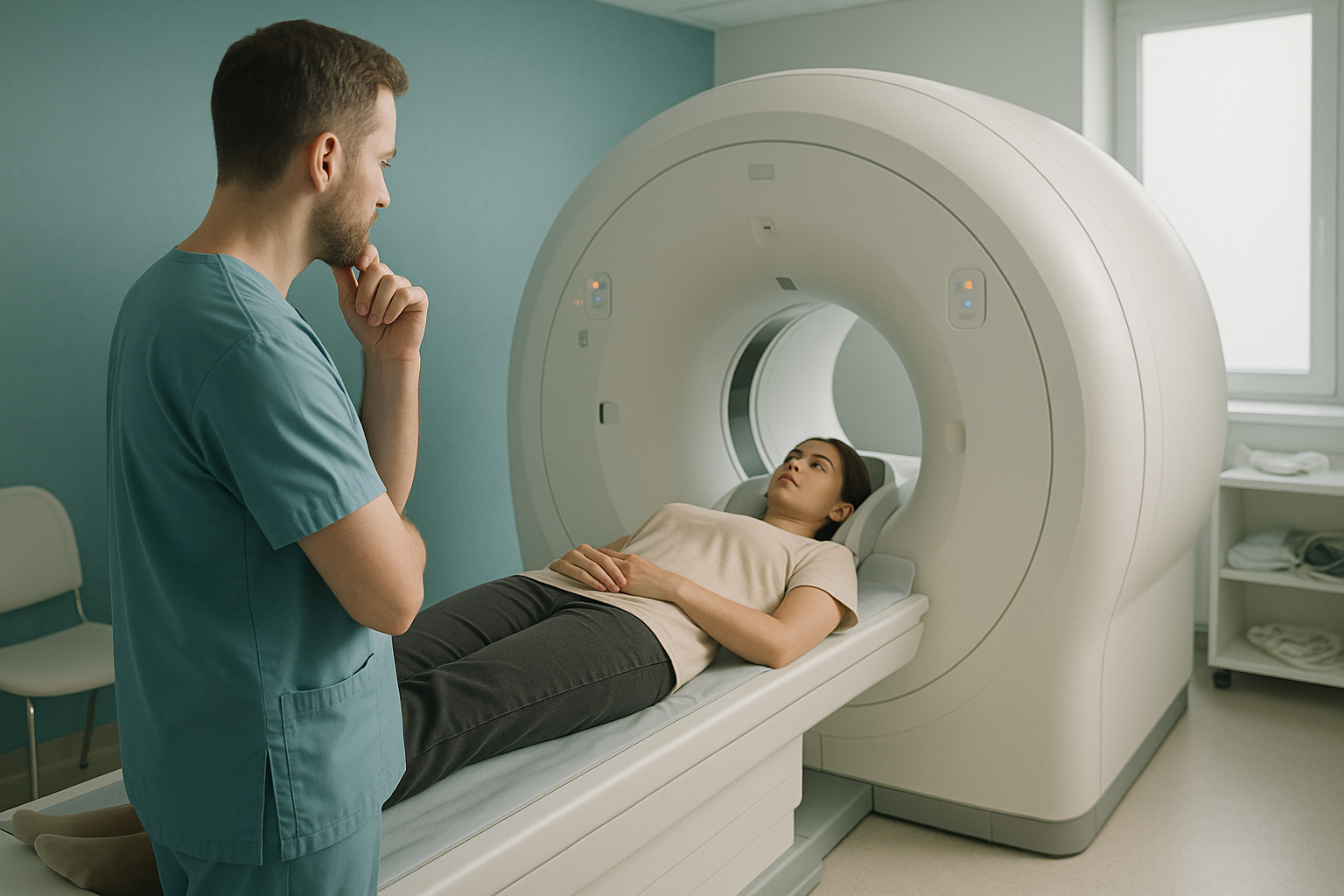
What Should You Ask Before Paying for a Private Scan?
Before you pay for any private scan, ask a few things. What does the total price cover? Is a specialist report included? Who will read the images? Do you need a referral? How will the results be shared with you and your clinician? These questions protect you from surprise charges and make sure the scan is truly useful.
Key takeaways
- Always check whether the report, the images and any follow-up consultation are included in the price.
- Check that the clinic is registered with the CQC, and that a qualified radiologist or reporting radiographer will read your scan.
- Ask whether you need a referral from your doctor or consultant, or whether the clinic accepts self-referrals.
- Find out how your images and report will be shared with you and with your own clinician.
- For bone and joint alignment, a standing scan can show problems that a lying-down scan may miss.
Paying for a private scan is a big decision, especially if it means travelling to London. You want clear answers, not unexpected bills. Yet many people book without knowing exactly what they are paying for. They only find the gaps later. This page gives you a simple checklist of questions to ask before a private scan. It helps you compare clinics with confidence and get the most from your investment.
What questions should you ask a private imaging clinic?
The questions below cover the areas where patients are most often caught out. Ask every one before you book.

| Question to ask | Why it matters |
|---|---|
| What is the total price, including the report? | Some clinics advertise a scan fee but charge extra for the written report. You need one number that covers everything. |
| Is the report written by a consultant radiologist or a reporting radiographer? | A qualified specialist should read your images. Ask who they are and what their qualifications are. |
| Do I need a referral from my doctor or consultant? | Some clinics require a referral letter. Others accept self-referrals. Knowing this avoids a wasted appointment. |
| Is the clinic registered with the CQC? | In England, diagnostic imaging providers should be registered with the Care Quality Commission. This confirms the clinic meets national safety and quality standards. |
| How will I receive my images and report? | You may need to share the results with your doctor, surgeon or physiotherapist. Ask whether you get a digital copy, a printed report, or both. |
| Is there a follow-up consultation included? | A scan is only useful if someone explains what it shows. Find out whether the price includes a consultation to talk through your results. |
| What is the cancellation policy? | Plans change. Know whether you can reschedule and whether there is a cancellation charge. |
| Will the scan be done standing up or lying down? | For bone, joint and alignment problems, a standing scan shows your body under real weight-bearing conditions. A lying-down scan relaxes the muscles and may hide the problem. |
Is the report included in a private scan price?
Not always. Some clinics charge a separate fee for the written report. This can come as a surprise after the scan is done. Before you pay, always check that the total cost includes a full specialist report, not just the images.
The report is arguably the most important part. It is the specialist's reading of what the images show, written so that your doctor or consultant can act on it. Without it, you have pictures but no clinical explanation.
Ask exactly who writes the report. In UK private imaging, this should be a consultant radiologist or a qualified reporting radiographer. You have the right to know their name and qualifications.
At ScanAlign, the price for patients travelling from abroad is confirmed during the free video consultation, and you can see what our price includes before you book. We believe the total cost should always be clear.
Why does it matter whether a scan is done standing up or lying down?
It matters because your skeleton behaves differently under gravity. When you lie down for a normal X-ray, CT or MRI, your muscles relax. Your spine, pelvis and legs settle into a position they are never in during daily life. Alignment problems that cause your pain while standing or walking can simply disappear on a lying-down image.
Your body is a connected chain from your feet to your head. A tilt in the pelvis can change the curve of your spine. A difference in leg length can shift your hips. Pain often shows up in a different place from the underlying cause, because one area compensates for another. A standing, whole-body image captures this full chain under real weight-bearing conditions, so your clinician can see the true picture.

EOS is a low-dose standing X-ray system. It captures your full skeleton from head to feet in a single image, using about 90% less radiation than a standard X-ray, around ten times less. This makes it well suited for assessing alignment and planning treatment when your problem involves posture, joints or the way your weight is spread.
Learn more about ScanAlign, private standing imaging in London.
When MRI is the better choice. EOS shows bones, joints and alignment very clearly. But for soft tissue, discs, nerves, ligaments or cartilage, MRI is usually the better tool. The right scan depends on the right question. If you are not sure which one you need, a good clinic will help you decide before you pay.
Before you start treatment, or change the one you are on, it is worth getting a detailed diagnosis. Knowing whether the cause sits in the pelvis, the legs or the spine changes what will actually help.
Frequently asked questions about choosing a private scan
At a minimum, the price should cover the scan itself, a written report from a qualified specialist, and a way for you to receive your images. Some clinics also include a follow-up consultation. Always ask for a single total figure before you commit.
It depends on the clinic. Some require a referral letter from a doctor or consultant. Others, including ScanAlign, accept self-referrals, so you can book directly without seeing your doctor first.
Check that the clinic is registered with the Care Quality Commission (CQC) in England. You can search the CQC website for its registration. Also ask about radiation dose, equipment maintenance and who will do the scan.
This varies between clinics. Some include the report in the scan fee. Others charge a separate reporting fee. Always check this before paying. The report is essential, because it is the specialist reading your clinician will use.
EOS is a low-dose X-ray system that images your full skeleton while you stand. Standing matters because your bones and joints sit differently under gravity than when you lie down. This gives a much more accurate picture of your real alignment.
An EOS scan uses about 90% less radiation than a standard X-ray, around ten times less. This makes it one of the lowest-dose skeletal imaging options available.
Yes. Ask the clinic how they share images. Most will give you a digital copy or send the images directly to your consultant or doctor. At ScanAlign, your report and images can be shared with any clinician you choose.
A normal X-ray usually images one area while you stand or lie on a table. EOS captures your entire skeleton from head to feet in one standing image, with much less radiation. It also produces a 3D model of your skeletal alignment that a standard X-ray cannot provide.
Prices vary by scan type, clinic and what is included. At ScanAlign, the price for patients travelling from abroad is confirmed during the free video consultation, and you can read more on our frequently asked questions page. We recommend always comparing the total cost, including the report, rather than the headline scan fee alone.
It depends on what your clinician needs to see. EOS is ideal for bones, joints and full-body alignment. MRI is better for soft tissue, discs, nerves and ligaments. If you are not sure, a consultation before booking can help you choose the right scan.
Not sure which scan you need?
Talk to a specialist radiographer first, before you plan your trip to London. We will help you work out whether a standing alignment scan is the right next step, with no obligation.
Book a free video consultationWritten by Abbas Dhami (Specialist Diagnostic Radiographer)
Sources
- Care Quality Commission. Registration of diagnostic imaging services. cqc.org.uk
- The Royal College of Radiologists. Standards for the reporting and interpretation of imaging investigations (2nd ed., 2018). rcr.ac.uk
- Deschênes S, Charron G, Beaudoin G, et al. Diagnostic imaging of spinal deformities: reducing patients' radiation dose with a new slot-scanning X-ray imager. Spine. 2010;35(9):989-994.
This page is general information and not a diagnosis.
ScanAlign is the trading name of CoreMed Solutions Ltd and operates under The Harley Street Hospital's CQC licence.