

What Do You Do When Physiotherapy Is Not Working?
If your physiotherapy is not working after several weeks of steady effort, the problem is rarely the physiotherapy itself. It usually means the real cause of your pain has not been fully found. A fresh assessment, sometimes with standing, weight-bearing imaging, can show structural or alignment problems that change the treatment plan entirely.
Key Takeaways
- Physiotherapy works best when the diagnosis is right. If it stalls, question the diagnosis first.
- Pain that moves or keeps coming back can point to a problem elsewhere in the body's alignment chain.
- Lying-down scans can miss alignment problems that only appear when you are standing and weight-bearing.
- A standing whole-body image shows how your spine, hips and legs work together under gravity.
- Getting better imaging does not mean giving up physiotherapy. It means giving your physiotherapist better information.
How do you know if physiotherapy is not helping?
Most people should notice some improvement within four to six weeks of regular sessions. That does not mean the pain is gone, but you should feel a change. Less stiffness in the morning, more confidence when moving, or the pain flaring up less often. If none of that is happening, and you have been doing your exercises regularly, it is worth stopping to ask why.
Your pain, movement or daily function stay the same, even though you attend regularly and do your home exercises.
Your back gets better, but now your hip hurts. The problem seems to move around your body.
The movements you were given make your symptoms worse again and again. This suggests they may be loading the wrong area.
You improve, stop treatment, and then the same pain returns within weeks. The pattern keeps repeating.
None of these signs mean physiotherapy has failed you. They are signals that something in the bigger picture may have been missed.
Why does physiotherapy sometimes stall?
Physiotherapy stalls most often because the treatment is aimed at the wrong area, not because the approach itself is wrong. A good physiotherapist will tell you this. Here are the most common reasons progress stops.
The first assessment found the painful area, but not the structural problem driving it.
Your body adapts around a problem somewhere else, so treating the painful spot never fixes the root cause.
Earlier scans were taken lying down. This relaxes the muscles and can hide alignment problems that only appear when standing.
A difference in leg length, a pelvic tilt or a spinal shift changes how forces travel through your body.
Your body is a connected chain from your feet to your head. A shift at one level can put stress on another. This means your pain may truly be caused by something happening in a completely different area. Muscle imbalance is one common example, where one side works harder to make up for a structural tilt. Without seeing the full chain, even excellent rehabilitation can end up treating a symptom rather than a cause.
How does standing imaging change the picture?
Standing, weight-bearing imaging shows your skeleton the way it really works: upright and under the force of gravity. This matters because when you lie down for a standard X-ray, CT or MRI, your muscles relax, your joints decompress and your spine settles into a position it never actually holds during your day. The alignment problems driving your pain can simply disappear on a lying-down scan.
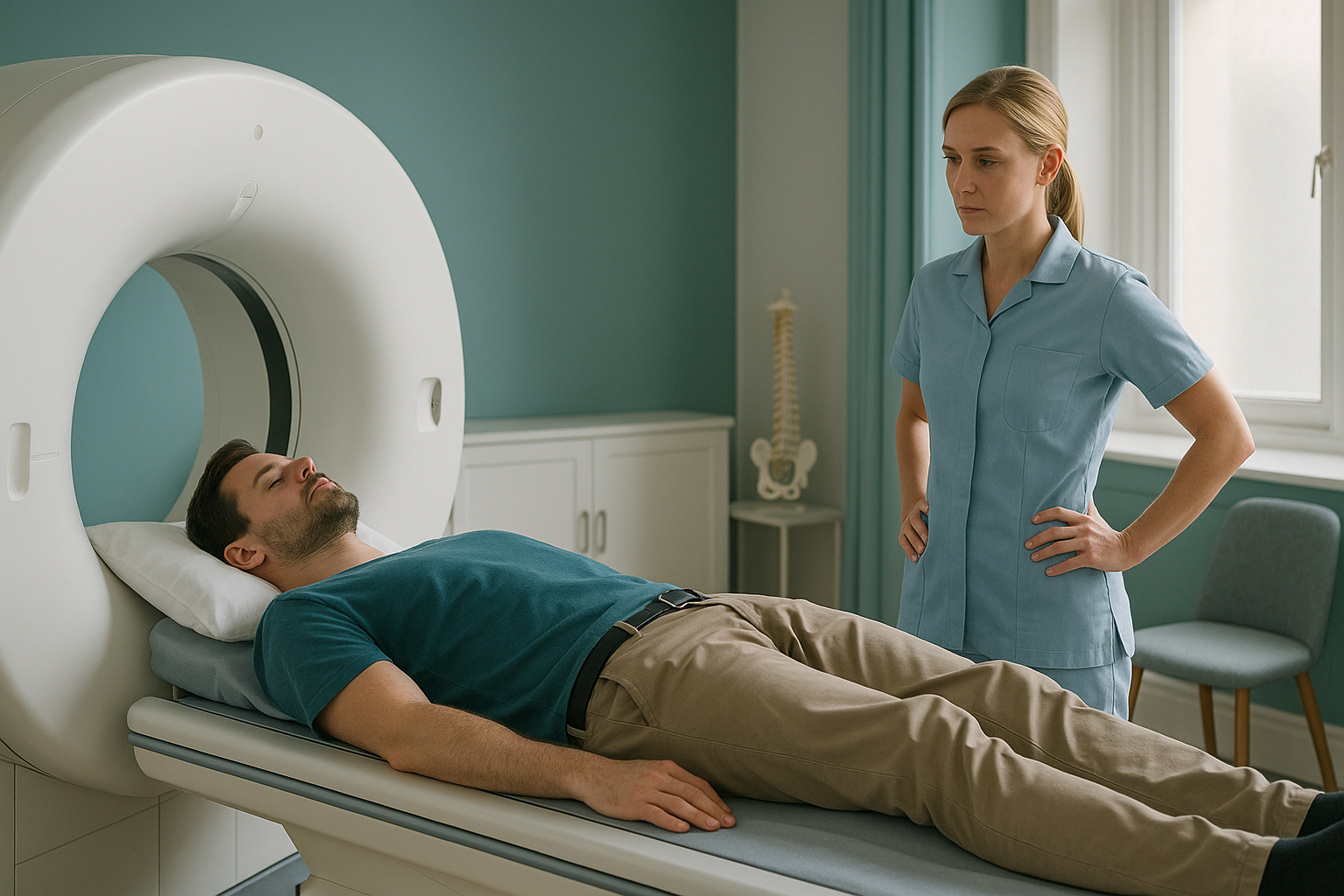
An EOS scan captures your entire skeleton in one standing image, from head to feet, with about 90% less radiation than a standard X-ray, around ten times less. It lets a specialist see the full alignment chain at once. So instead of guessing which area is the true driver, they can measure it.
This is not about replacing your physiotherapist. It is about giving them, and any specialist you see, the structural information they need to fine-tune your programme. Many physiotherapists actively refer patients for this kind of imaging when progress stalls. You can learn more about how this works on ScanAlign standing EOS imaging.
When is MRI the better choice? EOS shows bones, joints and alignment. For soft-tissue problems like disc bulges, nerve compression or ligament tears, MRI is usually the better tool. If your physiotherapist suspects a soft-tissue cause, an MRI referral may be the right next step. In many cases, both types of imaging together give the most complete picture.
What should you do if physiotherapy is not helping your back pain?
The answer is not to give up on physiotherapy. It is to question the diagnosis and fill in any gaps in the clinical picture. Here is a practical way forward.
Talk honestly with your physiotherapist
Tell them exactly what has and has not changed. A good therapist will welcome this conversation and may adjust the plan or suggest further tests.
Think about whether the full picture has been seen
Ask yourself whether any scans you have had were done lying down, and whether they covered only the painful area. If so, alignment problems may have been missed.
Get a standing, whole-body assessment
A weight-bearing image of your entire skeleton shows how your spine, pelvis and legs relate to each other under gravity. This can reveal the structural driver behind your symptoms.
Return to treatment with better information
Your physiotherapist, consultant or surgeon can use the results to fine-tune your programme or decide if a referral to a specialist is needed.
If you are wondering when to see a specialist, the general guideline is this: when you have tried a structured rehabilitation programme for six weeks or more without meaningful improvement, it is reasonable to seek a second opinion or further tests.
Not sure whether imaging is the right next step? You can book an assessment to talk it through with a specialist radiographer first, at no cost.
Book a free video consultationImportant. If you have numbness, weakness, loss of bladder or bowel control, or sudden severe symptoms, please get urgent medical help. Contact your doctor or go to your nearest emergency department. Do not wait for a scan appointment.
Who benefits from standing imaging after physiotherapy?
Standing imaging is not for everyone. It is most useful when there is a specific clinical question about alignment or structural balance that lying-down imaging cannot answer. For more detail, visit our back pain clinic page.
- Back, hip or knee pain that has not responded to 6 or more weeks of physiotherapy
- Pain that moves between areas
- Suspected leg-length difference or pelvic tilt
- Planning before joint replacement or spinal surgery
- Wanting a second opinion on alignment
- Acute injury within the last few days
- Suspected disc, nerve or soft-tissue problem (MRI is usually better)
- Pain that is clearly improving with current treatment
- Red-flag symptoms (see the urgent note above)
Before you start a new treatment, or change the one you are on, it is worth getting a detailed diagnosis. Knowing whether the cause sits in your pelvis, your legs or your spine changes what will actually help.
Frequently asked questions
Most people should notice some positive change within four to six weeks of regular, consistent sessions. That might be less pain, better movement or fewer flare-ups. If nothing has changed after this time, it is worth reviewing the diagnosis.
A little soreness after new exercises is normal and usually settles within a day or two. If your pain keeps increasing after sessions, or a new pain develops, tell your physiotherapist. It may mean the exercises are loading an area that is compensating for a problem elsewhere.
You should not simply stop and do nothing. If you are not making progress, have an honest conversation with your physiotherapist about next steps. That might include different exercises, further imaging or a referral for a specialist opinion.
No. ScanAlign is a self-pay clinic and you can refer yourself directly. No referral letter from your doctor is needed. You start with a free video consultation to discuss whether the scan is right for you.
An EOS scan captures your entire skeleton in one standing image, so a specialist can see how your spine, pelvis and legs relate to each other under gravity. A standard X-ray usually shows one area at a time and is often taken lying down, which can hide alignment problems.
Yes. EOS uses about 90% less radiation than a standard X-ray, around ten times less. The scan takes only a few seconds and you simply stand still inside the machine.
The price for patients travelling from abroad is confirmed during the free video consultation, and you can find more on the FAQs and cost page.
Absolutely. The report is designed to be shared with any treating clinician, whether that is your physiotherapist, doctor, consultant or surgeon. Better imaging gives your team better information to plan your care.
If you have stuck with a structured programme for six or more weeks without meaningful improvement, seeking a second opinion is a reasonable and responsible step. A fresh pair of eyes, supported by better imaging, can often find something that was missed at first.
You speak with a specialist diagnostic radiographer who reviews your history and symptoms. They will explain whether a standing scan is likely to add useful information in your case and answer any questions. There is no pressure to book.
Not sure what to do next?
A free video consultation with a specialist radiographer can help you decide whether standing imaging would add useful information to your care.
Book a free video consultationSources
- National Institute for Health and Care Excellence (NICE). Low back pain and sciatica in over 16s: assessment and management (NG59). 2016, updated 2020.
- Illés T, Somoskeöy S. The EOS imaging system and its uses in daily orthopaedic practice. International Orthopaedics. 2012;36(7):1405-1411.
- Chartered Society of Physiotherapy. What to expect from physiotherapy. csp.org.uk (accessed 2024).
Written by Abbas Dhami (Specialist Diagnostic Radiographer)
This page is general information and not a diagnosis.
ScanAlign is the trading name of CoreMed Solutions Ltd and operates under The Harley Street Hospital's CQC licence.