
How Does Your Pelvis Recover After Giving Birth?
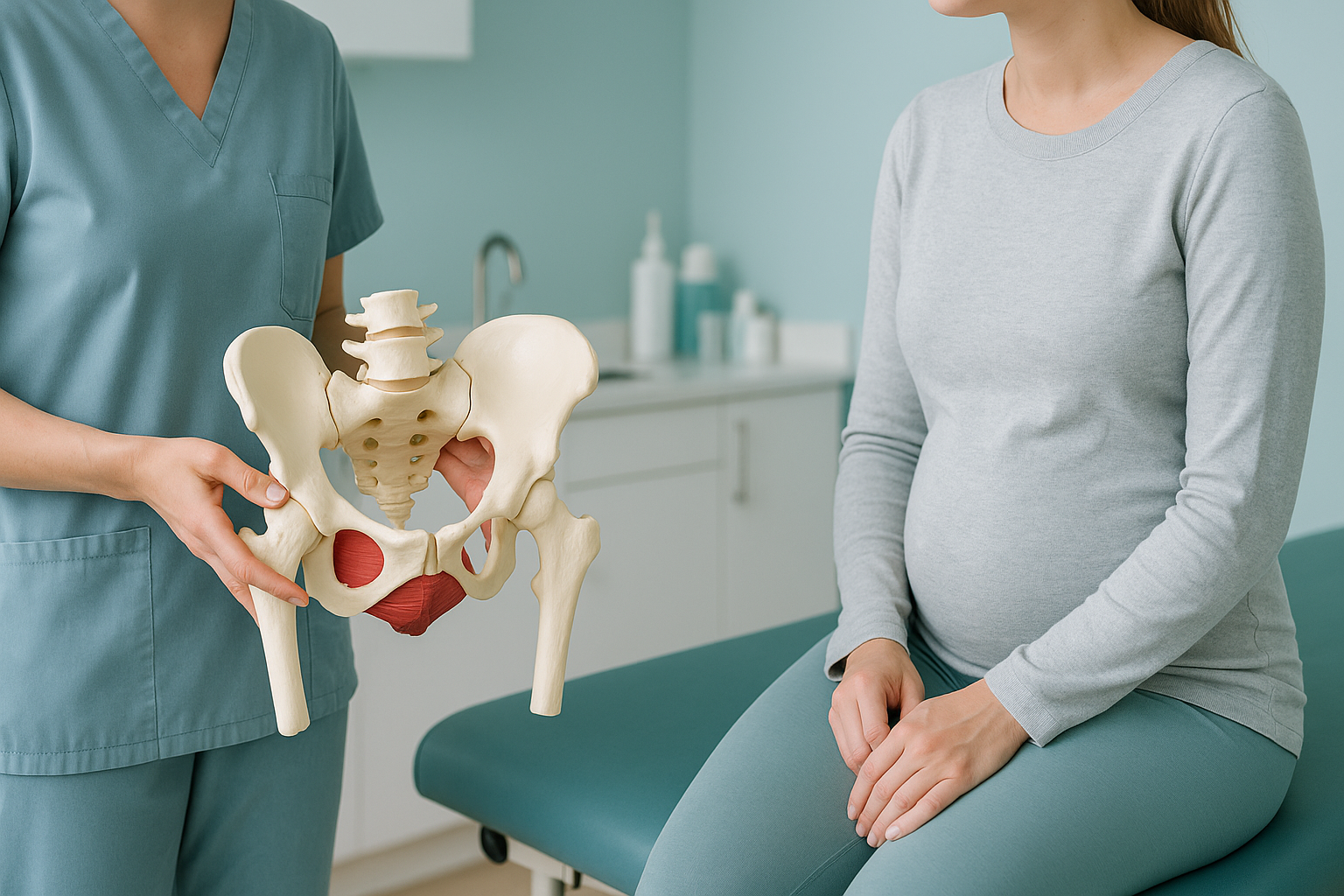
Your pelvis widens during pregnancy and delivery. Over the following months, it slowly moves back towards its position before pregnancy, as the hormone relaxin clears and the ligaments tighten. For some women, the pelvis does not fully realign. A standing whole-body image can show whether ongoing pain is linked to a shift, tilt or asymmetry that has remained.
Key points
- Relaxin softens the pelvic ligaments during pregnancy. After birth, it can take three to six months (or longer) for them to firm up again.
- Pelvic girdle pain, back pain after delivery and posture changes after birth are common. They usually improve, but not always fully.
- Scans done lying down can miss alignment problems that only appear when you are standing and bearing weight.
- A standing EOS image shows the whole skeleton in one shot. It shows whether your pelvis has stayed shifted, tilted or rotated.
- Most women can be scanned from around three months after a normal (vaginal) delivery, or around four months after a caesarean section. Your clinician will advise on timing.
What happens to your pelvis during pregnancy and birth?
Your body releases the hormone relaxin to loosen the ligaments around the pelvis. This makes room for your baby to pass through. The two halves of the pelvis at the front (the pubic symphysis) and the sacroiliac joints at the back all become more mobile. This is normal and necessary.
After delivery, relaxin levels drop and your ligaments slowly tighten. For most women, the pelvis returns close to its original position within a few months. But for some, the joint surfaces do not settle evenly. One side may sit slightly higher, or the pelvis may stay rotated. You might not notice this at all. Or you might feel it as ongoing pain in your lower back, hips or groin.
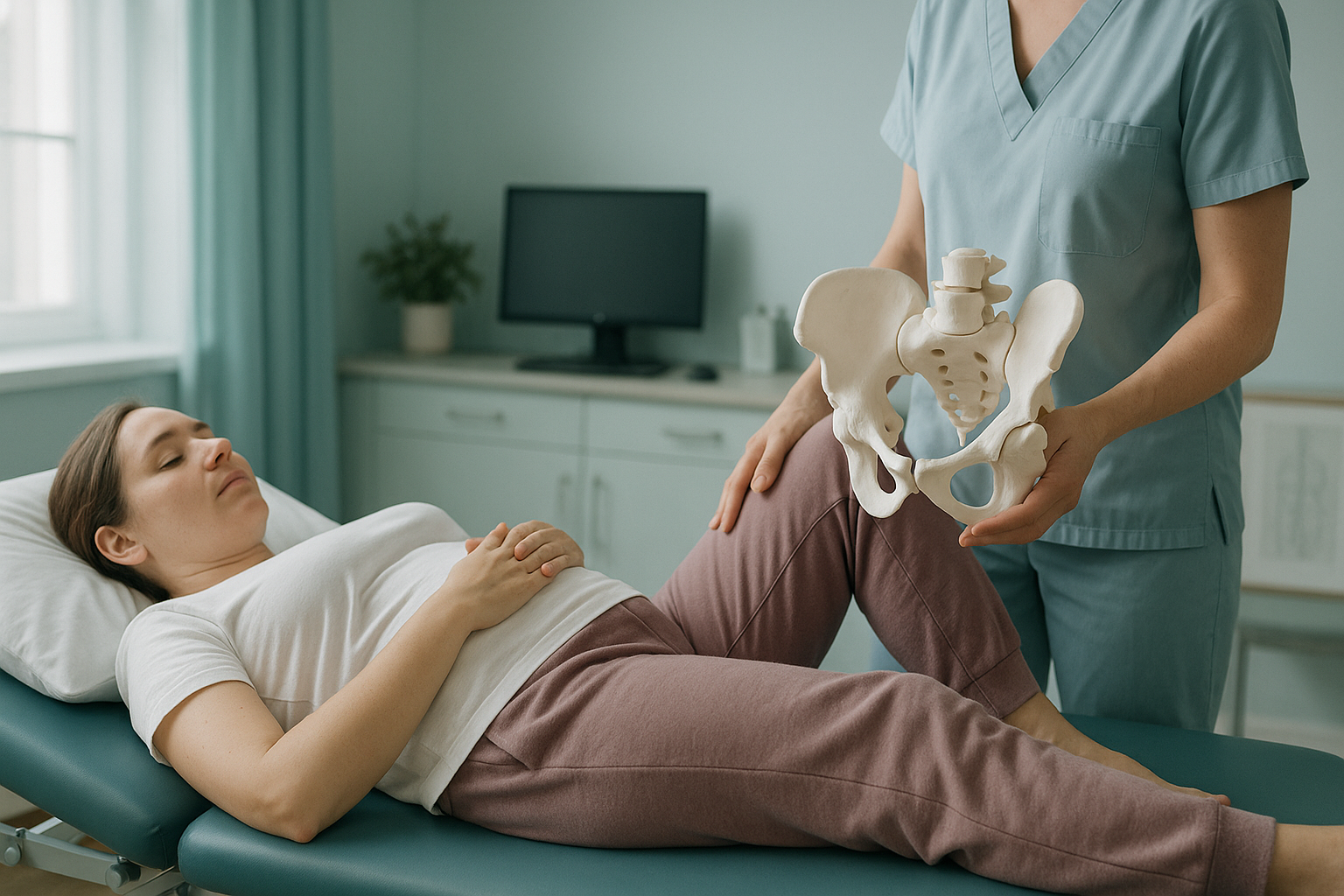
Diastasis recti, a separation of the abdominal muscles, often comes with these pelvic changes. When the deep core muscles are weakened, your spine and pelvis lose some of their usual support. This can contribute to back pain after delivery and changes in posture after birth.
What are the signs your pelvis hasn't fully recovered?
Ongoing pelvic girdle pain after birth is the most common sign. But a pelvis that has not fully realigned can show its effects in several ways.
A sharp or aching feeling at the front of the pelvis, especially when walking, climbing stairs or turning over in bed.
Aching across the lower back or sacroiliac joints that keeps going and does not settle with rest or simple exercises.
A feeling that one hip sits higher, or a limp or waddle that stays long after delivery.
Leaning forward when you stand, a bigger curve in your lower back, or a feeling that your balance has shifted since pregnancy.
If you also have sudden numbness, weakness in your legs, or any loss of bladder or bowel control, please get urgent medical help from your doctor or your nearest emergency department. These symptoms need to be checked straight away.
Why does pelvic pain after delivery continue for some women?
Several factors can slow or prevent full pelvic recovery. Often more than one is involved.
Breastfeeding can keep relaxin levels raised, so the ligaments stay loose for months after birth.
Separated abdominal muscles give the core less support. This puts extra load on the pelvis and lower back.
Holding your baby on one hip or feeding in a twisted position loads the pelvis unevenly, day after day.
A pelvic tilt or lateral pelvic tilt that was there before pregnancy may become more noticeable after birth.
The body is a connected chain from your feet to your head. When the pelvis shifts, your spine, hips and knees make up for it. That is why back pain after delivery can be felt far from the pelvis itself. It is also why a rotated pelvis can affect the way you walk and how comfortable one knee feels.
How is pelvic alignment after delivery checked standing up?
A standing, weight-bearing image is the most reliable way to see how the pelvis sits under real load. When you lie down for a standard X-ray or MRI, your muscles relax and gravity is taken away. A tilt, rotation or leg-length difference that causes pain under upright load may flatten out and look normal on a scan done lying down.
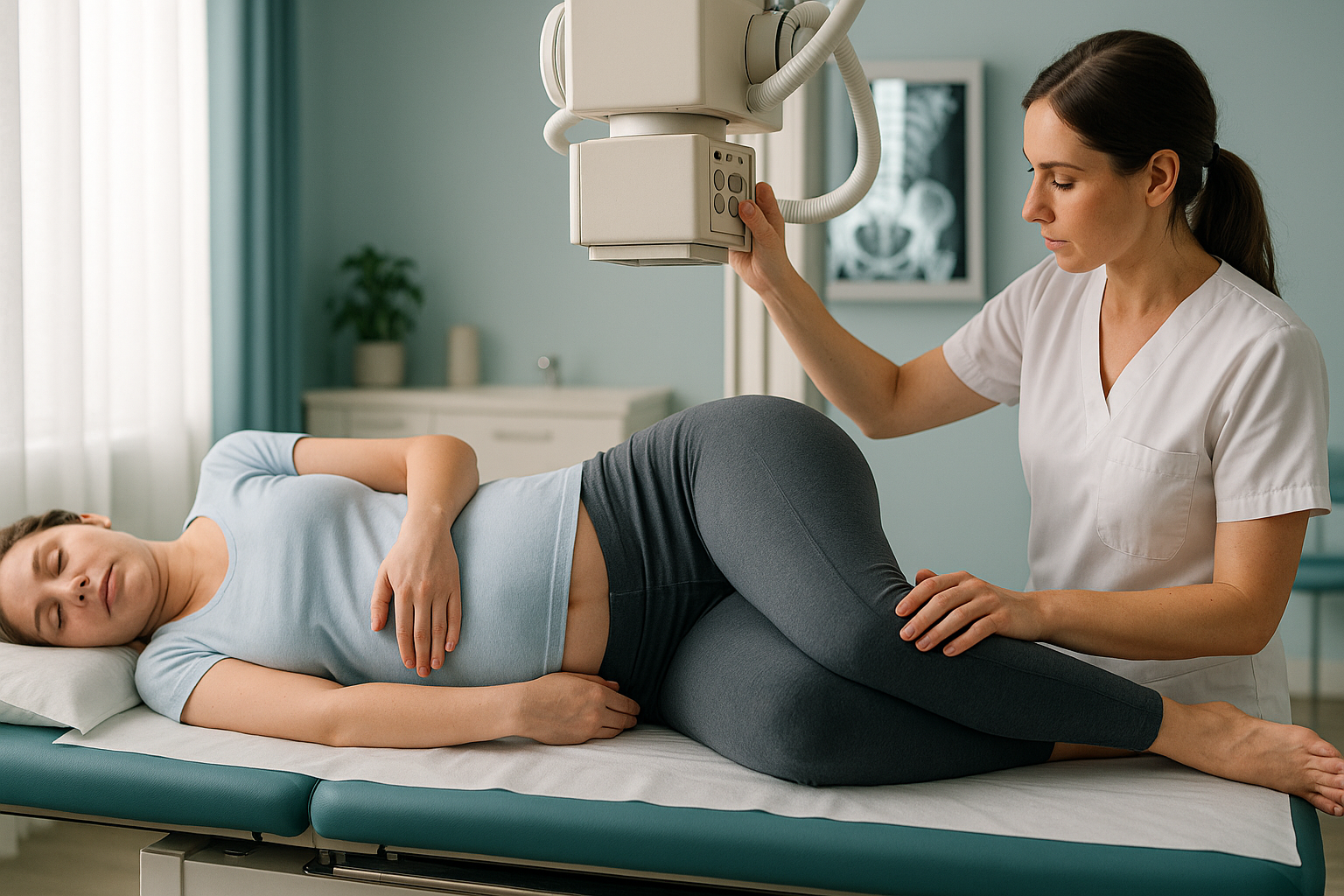
An EOS scan captures your entire skeleton, from your head to your feet, in a single standing image. It uses about 90% less radiation than a standard X-ray, around ten times less. The scan itself takes only a few seconds. You simply stand still inside the machine.
The image lets your clinician measure the exact position of the pelvis compared with your spine, hips and legs. If one side is higher, or the pelvis has stayed rotated, it will show clearly. This whole-body view is what makes ScanAlign standing EOS imaging especially useful for alignment concerns after delivery.
Still have questions about timing or what the scan involves?
A short video call with our team, from wherever you are, can help you decide if an alignment assessment is right for you at this stage, before you plan a trip to London.
Book a free video consultationWhat helps the pelvis recover after delivery?
Recovery is usually a mix of time, slowly building up load and, in some cases, targeted physiotherapy. These are the general approaches most often recommended.
- Pelvic floor rehabilitation. Rebuilding pelvic floor strength helps support the joints from below. A specialist physiotherapist can guide you through safe steps.
- Core recovery. Gentle deep-core work, especially for diastasis recti, helps steady the pelvis and reduce back pain after delivery. Avoid high-impact exercise until your core can handle the load.
- Carrying and feeding habits. Switching the hip you carry your baby on, and setting up supported feeding positions, reduces repeated one-sided loading.
- Slow return to exercise. Building up load slowly gives the ligaments time to firm up. Jumping straight back into running or heavy lifting while relaxin is still present can make symptoms last longer.
- Alignment assessment. If symptoms carry on beyond the early months, a standing whole-body image gives your physiotherapist or consultant the structural detail they need to fine-tune your plan.
When is MRI more suitable?
EOS is excellent at showing bones, joints and whole-body alignment. If your clinician suspects a disc problem, nerve compression, labral tear or another soft-tissue problem, MRI is usually the better tool. The two scans answer different questions, and sometimes both are needed.
How soon after birth can you have a pelvic alignment scan?
There is no single rule. As a general guide, most women can be scanned from around three months after a normal (vaginal) delivery, or around four months after a caesarean section. By this point, early healing is well underway. Any alignment problems that remain are more likely to show the pelvis's settled position, rather than short-term swelling after delivery.
If you are still breastfeeding, relaxin may stay raised, so your alignment could keep changing. That does not mean a scan is pointless. It means the result is a snapshot of where you are now, which your clinician can use to guide rehabilitation. A follow-up image later can show whether things have shifted further as your hormones return to normal.
Your six-week check after delivery is a good time to talk to your doctor about symptoms that are not going away. If pain continues beyond that point, an alignment assessment becomes more relevant.
Who benefits from an alignment assessment after delivery?
- Pelvic girdle pain or SPD that has not settled months after birth
- Back pain after delivery that physiotherapy alone has not resolved
- A feeling of unevenness, one hip higher or a limp that does not go away
- Planning to return to sport and wanting a structural baseline
- Diastasis recti with ongoing pelvic or lower back symptoms
- Still in the first few weeks after birth (too early for a settled reading)
- Symptoms that are clearly improving with physiotherapy alone
- Suspected disc, nerve or soft-tissue injury (MRI is usually better)
- Sudden numbness, weakness or bladder/bowel changes (get urgent medical help)
Before you start treatment, or change the one you are on, it is worth getting a detailed diagnosis. Knowing whether the cause sits in the pelvis, the legs or the spine changes what will actually help.
Frequently asked questions
For most women, symphysis pubis dysfunction (SPD) improves within a few weeks to a few months after birth. In some cases, the discomfort lasts six months or longer. This is especially likely if the pelvis has not fully realigned, or if the ligaments stay loose because of breastfeeding.
Yes. When the abdominal muscles separate, the deep core loses some of its ability to support the spine and pelvis. This can shift extra load to the lower back and contribute to back pain after delivery. Targeted core rehabilitation usually helps. But pain that does not go away may benefit from an alignment assessment to check for pelvic asymmetry as well.
Mild back discomfort in the first weeks after birth is very common. If it lasts beyond three to four months, or gets worse rather than better, it is worth looking into. Mention it at your six-week check. Consider further assessment if simple measures are not helping.
As a general guide, from around three months after a normal (vaginal) delivery or four months after a caesarean section. By this point, early healing has progressed enough for the image to show your settled alignment rather than short-term swelling. Your clinician will advise on the best timing for you.
Breastfeeding can keep relaxin levels raised, which means the ligaments may stay looser for longer. This does not mean you should stop breastfeeding, but it is useful to know. Your pelvis may keep settling after you finish.
A standard X-ray usually images one area while you lie down. An EOS scan captures your whole skeleton, from head to feet, while you stand. It uses about 90% less radiation than a standard X-ray, around ten times less. It also shows how the pelvis relates to your spine, hips and legs under real weight-bearing conditions.
No. ScanAlign accepts self-referrals. You can book a postnatal alignment assessment directly. The process starts with a free video consultation to discuss your symptoms and confirm that the scan is suitable for you.
The price for patients travelling from abroad is confirmed during the free video consultation. This call is a good first step to understand what is included and whether a scan is the right next move for you.
In most cases, a pelvic tilt from pregnancy resolves as the ligaments tighten and the muscles get stronger. However, if the pelvis settles in a shifted position and stays there for months, it can become the body's new normal. Finding a tilt that is not going away early means rehabilitation can be targeted more effectively.
Yes. The EOS scan uses about 90% less radiation than a standard X-ray. This very low dose does not affect breast milk or breastfeeding. You can feed as normal before and after the scan.
Still uncomfortable months after birth?
A short, free video call from home can help you understand whether a standing alignment scan is the right next step for your recovery.
Book a free video consultationWritten by Abbas Dhami (Specialist Diagnostic Radiographer)
Sources
- Vleeming A, Albert HB, Östgaard HC, Sturesson B, Stuge B. European guidelines for the diagnosis and treatment of pelvic girdle pain. European Spine Journal. 2008;17(6):794–819.
- NHS. Pelvic pain in pregnancy (SPD). NHS.uk. Available at: https://www.nhs.uk/pregnancy/related-conditions/common-symptoms/pelvic-pain/
- Sperstad JB, Tennfjord MK, Hilde G, Ellström-Engh M, Bø K. Diastasis recti abdominis during pregnancy and 12 months after childbirth. British Journal of Sports Medicine. 2016;50(17):1092–1096.
This page is general information and not a diagnosis.
ScanAlign is the trading name of CoreMed Solutions Ltd and operates under The Harley Street Hospital's CQC licence.