

What Is Military Neck, and Does a Straight Cervical Spine Matter?
Military neck is the everyday name for losing the normal inward curve of your neck. This curve is called cervical lordosis. On a scan, the neck bones look unusually straight, or even slightly reversed. It can cause stiffness and discomfort. But many people have a straighter neck with no symptoms at all. The full picture matters more than the shape alone.
Key takeaways
- Military neck means the normal gentle curve in your neck has flattened or reversed.
- It is often found by chance on a scan, and it is not always a problem.
- Muscle spasm, posture habits and lying down during a scan can all make the neck look straighter than it really is.
- A standing, weight-bearing image shows how your neck is really aligned in daily life.
- Knowing the full picture helps you and your clinician decide whether anything needs to change.
What does military neck actually mean?
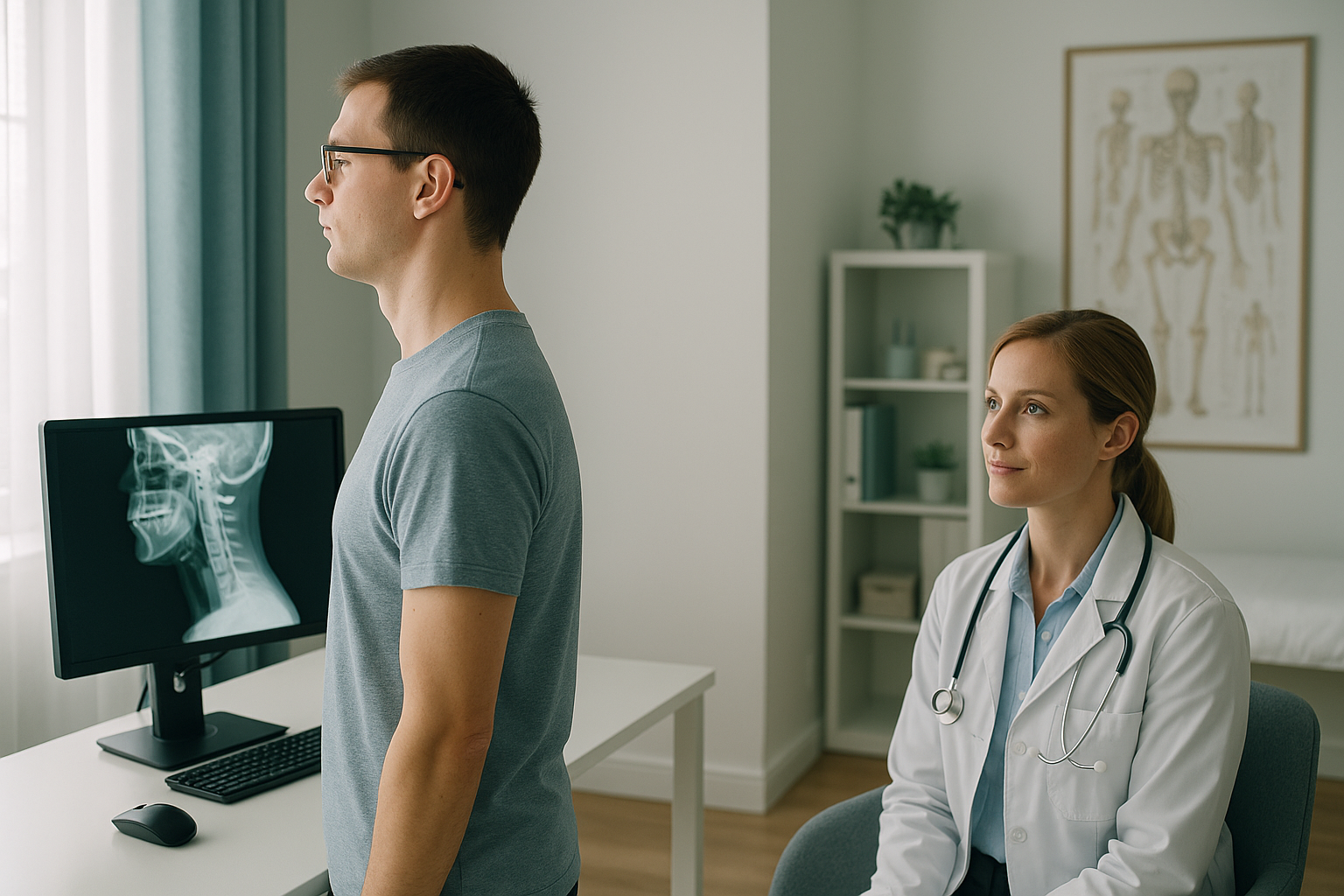
Military neck describes a neck spine that has lost its natural lordotic curve. Normally, the seven vertebrae in your neck form a gentle inward arc. This curve helps take the weight of your head and lets your neck move freely. Sometimes the curve flattens out. In more marked cases it tips slightly the wrong way, which is sometimes called a reversed cervical curve or cervical kyphosis. Reports may then use the words "straightening of the cervical spine" or "military neck."
The name comes from the upright, chin-tucked posture of a soldier on parade. It sounds serious, but the label only describes. It is not a diagnosis. It tells you the shape of the curve, not the cause or what it means for you.
What are the signs of military neck?
Some people notice symptoms. Others only find out about a loss of cervical lordosis when they have a scan for a completely different reason. The most common things people report are:
A feeling that movement is limited when you turn or tilt your head, especially first thing in the morning.
A dull pain at the base of the neck or across the upper back after sitting or working at a screen.
Tension-type headaches that start at the back of the head, sometimes linked to forward head posture.
Plenty of people with a straight neck spine feel fine. A finding on a report does not automatically mean there is a problem.
What causes a loss of cervical lordosis?
There is rarely just one cause. A straightened neck spine usually comes from a mix of factors. Some are structural and some are muscular. Some are simply about how you were positioned when the image was taken.
Hours of screen work or phone use can encourage a forward head position. Over time, this can slowly flatten the neck curve.
When neck muscles go into spasm, they can pull the spine straighter than normal. This is temporary, but it shows up clearly on a scan.
A whiplash injury can change the neck's resting curve, sometimes for good. The straightening may show up on a scan years later.
As discs lose height with age, the spacing and curve of the neck spine can shift. This is common and not always painful.
Some people naturally have less curve in the neck. Research shows a wide range of "normal" across the population.
This point is important. A report that mentions straightening of the cervical spine is describing a shape, not necessarily a disease. How you feel, how you move and how your whole spine is aligned all matter just as much as the curve itself.
Why does a standing scan show military neck more accurately?
A standing, weight-bearing image shows your neck the way it really works: upright, holding up the weight of your head, with the muscles active. This matters because most routine scans are done lying down.
Weight-bearing EOS imaging captures your neck spine while you stand naturally. Gravity, muscle tone and posture habits all affect the curve. If your neck straightens because of how you hold yourself during the day, a standing image will show it. It also captures the rest of your spine in the same image. This lets a clinician see whether cervical tilt or changes lower down are adding to the loss of curve. The EOS system uses about 90% less radiation than a standard X-ray, around ten times less.
Lying-down imaging (standard X-ray, CT, MRI) relaxes the muscles around your spine. That relaxation can change the shape of the neck curve for a while. Muscle spasm may ease when you lie flat, so the neck looks more normal than it feels during the day. On the other hand, the position of your head on a pillow or table can flatten the curve artificially. This can make a normal neck look too straight. Positioning during the scan is one of the most common reasons for a "loss of lordosis" finding.
Your body is a connected chain from your feet to your head. A problem at one level can make another area compensate. A flattened curve in the upper back, a shift in the pelvis or even a difference in leg length can change how your neck sits. ScanAlign standing EOS imaging captures the full picture in a single upright image, so these compensation patterns can be seen rather than staying hidden.
Wondering whether your military neck finding tells the full story? A standing scan shows how your neck is really aligned.
Book a free video consultationCan military neck be improved?
That depends on what is causing it and whether it is really causing symptoms. ScanAlign is a diagnostic imaging clinic, not a treatment provider, so we cannot prescribe a plan of treatment. What we can say is that understanding your alignment accurately is the first step.
If muscle tension or habitual posture is the main driver, many clinicians recommend targeted exercises, changes to your work setup and physiotherapy to encourage the curve back. If degenerative changes are the cause, the approach may be different. And if the finding turns out to be positional, meaning it showed up on a lying-down scan but is not there when you stand, you may not need any treatment at all.
A detailed standing alignment assessment gives you and your clinician the information to make that decision with confidence, rather than guessing.
So before you start a treatment, or change the one you are on, it is worth getting a detailed diagnosis first. Knowing whether the cause sits in your pelvis, your legs or your spine changes what will actually help.
When MRI is the better tool. EOS imaging shows bones, joints and alignment clearly. If your clinician suspects a disc bulge, a pressed nerve or a soft-tissue problem in the neck, MRI is usually the more suitable test. The two work together rather than competing.
Frequently asked questions about military neck
Yes. Military neck is the everyday term for a loss of cervical lordosis. Both describe a neck spine that has lost its normal inward curve and looks straight or slightly reversed on a scan.
It can. When the neck curve flattens, the muscles at the base of the skull may work harder to hold up the head. This extra strain can trigger tension-type headaches, especially when it comes with forward head posture.
Not necessarily. A neck can look straight because of muscle spasm at the time of the scan, the way your head was positioned, or simply normal variation. Many people without symptoms have a reduced neck curve with no problems at all.
A straightened neck has lost its curve and looks flat. Cervical kyphosis goes a step further. The curve has reversed, so the neck bends slightly outward instead of inward. Kyphosis is less common and generally needs closer medical attention.
Yes. A whiplash injury can damage the ligaments and muscles that keep the neck curve in place. This may lead to straightening that lasts long after the first injury has healed. It is one of the most often studied links in the research.
No. ScanAlign accepts self-referrals. You can book a standing neck and spine scan directly. If you prefer, your doctor, physiotherapist or consultant can also refer you.
An EOS scan uses about 90% less radiation than a standard X-ray, around ten times less. This makes it a very low-dose option for full standing alignment imaging.
EOS imaging shows bones, joints and overall alignment. It does not directly show soft tissues like discs or nerves. If a disc problem is suspected, MRI is usually the better test. The two scans work well together.
For patients travelling from abroad, the price is confirmed during the free video consultation.
If the straightening is mainly driven by muscle tension and habitual posture, targeted exercises and physiotherapy may help bring back some of the curve. The evidence varies depending on the underlying cause. Accurate imaging helps your clinician decide the best approach for you.
See your neck alignment as it really is
A free video consultation lets you talk through your findings and decide whether a standing scan at our London clinic is the right next step. No obligation, no pressure.
Book a free video consultationWritten by Abbas Dhami (Specialist Diagnostic Radiographer)
Sources
- Gore DR, Sepic SB, Gardner GM. Roentgenographic findings of the cervical spine in asymptomatic people. Spine. 1986;11(6):521-524.
- NHS. Whiplash. nhs.uk. Available at: https://www.nhs.uk/conditions/whiplash/
- Harrison DD, Harrison DE, Janik TJ et al. Modeling of the sagittal cervical spine as a method to discriminate hypolordosis. Spine. 2004;29(22):2485-2492.
This page is general information and not a diagnosis.
ScanAlign is the trading name of CoreMed Solutions Ltd and operates under The Harley Street Hospital's CQC licence.