

How Do You Avoid Injury While Training for a Marathon?
Most marathon training injuries happen because of sudden jumps in distance, too little recovery, or hidden alignment problems that force one part of the body to make up for another. Managing your training load, planning recovery weeks and understanding your own biomechanics are the most effective ways to stay healthy through a training block.
Key takeaways
- Sudden jumps in weekly distance are the single biggest risk factor for marathon training injury.
- A niggle that changes how you run is not something to push through.
- Alignment issues in the hip, pelvis or leg can cause pain far from the actual problem.
- A standing, weight-bearing scan shows how your skeleton takes load under gravity, which lying-down imaging cannot.
- Strength work and planned recovery weeks are as important as the running itself.
Training for a marathon is one of the hardest things you can ask your body to do. Over a typical 16 to 20 week plan, your bones, joints, muscles and tendons absorb millions of repeated impacts. Most runners who get injured during marathon training are not unlucky. They are usually under-recovered, increasing too fast, or running with an alignment problem they do not know about.
What are the most common marathon training injuries?
The injuries that stop marathon runners most often are overuse injuries, not sudden tears or sprains. They build slowly. They start as mild discomfort and then become pain that disturbs your running gait.
Pain around or behind the kneecap, often worse when running downhill or after sitting for a long time.
Aching along the front of the shin that can progress to a stress fracture if ignored.
Sharp pain on the outside of the knee, usually starting at the same point in a run. Read more about IT band syndrome.
Stiffness and pain at the back of the ankle, worst first thing in the morning or at the start of a run.
A stabbing pain under the heel, especially with the first steps of the day.
Why do marathon runners get injured during training?
The short answer is too much load, too little recovery, or a biomechanical weakness the body has been making up for. Often it is a mix of all three.
Increasing weekly volume by more than about ten percent is the most consistently identified risk factor for bone stress injuries in runners.
Skipping easy days or recovery weeks means tissue never fully adapts. Fatigue builds up until something breaks down.
A leg-length difference, pelvic tilt or rotational imbalance may go unnoticed in daily life, but it creates overload that adds up across thousands of strides.
Running alone does not build the hip, glute and calf strength needed to control each landing. Weakness shows up as injury.
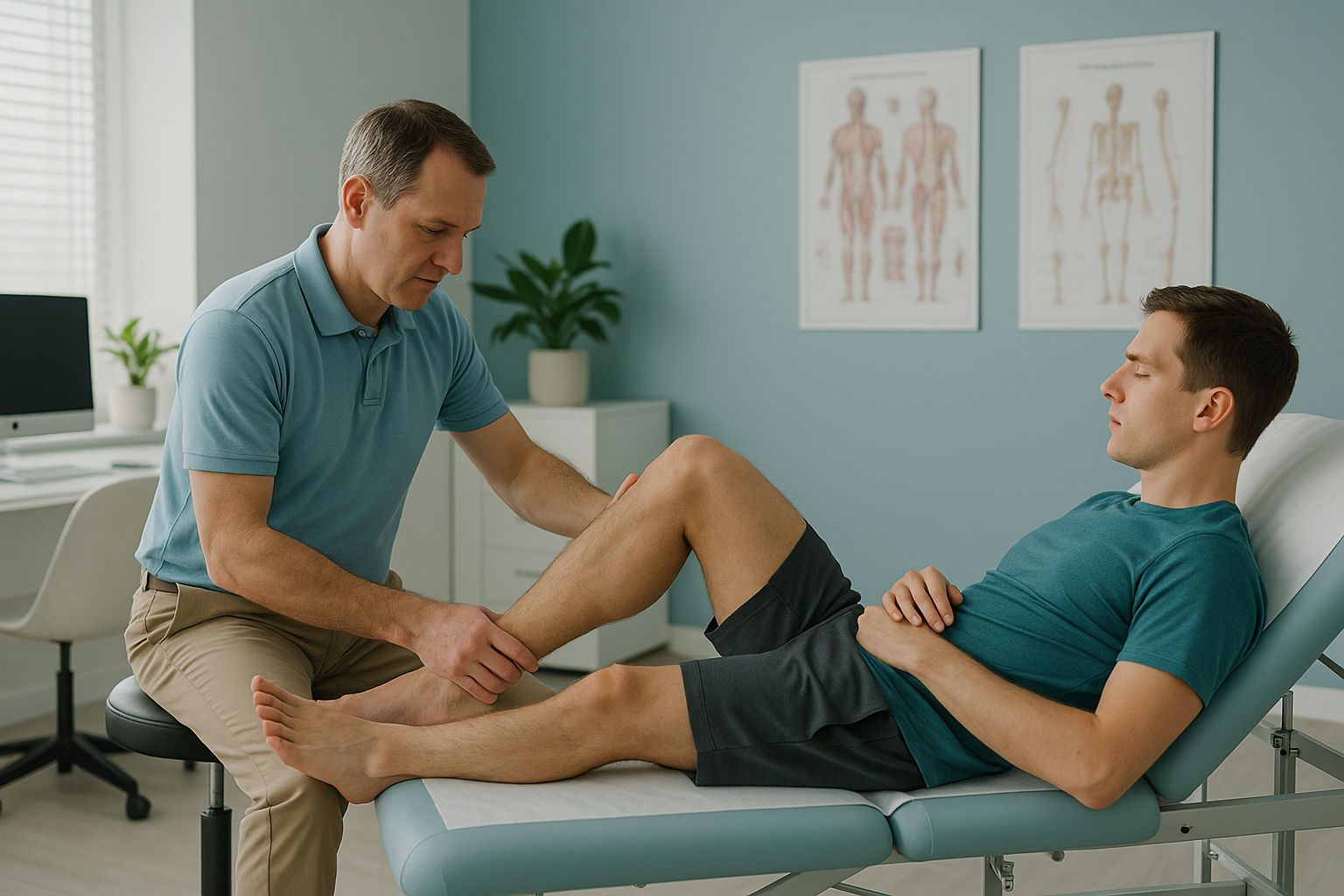
Your body is a connected chain. A tilt at the pelvis or a difference in leg length can shift load to the opposite knee or ankle, far away from the real cause.
Should I run through pain during marathon training?
Not if the pain changes the way you run. A mild ache that is the same on both sides, warms up within the first ten minutes and does not get worse is usually a niggle your body can manage. But pain that makes you limp, shifts your weight to one side, gets worse as you run, or is still there the next morning is your body telling you to stop and find out what is wrong.
- Mild stiffness that eases after warming up
- Affects both sides equally
- No worse the day after a run
- Does not change your running form
- Sharp or localised pain at one specific spot
- Limping or changing your gait to avoid pain
- Getting worse during or after every run
- Swelling, tenderness or pain at rest
Urgent warning. If you have sudden numbness or weakness in a leg, or loss of bladder or bowel control, seek urgent medical attention. Contact your doctor or go to your nearest emergency department. Do not book a scan as your next step.
During the taper, the last two or three weeks before race day, small aches can feel bigger because you are running less and paying more attention to your body. A real injury during the taper is rare. If something new and sharp appears during the taper, get it checked rather than hoping it will settle by race morning.
What helps prevent marathon training injuries?
There is no single magic fix, but runners who stay healthy tend to follow the same set of principles. For a wider look at reducing risk in all activities, see our guide to sports injury prevention.
Increase your total weekly distance by no more than about ten percent per week. Plan a recovery week every three to four weeks, where you run less.
Two short sessions a week focusing on hips, glutes, calves and single-leg stability can substantially reduce injury risk.
Using two or more pairs of running shoes changes how forces spread through your feet and legs. This reduces repeated strain on the same tissues.
Bone and tendon repair happens while you sleep. Enough protein and calcium support the tissue remodelling that training demands.
How does whole-body alignment affect marathon injury risk?
Your skeleton absorbs every footstrike. If your pelvis is tilted, one leg works as if it is shorter than the other, or your hips rotate unevenly, your body compensates. Over a few kilometres, these compensations are harmless. Over hundreds of kilometres of marathon training, they can overload a tendon, joint or bone on one side.
The problem is that standard imaging, such as an X-ray or MRI taken while you lie down, relaxes the muscles and takes gravity out of the picture. It can miss the alignment issues that only appear when you are standing and bearing weight, the position you actually run in.
An EOS scan captures your full skeleton, from head to feet, in one image while you stand naturally. It shows how your joints, spine, pelvis and legs actually line up under your own body weight. This is exactly the loading pattern your body goes through when running. The scan uses about 90% less radiation than a standard X-ray, around ten times less.
A conventional X-ray, CT or MRI is taken while you lie flat. Gravity is removed. Muscles relax. A pelvic tilt or functional leg-length difference may flatten out and look normal on the image, even though it creates real asymmetry when you stand and run.
ScanAlign standing EOS imaging captures a full weight-bearing picture of your alignment from ankles to spine in a single scan. The detailed report can show your physiotherapist, coach or orthopaedic specialist exactly where any asymmetry lies, so any corrective work is targeted rather than guesswork.
When MRI is the better tool. EOS shows bones, joints and alignment. If your clinician suspects a soft-tissue problem such as a cartilage tear, disc issue or nerve compression, MRI is usually more suitable. The two types of imaging answer different questions, and your free consultation can help you decide which one you need.
Before you start treatment, or change the one you are on, it is worth getting a detailed diagnosis. Knowing whether the cause sits in your pelvis, your legs or your spine changes what will actually help.
Injured during marathon training and not sure why? A free video consultation, from wherever you are, can help you work out whether a standing alignment scan in London is the right next step.
Book a free video consultationFrequently asked questions
A niggle is mild, warms up quickly and does not change the way you run. An injury tends to be sharp and localised, and either stays the same or gets worse during a run. If you are limping or changing your form to avoid pain, treat it as an injury and get it assessed.
Minor aches during the taper are common and are often just greater awareness of your body. However, a new, sharp or worsening pain during the taper is not normal. Have it checked by a clinician before race day rather than risk a longer break from running afterwards.
It is a widely used guideline. It suggests you should not increase your total weekly running distance by more than about ten percent from one week to the next. It helps your bones and tendons adapt gradually rather than being overloaded by sudden jumps in distance.
Yes. A leg-length difference, pelvic tilt or rotational imbalance shifts load unevenly across your joints with every stride. With high training volumes, this asymmetry can overload a knee, shin or hip on one side. This causes an injury that feels random but has a structural explanation.
An EOS scan images your whole body while you stand, capturing your natural alignment under gravity. It uses about 90% less radiation than a standard X-ray, around ten times less. A conventional X-ray usually covers only one body area and is often taken lying down, which can hide weight-bearing alignment issues.
No. ScanAlign is a self-referral clinic. You can book a runner's alignment scan directly through a free video consultation, without needing a referral letter from your doctor.
Research consistently shows that runners who do regular strength work, especially for the hips, glutes and calves, have a lower rate of overuse injuries. Two short sessions a week is enough to make a meaningful difference.
The price for patients travelling from abroad is confirmed during the free video consultation, and you can see what the scan includes on the ScanAlign FAQs and cost page.
It is particularly useful for recurring or one-sided problems such as runner's knee, IT band pain, shin splints and hip pain. These often have an underlying alignment component that only shows up in a full weight-bearing image.
Yes. The radiation dose is about 90% less than a standard X-ray, around ten times less. This makes it one of the lowest-dose skeletal imaging options available. Full safety details are on the FAQs page.
Training for a marathon and something is not right?
A free video consultation takes a few minutes. It helps you understand whether a standing alignment scan could explain what is going on, before you plan a trip to London.
Book a free video consultationSources
- Nielsen, R.O. et al. "A prospective study on time to recovery in 254 injured novice runners." PLoS ONE, 2014; 9(6): e99877. (Training-load progression and injury risk.)
- Lauersen, J.B. et al. "The effectiveness of exercise interventions to prevent sports injuries: a systematic review and meta-analysis." British Journal of Sports Medicine, 2014; 48(11): 871-877. (Strength training and injury prevention.)
- NHS. "Common running injuries and how to avoid them." nhs.uk. (General guidance on overuse injuries in runners.)
Written by Abbas Dhami (Specialist Diagnostic Radiographer)
This page is general information and not a diagnosis.
ScanAlign is the trading name of CoreMed Solutions Ltd and operates under The Harley Street Hospital's CQC licence.