
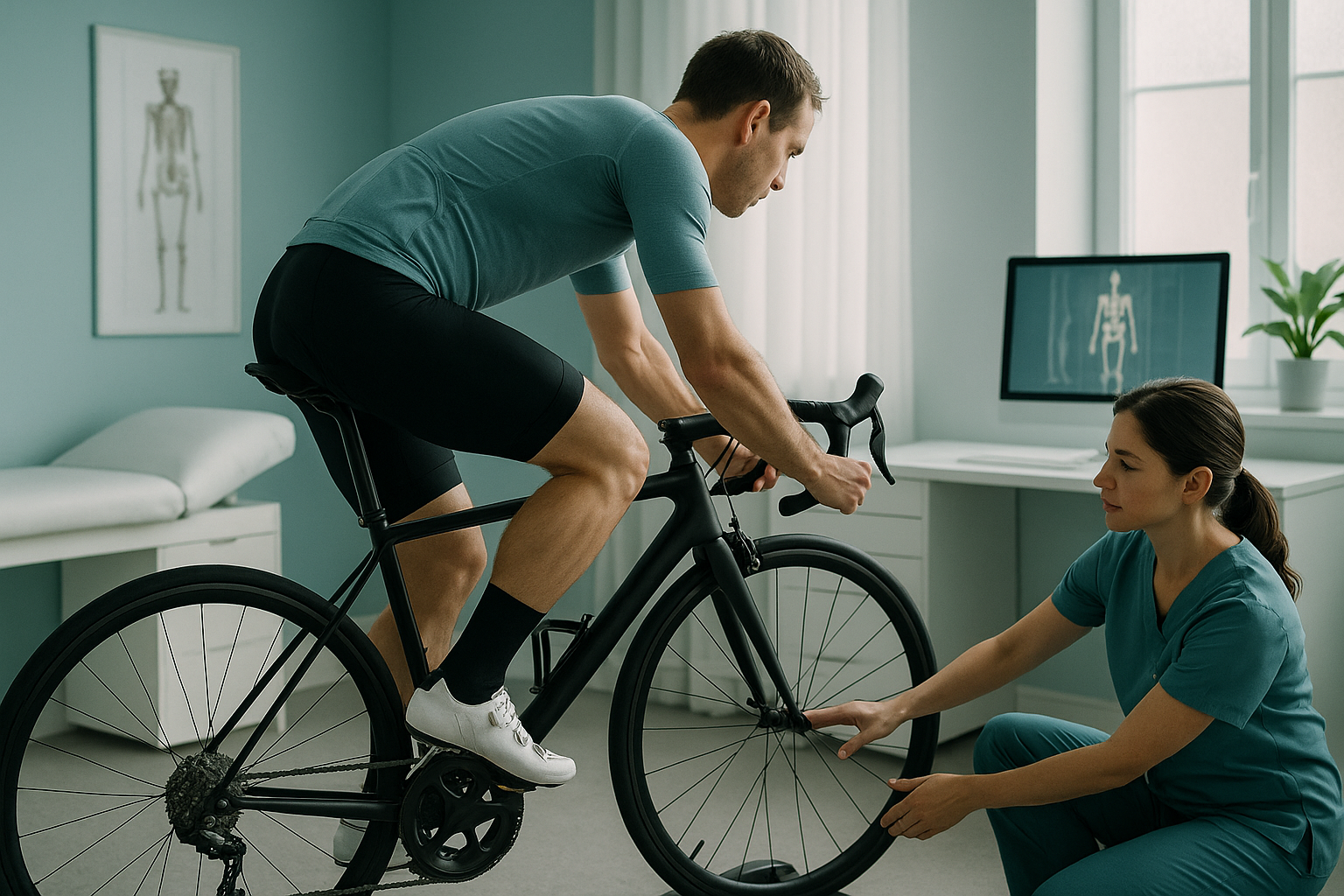
How Do Leg Length and Pelvic Position Affect Your Bike Fit?
A difference in leg length, even a small one, changes your saddle height, how your knee tracks and how evenly you pedal. If one leg is shorter, your pelvis rocks to make up for it. This shifts the balance of power between your legs and often causes pain. Measuring your bone length accurately while you stand gives bike fitters the data they need to set up your bike correctly.
Key takeaways
- Even a small leg length discrepancy can change saddle height, knee tracking and power balance.
- Pelvic rotation on the bike is often the body making up for unequal leg lengths. It is not a flexibility problem.
- Tape-measure and lying-down methods can miss true differences in bone length.
- A standing whole-body EOS scan measures femur and tibia lengths accurately. This gives your bike fitter reliable numbers.
- EOS uses about 90% less radiation than a standard X-ray, around ten times less.
Why does leg length matter for cycling?
On the bike, your legs are your engine. If one femur or tibia is even slightly shorter than the other, each pedal stroke follows a different arc. The shorter leg over-reaches at the bottom of the stroke and does not extend fully at the top. Over hundreds of turns of the pedals on every ride, that difference adds up.
Your body is smart. It makes up for the difference on its own, usually by tilting the pelvis, dropping one hip or shifting your weight to one side. That may keep you pedalling, but it also puts uneven load through your knees, hips and lower back. Many cyclists with persistent knee pain on one side, or lower-back stiffness after rides, are in fact feeling the knock-on effect of a leg length difference they do not know they have.
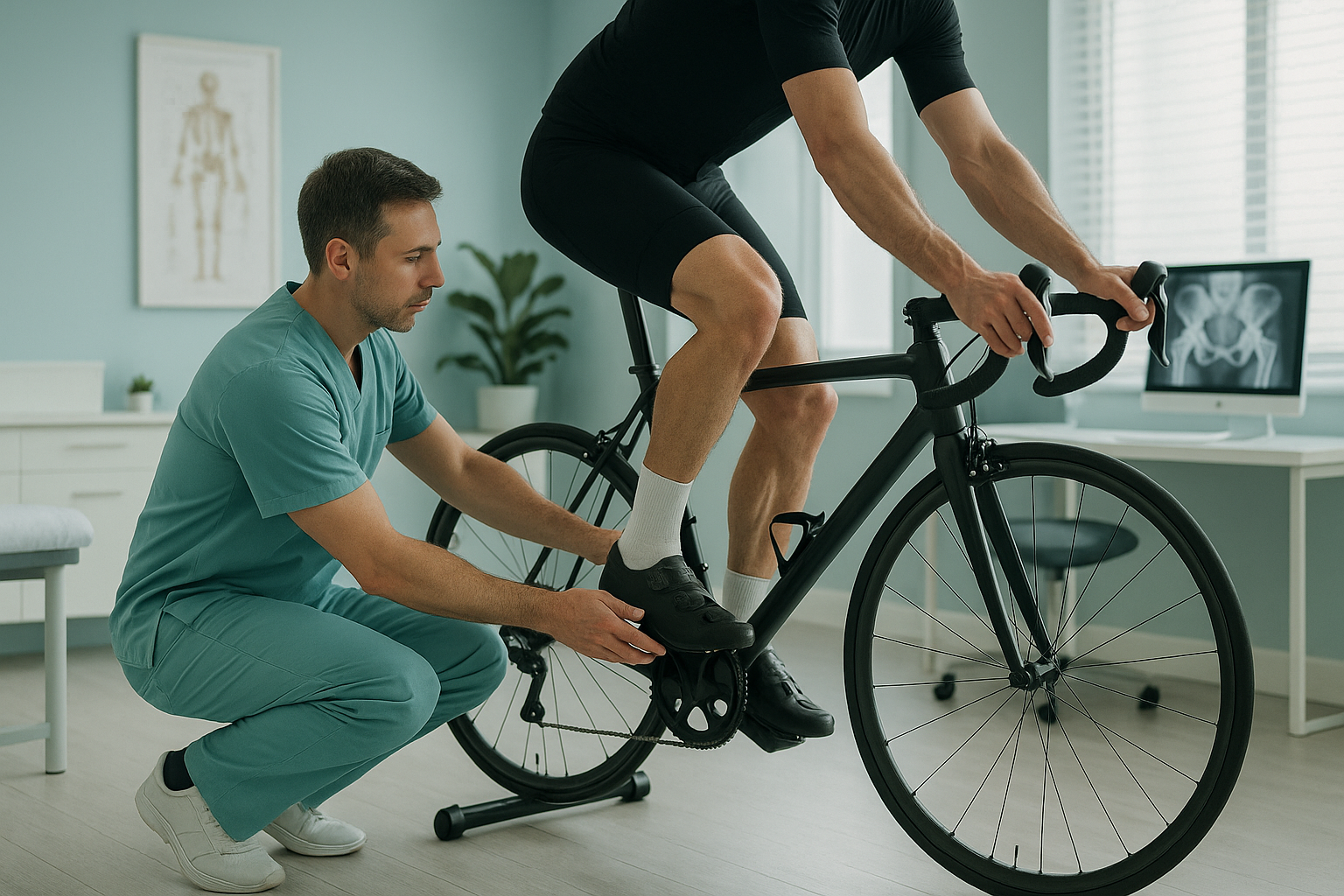
What are the signs of a leg length problem on the bike?
You may notice one or more of these patterns during or after rides. Each one on its own can have other causes. But when several appear together, it is worth checking for a difference in leg length or pelvic position.
Pain on the inside or outside of one knee that does not get better with the usual bike fit adjustments.
Uneven pressure on the sit bones, or a feeling that you are always sliding to one side of the saddle.
Your hips clearly rock from side to side at the bottom of each stroke. This can sometimes be seen from behind.
One leg always produces more watts than the other. You can see this on dual-sided power meters.
Lower-back pain after longer rides, Achilles irritation on one side, or repeated cleat wear on one shoe are also common patterns.
How does pelvic rotation affect your position on the bike?
Pelvic rotation on the bike is rarely just a flexibility problem. When one leg is functionally or structurally shorter, the pelvis tips to that side so the shorter leg can reach the pedal. This is called a lateral pelvic tilt. It shows up clearly when you stand, but it can be hidden when you lie down for a standard assessment.
On the bike, that tilt does three things. First, it shifts where your sit bones touch the saddle, which causes saddle discomfort. Second, it changes how both knees track, sometimes leading to patellofemoral pain syndrome. Third, it rotates the lower spine under load, which is a common source of back pain linked to cycling.
Many bike fitters can spot an uneven pelvis. But they often lack a precise, full-length bone measurement to confirm whether the cause is structural (a true difference in bone length) or functional (muscle tightness, habit, or joint restriction). That difference matters because the fix is different for each.
How is leg length measured accurately for bike fitting?
There are several methods, and some are more precise than others. The most common ones used by bike fitters are tape-measure comparisons (from the hip to the ankle bone) and saddle-height formulas based on inseam. These are a useful starting point. But they measure the distance from skin to skin, not the actual length of the bone. Soft tissue, muscle bulk and pelvic position can all change the number.
Standing EOS scan. You stand naturally in front of the scanner. It captures your whole skeleton, from head to toe, in a single upright image. This means the femur, tibia and pelvis are all measured under normal weight-bearing load. It shows your real-world alignment, the same conditions your body works in on the bike. The radiation dose is about 90% less than a standard X-ray, around ten times less.
Lying-down X-ray, CT or MRI. When you lie flat, gravity no longer pulls on your joints and your muscles relax. Any tilt in the pelvis that your body uses to make up for a difference can flatten out. A real difference can then look smaller, or disappear, on the image. That is why a lying-down scan sometimes shows "equal" legs even when a standing assessment does not.
For cycling, what matters is how your skeleton behaves under load. That is why ScanAlign standing EOS imaging gives bike fitters data they can act on with confidence.
What can a bike fitter do with accurate bone-length data?
When a qualified bike fitter knows the true length of each femur and tibia, and the position of the pelvis, they can make targeted changes instead of guessing.
Set precisely for the true reach of each leg, not an average of both.
A shim under the cleat of the shorter leg can level the pelvis and balance the stroke.
Different crank arms can make up for a significant difference without using shims.
ScanAlign does not do bike fits. We provide the diagnostic imaging that gives your fitter precise, objective measurements. You can share the report directly with any fitter or physiotherapist, wherever they are.
Before you start a new treatment, or change the one you are on, it is worth getting a detailed diagnosis first. Knowing whether the cause sits in your pelvis, your legs or your spine changes what will actually help.
Want to know your true bone lengths before your next bike fit? Get measured standing up.
Book a free video consultationWhen MRI is the better choice. EOS shows bones, joints and alignment clearly. If your fitter or physiotherapist suspects a soft-tissue injury, such as a meniscus tear, tendon damage or a disc problem in the lower back, MRI is usually the better tool for that. The two types of imaging answer different questions and work well together.
Frequently asked questions
Yes. Even a few millimetres of difference changes the angle at which your knee tracks over the pedal. Over thousands of repeats on every ride, that changed tracking can irritate the kneecap or the structures around it.
A video taken from behind during a fit session often shows hip rocking. Uneven saddle wear, numbness on one side, or a dual-sided power meter showing a persistent left-right imbalance are also clues. A standing whole-body scan can confirm whether the tilt has a structural cause.
When you lie down, gravity no longer loads your joints and your muscles relax. A real pelvic tilt or alignment difference can flatten out. Standing imaging captures your skeleton under normal weight-bearing conditions, which is closer to how your body works on the bike.
EOS uses about 90% less radiation than a standard X-ray, around ten times less. The scan takes seconds and you simply stand still in front of the scanner.
No. ScanAlign is a private self-pay clinic. You can refer yourself. You start with a free video consultation to confirm the scan is right for you.
The price for patients travelling from abroad is confirmed during the free video consultation, which you can arrange on the booking page.
Yes. The report includes precise bone-length measurements and alignment data that any qualified bike fitter, physiotherapist or orthopaedic specialist can use straight away.
A shim can help balance smaller differences. Larger differences may need a mix of approaches, such as different crank lengths or saddle adjustments. The right approach depends on accurate measurement first.
A structural difference means one bone is truly shorter. A functional difference means the bones are the same length, but muscle tightness, joint restriction or pelvic tilt makes one side behave as if it is shorter. Standing imaging helps identify which type you have.
Metal implants are generally fine for EOS imaging. Mention any implants during your free video consultation so the radiographer can plan for them.
Get measured before your next bike fit
A free video consultation takes a few minutes, and you can join from home. We will tell you whether a standing scan in London is the right next step for your cycling problem.
Book a free video consultationWritten by Abbas Dhami (Specialist Diagnostic Radiographer)
Sources
- Knutson, G.A. "Anatomic and functional leg-length inequality: a review and recommendation for clinical decision-making." Chiropractic & Osteopathy, 2005; 13:11.
- Deschênes, S. et al. "Diagnostic imaging of spinal deformities: reducing patients' radiation dose with a new slot-scanning X-ray imager." Spine, 2010; 35(9): 989-994.
- British Medical Journal Best Practice. "Assessment of leg length discrepancy." BMJ, 2023.
This page is general information and not a diagnosis.
ScanAlign is the trading name of CoreMed Solutions Ltd and operates under The Harley Street Hospital's CQC licence.