
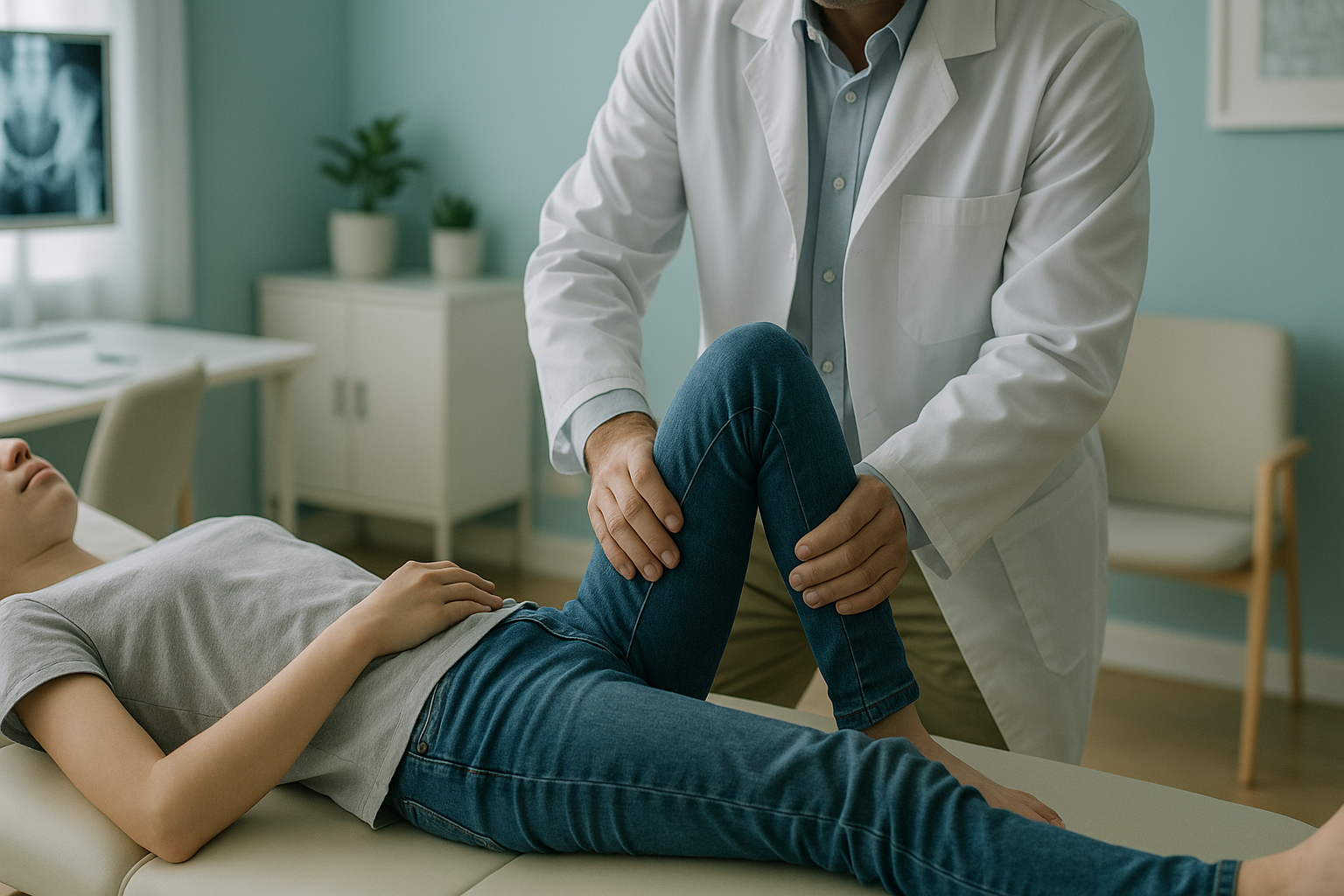
What Causes Hip Pain in Teenagers?
Hip pain in teenagers is commonly caused by growth-plate conditions such as slipped upper femoral epiphysis (SUFE) and Perthes disease, or by sports overuse injuries. Some of these are urgent. A teenager with sudden hip, groin or knee pain and a limp should be checked quickly, because SUFE can need emergency surgery if the growth plate slips further.
Key points
- SUFE is a surgical emergency. It often shows up as knee pain, not hip pain, so it is easily missed.
- Growth-plate problems, sports overuse and structural conditions like hip impingement (FAI) are the most common causes.
- A teenager who suddenly cannot put weight on one leg needs urgent medical attention, not a routine appointment.
- Standing, weight-bearing imaging can show alignment problems that a lying-down scan may miss.
- EOS imaging uses about 90% less radiation than a standard X-ray, around ten times less.
When is hip pain in a teenager an emergency?
Any teenager who suddenly develops a painful limp, cannot put weight on the leg, or has groin, hip or knee pain that came on quickly needs to be seen urgently. Do not wait for a routine appointment.
Seek urgent medical help (your doctor, or the nearest emergency department) if your teenager has:
- Sudden hip, groin or knee pain and cannot walk or put weight on the leg
- A leg that seems to turn outward and looks shorter than the other
- Fever together with hip or groin pain (may suggest infection)
- Numbness, weakness, or loss of bladder or bowel control
SUFE (slipped upper femoral epiphysis) is the most important condition to rule out. The top of the thigh bone slips at the growth plate. It is most common in teenagers aged 10 to 16 and happens more often in those who carry extra weight. Importantly, SUFE often shows up as knee pain rather than hip pain. This means it can be mistaken for a simple knee injury. If SUFE is not treated quickly, the slip can get worse and permanently damage the hip joint.
What are the main causes of hip pain in teenagers?
The main causes fall into three groups: growth-plate conditions, sports overuse, and structural problems in the hip joint itself.
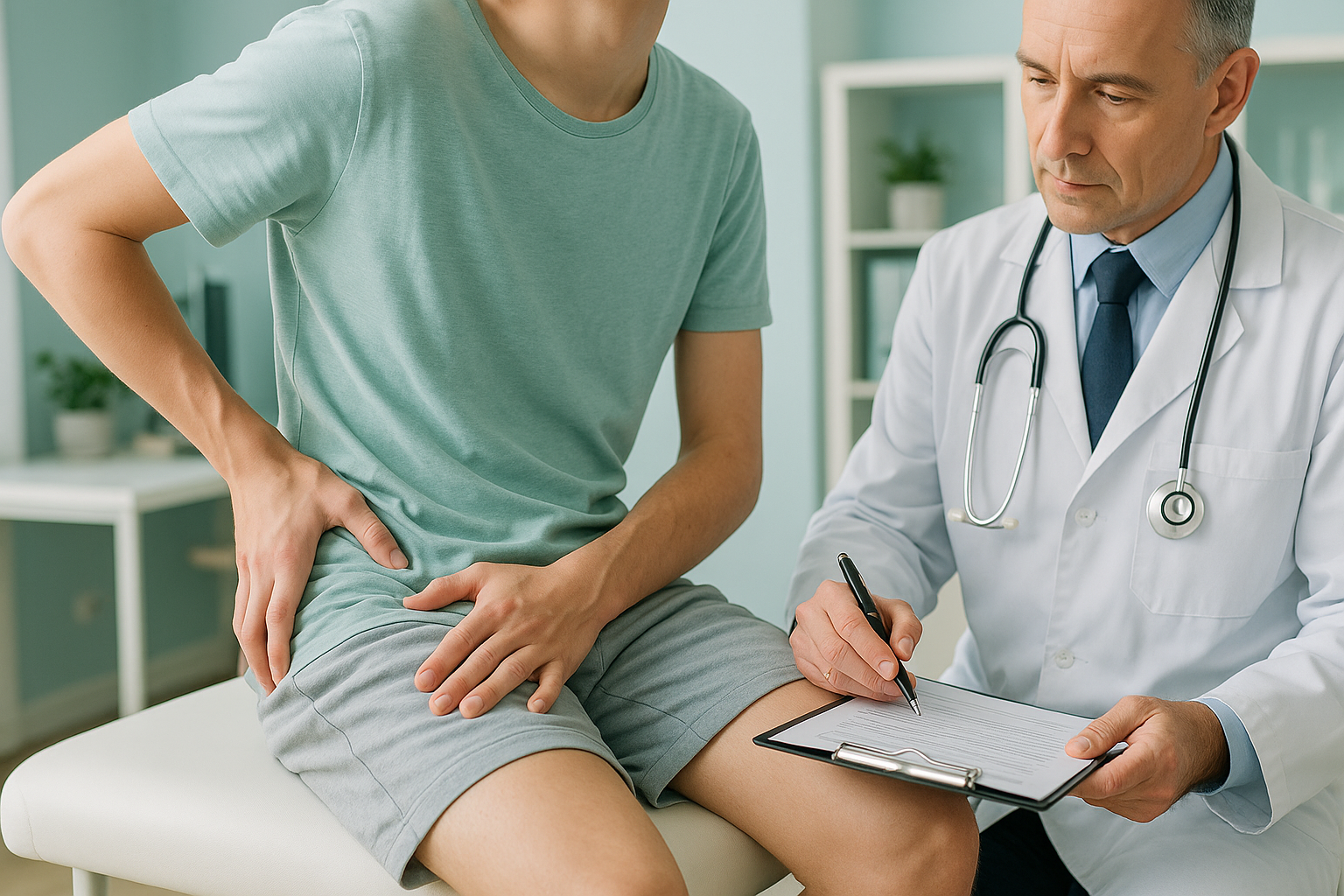
The femoral head slips at the growth plate. More common in overweight teenagers. Often shows up as knee or groin pain.
Blood supply to the femoral head is temporarily disrupted. Usually affects younger children but can appear in the early teens.
Repeated training can put stress on the hip flexors, apophyses (muscle attachment points on growing bone) or labrum.
Extra bone at the rim of the hip socket can pinch the labrum (cartilage ring), causing groin pain during sport.
Other, less common causes include stress fractures, hip joint infection and inflammatory conditions. Your teenager's doctor or specialist can help narrow these down.
What are the signs of a serious hip problem in a teenager?
The signs depend on the cause, but some patterns are worth knowing. A limp that appears slowly or suddenly is always worth checking.
Walking with a limp, especially after sport, is the most common early sign parents notice.
Hip conditions, especially SUFE, commonly cause pain at the knee rather than the hip. This often delays diagnosis.
Pain deep in the groin while running, kicking or squatting can point to a labral tear or FAI.
Difficulty turning the hip inward is a classic clinical finding in SUFE and FAI. A clinician usually checks this during the examination.
Obesity is a known risk factor for SUFE. If a teenager who carries extra weight develops hip, groin or knee pain and a limp, SUFE should be considered promptly.
How is hip pain in teenagers checked with imaging?
Standard X-rays are usually the first step and can find many growth-plate problems. But most X-rays and MRI scans are taken lying down. This relaxes the muscles and removes the effect of body weight on the joints. It can hide alignment problems that only appear when standing.
The body is a connected chain from feet to head. A tilt in the pelvis or a difference in leg length can change the load through the hip, and the pain may show up in a completely different area. Standing, weight-bearing imaging captures the skeleton under real-life load, so alignment problems become visible.
EOS imaging takes a full standing image of the skeleton from head to feet in a single scan. It uses about 90% less radiation than a standard X-ray, around ten times less. For growing teenagers, keeping radiation as low as possible matters. Imaging for children and teenagers at ScanAlign follows this low-dose approach.
When is MRI the better choice? EOS shows bones, joints and alignment clearly. For soft tissue, discs or nerves, MRI is usually the better tool. If your teenager's specialist suspects a labral tear or cartilage damage, they may recommend MRI alongside or instead of X-ray-based imaging.
Not sure which type of imaging your teenager needs? Our radiographer can advise you during a free video call, before you plan any travel to London.
Book a free video consultationWhat should you do if your teenager has hip pain?
The right response depends entirely on the symptoms. Here is a practical guide.
- See your doctor promptly, especially if there is a limp
- Cut back on sport until a cause is found
- Keep a note of when the pain happens and what makes it worse
- Ask your doctor about imaging if symptoms last beyond a couple of weeks
- Your teenager cannot put weight on the leg
- Pain came on suddenly and is severe
- The leg seems to turn outward or looks shorter
- There is a fever along with hip or knee pain
ScanAlign is a diagnostic imaging clinic. It provides the imaging that helps specialists find the problem. It does not provide treatment. Once there is a clear picture of your teenager's alignment and anatomy, their clinician can plan the right next step.
With low-dose standing imaging at ScanAlign, the scan captures the full skeleton standing up, so your teenager's specialist gets a complete view of alignment under real body weight.
Before your teenager starts treatment, or changes the one they are on, it is worth getting a detailed diagnosis. Knowing whether the cause sits in the pelvis, the legs or the spine changes what will actually help.
Frequently asked questions about hip pain in teenagers
SUFE (slipped upper femoral epiphysis) is a condition where the ball at the top of the thigh bone slips at the growth plate. It needs urgent treatment, usually surgery, to stop the slip from getting worse. It is most common in overweight teenagers aged 10 to 16.
The hip and knee share nerve pathways, so a problem in the hip joint can be felt as pain in the knee. This is called referred pain. It is especially common in SUFE and can delay diagnosis if clinicians focus only on the knee.
Sometimes, mild aches during a growth spurt are normal. But hip pain that causes a limp, stops your teenager from playing sport, or wakes them at night should always be checked by a doctor. It is better to rule out a growth-plate condition early.
Yes. Repeated training, especially in football, gymnastics and running, can cause overuse injuries to the hip flexors, apophyses, or the labrum (the cartilage ring around the hip socket). Rest, physiotherapy and sometimes imaging help guide recovery.
Perthes disease is a temporary loss of blood supply to the femoral head. It usually affects younger children (ages 4 to 10) but sometimes early teens. SUFE is a physical slip of the growth plate, more common in older, heavier teenagers. Both cause a limp and hip or groin pain, but they need different management.
Femoroacetabular impingement (FAI) happens when extra bone at the rim of the hip socket or the femoral head causes pinching during movement. It is a common cause of groin pain in active teenagers. You can learn more about hip impingement (FAI) on our dedicated page.
No. The scan is painless. Your teenager simply stands still inside the EOS machine for around 15 to 20 seconds while the image is taken. There are no injections, no contrast dye and no enclosed tunnel.
EOS uses about 90% less radiation than a standard X-ray, around ten times less. For teenagers with growing bodies, this lower dose is an important consideration.
No. ScanAlign accepts self-referrals. You can book a hip assessment for your teenager directly. A free video consultation with our radiographer is the first step, where we discuss whether a scan is appropriate.
The price for patients travelling from abroad is confirmed during the free video consultation. We are a private, self-pay clinic at 19 Harley Street, London.
Worried about your teenager's hip pain?
A free video consultation with our specialist radiographer can help you decide whether imaging is the right next step, before you plan a trip to London.
Book a free video consultationSources
- NHS. "Slipped upper femoral epiphysis." nhs.uk. Accessed 2024.
- Perry DC, Hall AJ. "The epidemiology and aetiology of Perthes disease." Orthopaedics and Trauma, 2011; 25(4): 276-283.
- Royal College of Radiologists. "iRefer guidelines: making the best use of clinical radiology." rcr.ac.uk. Accessed 2024.
Written by Abbas Dhami (Specialist Diagnostic Radiographer)
This page is general information and not a diagnosis.
ScanAlign is the trading name of CoreMed Solutions Ltd and operates under The Harley Street Hospital's CQC licence.