
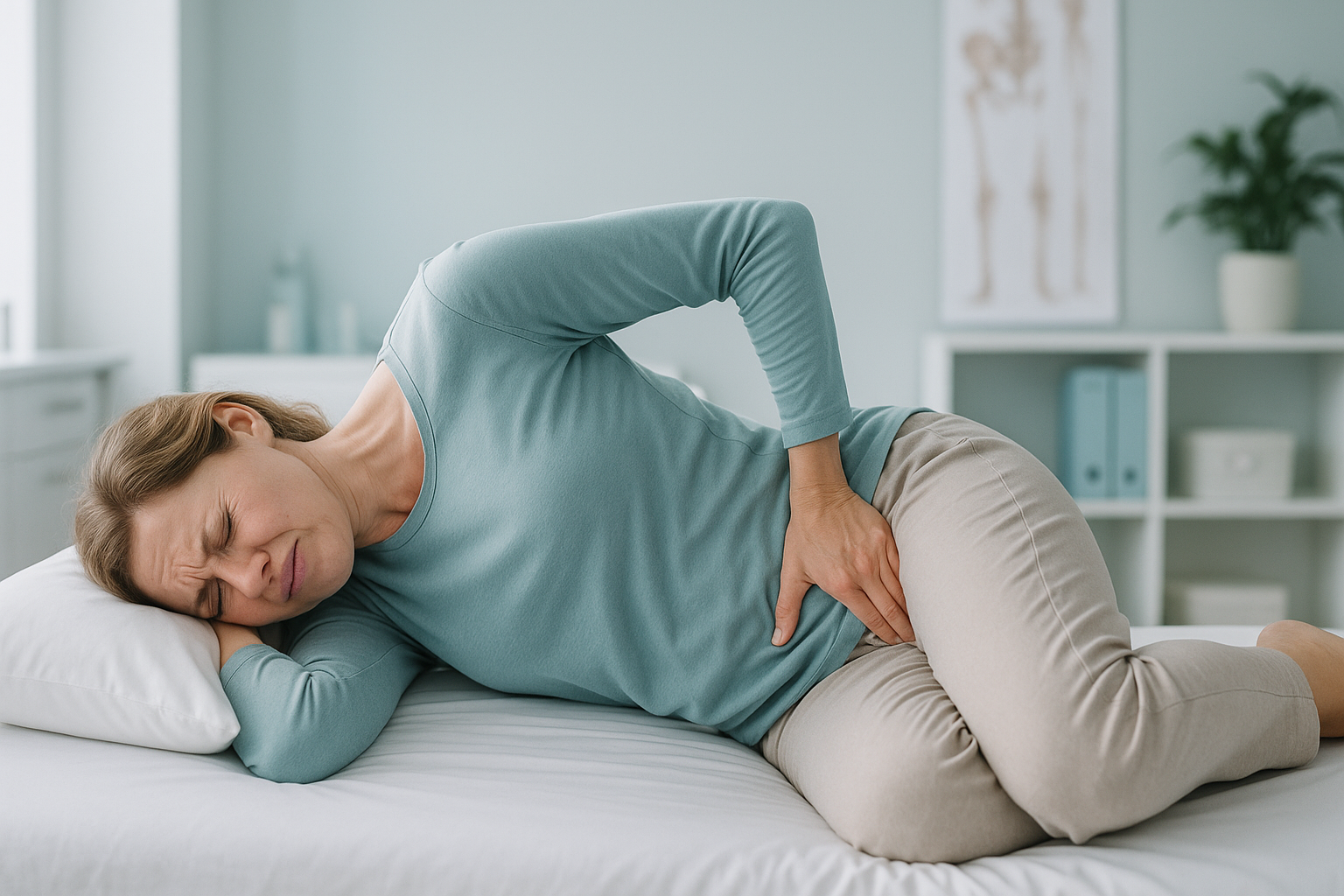
Why Does My Hip Hurt More at Night?
Hip pain at night is often caused by steady pressure on the outer hip while you lie down, especially on your side. Tendons, the bursa (a fluid-filled cushion) and the joint itself can become compressed or irritated in positions you hold for hours while you sleep. Alignment problems that stay hidden during the day may only become obvious once you stop moving.
Key points
- Sleeping on your side compresses the structures of the outer hip. It is the most common trigger for hip pain at night.
- Inflammation from conditions like arthritis tends to get worse at rest, causing stiffness and aching overnight.
- Hip pain can be referred from the lower back or pelvis, so the source is not always where you feel it.
- A standing, weight-bearing scan can show alignment problems that lying-down scans may miss.
- Sudden weakness, numbness, or loss of bladder or bowel control needs urgent medical attention, not a scan.
What causes hip pain when lying down?
Several structures around the hip can be irritated by the long, still positions you hold during sleep. The most common causes are tendon compression on the outer hip, bursa inflammation, joint wear from arthritis, and pain referred from the lower back or pelvis.
Lying on your side presses the gluteal tendons against the bony point of the hip for hours at a time.
The trochanteric bursa cushions the outer hip. Repeated pressure or friction inflames it, causing a deep ache.
Inflammatory and wear-and-tear arthritis follow a pattern: pain and stiffness increase at rest and overnight.
A problem in the lower back or pelvis can send pain into the hip area, especially when lying flat relaxes the spine.
Knowing the difference matters, because treatment depends on which structure is involved. If your hip pain and alignment have not been checked together, the real cause can be missed.
How do I know if my hip pain at night is serious?
Most hip pain at night has a mechanical or inflammatory cause and gets better with the right guidance. But some patterns need a closer look, and a few need urgent care.
Pain that pulls you out of sleep most nights may point to an inflammatory pattern or steady tendon compression.
Long-lasting stiffness after waking is a hallmark of inflammatory arthritis and is worth discussing with your doctor.
If switching sides does not help, the problem may be inside the joint itself rather than from outside pressure.
Night pain together with weight-bearing pain during the day often suggests the joint or tendons need proper imaging.
If you are not sure whether your symptoms need tests, our guide on when to see a specialist can help you decide.
Why does sleeping on my side make hip pain worse?
Side sleeping puts your body weight directly onto the bony point on the outer hip, called the greater trochanter. The tendons and bursa that sit over this bone are squeezed between it and the mattress for hours at a time. This steady compression restricts blood flow to the area and triggers pain.
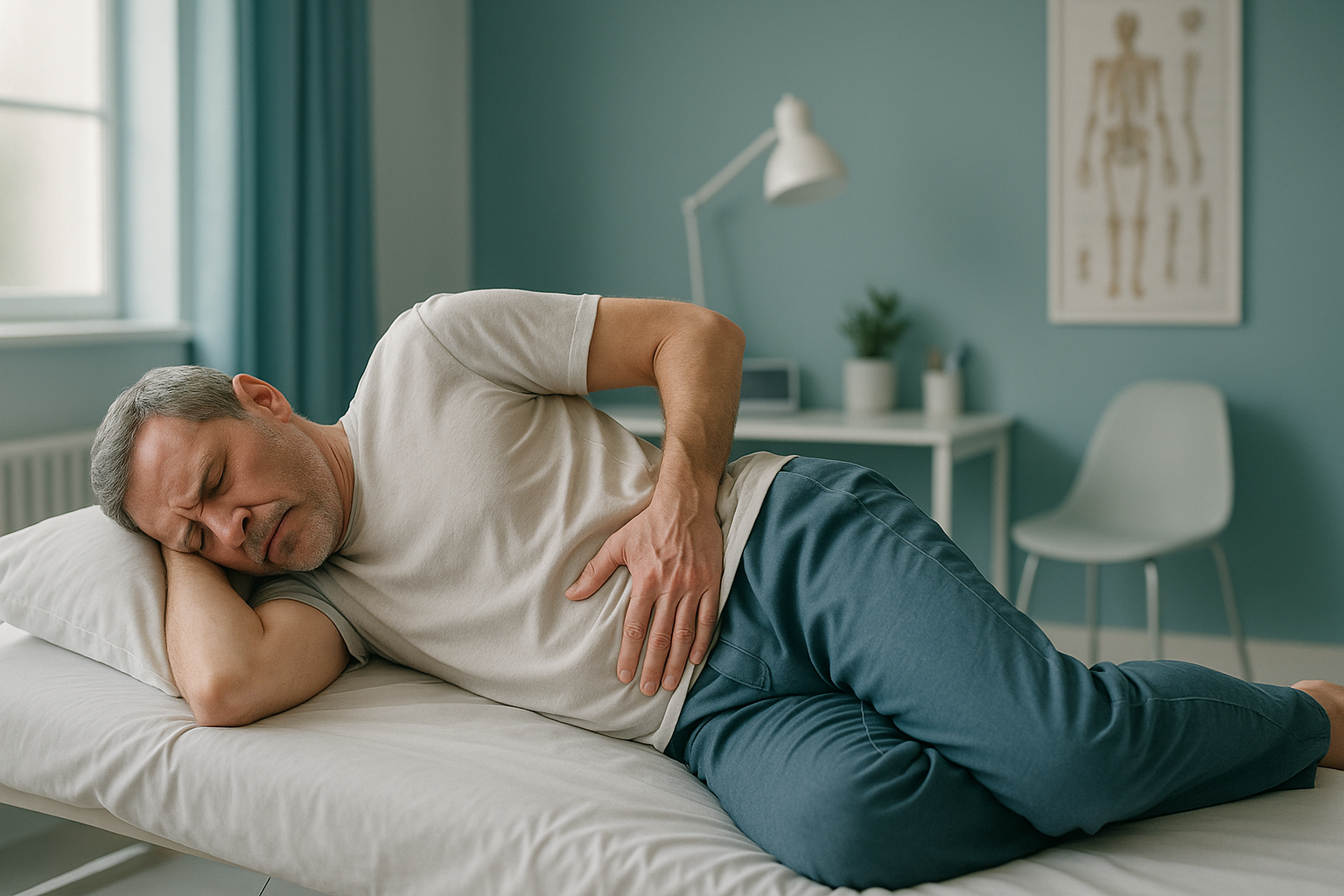
If you usually sleep on one side, you may notice the pain is always in the same hip. A pillow between your knees can reduce the compression slightly. But it does not address why the area has become sensitive in the first place.
The load your hip carries during the day also plays a part. If your pelvis sits unevenly when you stand, one hip takes more strain all day long. By the time you lie down, that side is already overloaded. This is why understanding your standing alignment is a useful step.
Are there warning signs I should not ignore?
Yes. Most hip pain at night is not dangerous, but some symptoms need urgent medical attention rather than a scan. Contact your doctor straight away, or go to your nearest emergency department, if you have any of the following:
- Sudden numbness or weakness in your leg or foot.
- Loss of bladder or bowel control.
- Severe pain after a fall or injury, especially if you cannot put weight on the leg.
- Unexplained weight loss along with worsening hip pain.
- A hot, red, swollen joint with fever.
These symptoms can point to serious conditions that need prompt assessment by a doctor.
Can a standing scan show why my hip hurts at night?
It can show alignment problems that lying-down scans miss. When you lie on an X-ray table or inside an MRI scanner, gravity is taken away and your muscles relax. The pelvis can then settle into a neutral position. This may hide a tilt, a rotation or a leg-length difference that puts extra load on one hip all day.
A standing EOS scan captures your skeleton upright, exactly as it works when you walk, stand and carry weight. It shows how your spine, pelvis, hips and legs relate to each other in one image, from head to ankle. If one hip sits higher, or the pelvis is rotated, the scan will show it. The difference between weight-bearing and lying-down imaging can be significant for people with unexplained or long-standing hip pain.
EOS uses about 90% less radiation than a standard X-ray, around ten times less. The scan itself takes only a few seconds while you stand still.
Wondering whether a standing assessment could help your hip before you plan a trip to London? A short video call with our team can help you decide.
Book a free video consultationWhen MRI is the better choice: EOS shows bones, joints and alignment clearly. If your treating specialist suspects a soft-tissue problem such as a labral tear, tendon damage or nerve involvement, MRI is usually the better tool. The two scans answer different questions, and sometimes you need both.
How can I sleep better with hip pain?
Small changes to how you sleep can reduce pressure on the hip overnight while you find out the underlying cause.
- Pillow between the knees. If you sleep on your side, a firm pillow between your knees stops the top leg from dropping across the body and compressing the outer hip.
- Try your back. Lying on your back spreads the load more evenly. A thin pillow under the knees can take tension off the hip flexors.
- Mattress firmness. A mattress that is too firm pushes into the hip point. One that is too soft lets the pelvis sag. A medium-firm surface usually gives the best balance.
- Avoid crossing your legs during the day. Crossing your legs out of habit can tighten the outer hip structures, making them more sensitive at night.
These steps can ease symptoms, but they do not replace finding out what is actually causing the pain. If your hip pain has lasted more than a few weeks, understanding your alignment through ScanAlign standing EOS imaging can give your treating specialist the information needed to plan the right next step.
Before you start a treatment, or change the one you are on, it is worth getting a detailed diagnosis. Whether the cause sits in the pelvis, the legs or the spine changes what will really help.
Frequently asked questions
During the day, movement keeps blood flowing to the hip and stops steady pressure building on any one structure. At night, lying still for hours compresses tendons and the bursa, and inflammatory chemicals can build up in the joint when you are not moving.
It can be. Arthritis often causes pain and stiffness that get worse at rest. If you also notice morning stiffness lasting more than 30 minutes, it is worth discussing with your doctor. However, arthritis is only one of several possible causes.
Sleeping on your back takes direct pressure off the outer hip and is often more comfortable. A thin pillow under your knees can help. If you find sleeping on your back difficult, a pillow between your knees while you sleep on your side can also reduce compression.
Yes. The nerves that supply the hip area come out of the lower spine. A disc or joint problem in the lower back can refer pain into the hip, buttock or groin, and lying flat can change the position of the spine enough to bring this on.
The bursa is a small fluid-filled sac that cushions the bony point of the hip. Tendons are the tough cords that attach muscles to bone. Both sit in the same area and can be compressed when you sleep on your side. They often become irritated together, which is why the condition is sometimes called greater trochanteric pain syndrome.
No. ScanAlign is a private, self-pay clinic. You can book a standing hip assessment directly, starting with a free video consultation to check the scan is right for you.
An EOS scan uses about 90% less radiation than a standard X-ray, around ten times less. This makes it a very low-dose option for full-body skeletal imaging.
The price for patients travelling from abroad is confirmed during your free video consultation.
Yes. Because the EOS scan images your whole skeleton while you stand, it can measure the true functional length difference between your legs under load. A small difference can cause the pelvis to tilt, overloading one hip.
A mattress that is too firm or too soft can make hip pain at night worse, and switching to a medium-firm surface sometimes helps. However, a new mattress treats the symptom, not the cause. If the pain has lasted more than a few weeks, it is worth finding out what is driving it.
Tired of waking up with hip pain?
A free video consultation with our team can help you understand whether a standing hip assessment in London is the right next step.
Book a free video consultationWritten by Abbas Dhami (Specialist Diagnostic Radiographer)
Sources
- Grimaldi, A. & Fearon, A. (2015). Gluteal tendinopathy: integrating pathomechanics and clinical features in its management. Journal of Orthopaedic & Sports Physical Therapy, 45(11), 910-922.
- NHS (2023). Hip pain in adults. nhs.uk. Available at: https://www.nhs.uk/conditions/hip-pain/
- Segal, N.A. et al. (2012). The effect of leg length inequality on spinal loading and low back pain. The Spine Journal, 12(9 Suppl), S134.
This page is general information and not a diagnosis.
ScanAlign is the trading name of CoreMed Solutions Ltd and operates under The Harley Street Hospital's CQC licence.