

How Are Hip Pain and Lower Back Pain Connected?
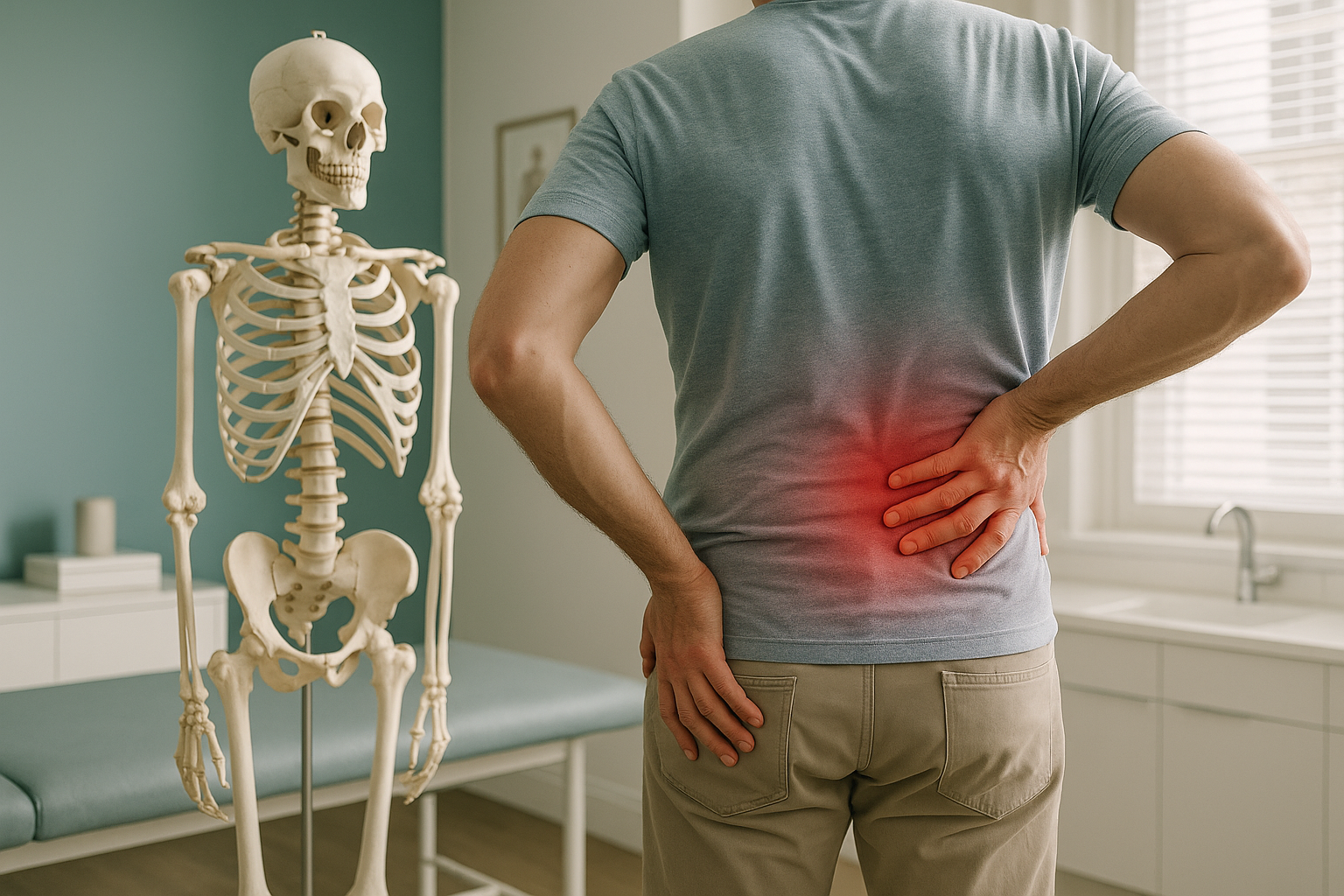
Hip and back pain often come together. This is because the hip joint, the pelvis and the lumbar spine work as one mechanical unit. Stiffness or misalignment in one area changes how the others move and carry weight. So the place where you feel pain is not always the place where the problem started. A standing whole-body image can show the full picture.
Key points
- The hip, pelvis and lower back share muscles, nerves and load. A problem in one affects the others.
- Back pain that spreads to the hip, and hip pain that leads to a sore back, are both common patterns.
- Lying-down scans relax the muscles. They can hide alignment problems that only appear when you stand.
- A whole-body standing image captures the full chain, from the feet to the spine, in one view.
- EOS imaging uses about 90% less radiation than a standard X-ray, around ten times less.
Why do the hip and lower back affect each other?
The hip joint and the lumbar spine are neighbours that share the work. Each time you stand, walk or bend, force passes through both. The pelvis sits between them like a platform. If your hip gets stiff, your lower back bends more to make up for it. If your lumbar curve flattens or deepens, your hip takes extra strain. Clinicians sometimes call this link "hip-spine syndrome."
This chain effect also involves sagittal balance, the front-to-back alignment of your whole skeleton when you stand upright. When one link in the chain shifts, everything above and below adjusts. That is why back pain spreading to the hip, or hip and lower back pain on the same side, is so common.
How do I know if my pain is coming from my hip or my back?
It can be truly hard to tell. Both can cause pain in the buttock, groin or thigh. Some patterns give useful clues, but they often overlap. That is why imaging the whole chain, not just one joint, matters.
Often points to the hip joint itself, especially if it gets worse when you put weight on the leg.
Pain that travels past the knee or into the foot often suggests a nerve problem in the lower back, not the hip.
Trouble bending to reach your feet can be a sign of reduced hip movement. But a stiff lower back can cause the same difficulty.
Hip and lower back pain on the same side is a classic compensation pattern. Both areas may be involved.
A note on soft tissue. EOS imaging shows bones, joints and alignment clearly. If your clinician suspects a disc bulge, nerve compression or soft-tissue damage, MRI is usually the better tool. The two types of imaging work well together.
Get urgent help if you have sudden numbness or weakness in your legs, or any loss of bladder or bowel control. Contact your doctor, call your local emergency number, or go to the nearest emergency department. Do not wait for a scan.
What causes hip and lower back pain together?
Several conditions can cause hip and back symptoms at the same time. Often the root cause is a problem with alignment or movement that puts extra load on the nearby structures.
A stiff hip reduces extension. The lumbar spine makes up for it by bending more, which strains muscles and discs.
A forward or backward tilt of the pelvis changes the curve of the lower back. It also loads the hip joints unevenly.
SI joint dysfunction sits right where the spine meets the pelvis, causing pain in both areas.
Nerves from the lower lumbar spine supply the hip and groin. A back problem can feel like a hip problem, and the other way round.
How does a standing scan show what lying-down imaging misses?
Most usual imaging, including standard X-rays, CT and MRI, is done while you lie down. That position relaxes your muscles and takes away the effect of gravity. Your joints settle into a resting position. This may look normal even when your standing posture is not.
When you lie flat, gravity no longer pulls through your skeleton. A pelvic tilt may disappear. A lumbar curve may look normal. Your hip may seem well aligned. The image is accurate for that position, but it is not the position you live in.
Standing up puts your full weight through the hip, pelvis and spine. A tilt, a change in curve, or a compensation pattern that only shows up under gravity becomes visible. With ScanAlign, whole-body standing EOS imaging, the whole chain from your feet to the top of your spine is captured in a single, weight-bearing image. It uses about 90% less radiation than a standard X-ray, around ten times less.

This matters because treatment decisions, whether physiotherapy, injection or surgery, depend on understanding how your body behaves under load. A scan that shows you relaxed and lying down may not tell the full story. Read more about what EOS imaging shows about back pain and posture.
Wondering whether your hip and back pain are connected? A standing whole-body image can show the full alignment picture.
Book a free video consultationWhat can be done about hip and lower back pain?
The most important first step is finding out where the problem really starts. Many people spend months treating one area when the cause sits somewhere else in the chain. Once you have a clear picture of your alignment, your clinician, whether a physiotherapist, osteopath or orthopaedic surgeon, can plan the right approach.
Common approaches include targeted exercises to improve hip movement or core stability, manual therapy, and sometimes guided injections. In some cases, surgery on the hip or spine may be considered, but only after the whole alignment picture is understood. ScanAlign does not provide treatment. It provides the diagnostic imaging that helps your treating clinician make better decisions.
If you have already had lying-down imaging that looks normal but your symptoms continue, a standing whole-body scan may show the compensation pattern your earlier images could not. You can book a whole-body standing scan without a referral from your doctor.
Before you start a treatment, or change the one you are on, it is worth getting a detailed diagnosis. Knowing whether the cause sits in the pelvis, the legs or the spine changes what will actually help.
Frequently asked questions
Yes. A stiff or arthritic hip reduces your range of movement. This forces the lumbar spine to bend and twist more to make up for it. Over time, this extra demand can cause back pain, even if there is nothing structurally wrong with your spine.
Yes. Nerves from the lower lumbar spine supply the hip, groin and buttock. A disc problem or joint narrowing in the lower back can refer pain into the hip area. This can make it feel as though the hip itself is the problem.
Hip-spine syndrome describes the overlap between hip and spinal conditions. When both areas are affected, treating just one may not resolve your symptoms. Understanding the link between the two is essential for planning the right course of action.
Same-side pain often happens because the hip and lumbar spine share muscles and nerves on each side. Stiffness or misalignment on one side creates an uneven load. Your body makes up for it on that side, causing pain in both areas.
Groin pain that gets worse with walking often points to the hip. Pain that travels down the leg past the knee usually starts in the back. However, overlap is common, and many people have problems in both areas. A full assessment of your alignment can help make the source clearer.
Lying-down scans remove the effect of gravity, so your muscles relax and your joints settle into a resting position. Alignment problems that only appear when you stand and bear weight can be missed. A standing whole-body image captures your skeleton in the position it actually works in.
EOS uses about 90% less radiation than a standard X-ray, around ten times less. The scan takes only a few seconds while you stand still. It is a very low-dose form of imaging.
No. ScanAlign is a private self-pay clinic. You can book directly without a referral. You start with a free video consultation to make sure the scan is right for you.
The price for patients travelling from abroad is confirmed during the free video consultation, which comes with no obligation.
They do different jobs. EOS is excellent at showing bones, joints and whole-body alignment under gravity. MRI is usually better for soft tissue, discs and nerves. In many cases, having both gives the most complete picture.
Find out where your pain really starts
A free video consultation helps us understand your symptoms and confirm whether a standing whole-body image is right for you, before you plan your trip to London.
Book a free video consultationSources
- Offierski CM, MacNab I. Hip-spine syndrome. Spine. 1983;8(3):316-321.
- NHS. Back pain: causes, treatment and prevention. nhs.uk/conditions/back-pain.
- Deschênes S, et al. Diagnostic imaging of spinal deformities: reducing patients' radiation dose with a new slot-scanning X-ray imager. Spine. 2010;35(9):989-994.
Written by Abbas Dhami (Specialist Diagnostic Radiographer)
This page is general information and not a diagnosis.
ScanAlign is the trading name of CoreMed Solutions Ltd and operates under The Harley Street Hospital's CQC licence.