
What Is Hallux Rigidus, and Why Has My Big Toe Become Stiff?
Hallux rigidus is arthritis of the big toe joint. The cartilage wears down and bony spurs form around the joint. This makes it stiff and painful, especially when you push off while walking. It is not the same as a bunion, which shifts the toe sideways. A standing weight-bearing x-ray shows the joint under real load and shows how far the condition has progressed.
Key points
- Hallux rigidus means the big toe joint has become arthritic and can no longer bend upward normally.
- It is not a bunion. A bunion pushes the toe sideways. Hallux rigidus locks it in place.
- Pain usually comes during push-off, the moment your foot needs the toe to bend the most.
- Stiffness in one joint can change the way you walk, causing knee, hip or back pain over time.
- A weight-bearing scan shows the joint space under real standing load. A lying-down scan can miss this.
If your big toe has slowly become stiffer and more painful, hallux rigidus is one of the most common reasons. It affects the first metatarsophalangeal joint, the large joint at the base of your big toe. Over time, the smooth cartilage lining that joint wears away. Bone rubs against bone, and small bony lumps called osteophytes form around the edges.
People often mix this condition up with a bunion, but the two are quite different. A bunion (hallux valgus) angles the toe inward towards the smaller toes. Hallux rigidus keeps the toe roughly straight but stops it bending upward. Both can be painful. But the treatment path, and what the scan needs to show, is different for each.
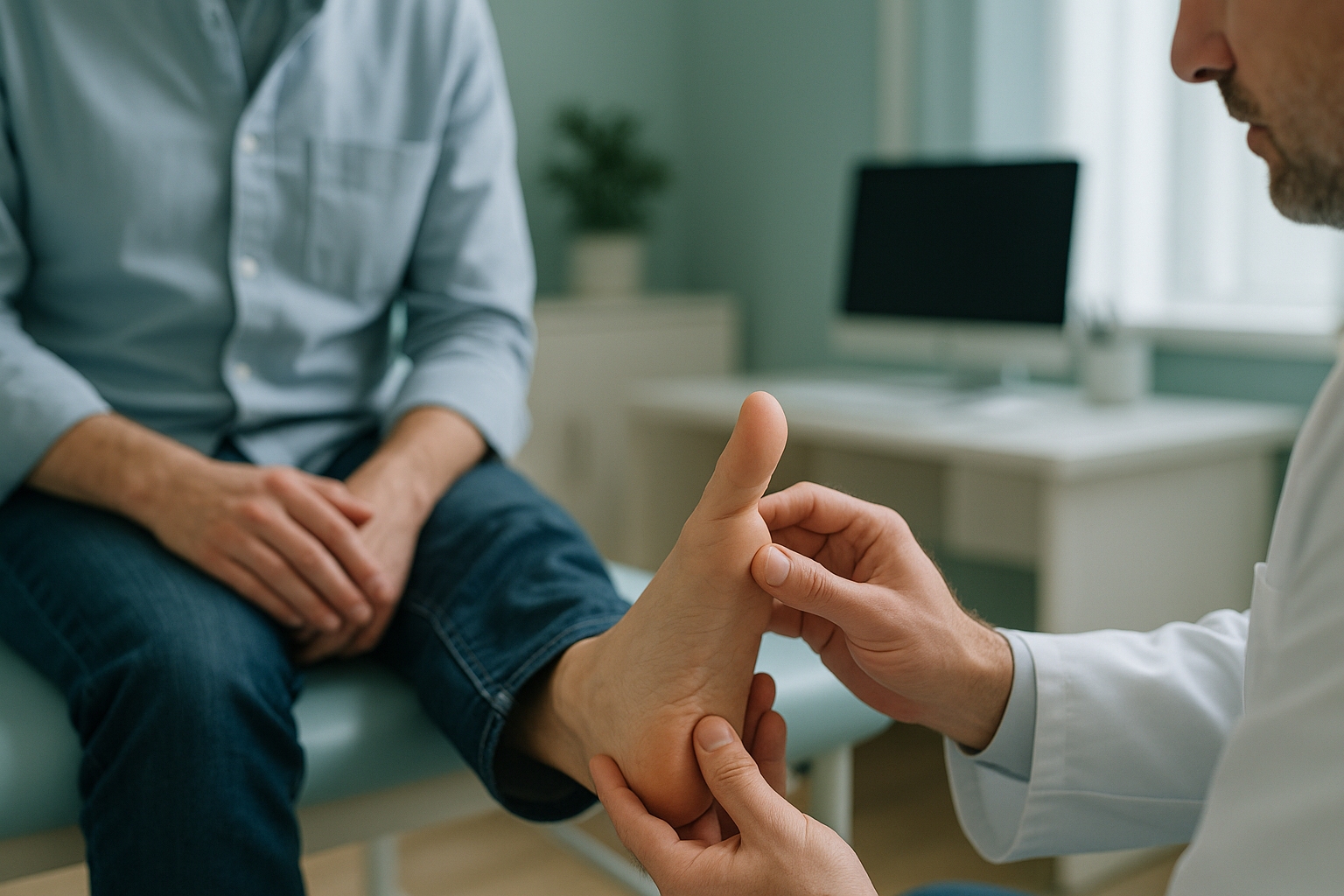
What does hallux rigidus feel like?
The main symptom is pain and stiffness at the base of your big toe. You notice it most when you walk, climb stairs or push off from the ground. In the early stages the joint may only ache after activity. As it progresses, the stiffness can become constant.
Sharp or aching pain at the big toe joint as you push off while walking or running.
The toe will not bend upward as far as it used to. Crouching or rising onto your tiptoes becomes difficult.
A visible bony lump on top of the joint. Shoes may press on it and cause irritation.
You start walking on the outside of your foot to avoid bending the toe. This changes your whole walking pattern.
Doctors sometimes call the earlier, milder stage hallux limitus. This means the toe still has some movement, but less than normal. Hallux rigidus is the more advanced stage, where movement is severely limited or lost altogether.
What causes big toe arthritis?
Big toe arthritis usually comes from years of normal wear. This is sometimes sped up by the shape of your foot, an old injury or the way you walk. There is no single cause, but several factors raise your risk.
A long first metatarsal or a flat foot puts extra stress on the big toe joint with every step.
A stubbed, jammed or fractured toe can trigger cartilage breakdown years later.
Jobs or sports that need repeated bending of the toe, such as running or squatting, increase wear on the joint.
A family tendency towards arthritis and the natural ageing of cartilage both play a part.
Can a stiff big toe cause pain in my knee, hip or back?
Yes, and this is one of the most overlooked parts of hallux rigidus. Your body is a connected chain from your feet to your head. When your big toe cannot bend properly as you push off while walking, you shift your weight without thinking. You might roll onto the outside of your foot, take shorter steps, or twist your ankle slightly with every step.
These small compensations ripple upward. Your ankle, knee and hip all adjust to protect the stiff toe. Over weeks and months, the changed gait analysis pattern can create new pain in places far from the toe itself. It is common for someone with undiagnosed hallux rigidus to come in with knee pain, hip stiffness or a lower back ache. This is because their clinician is looking at the painful area rather than the root cause below.
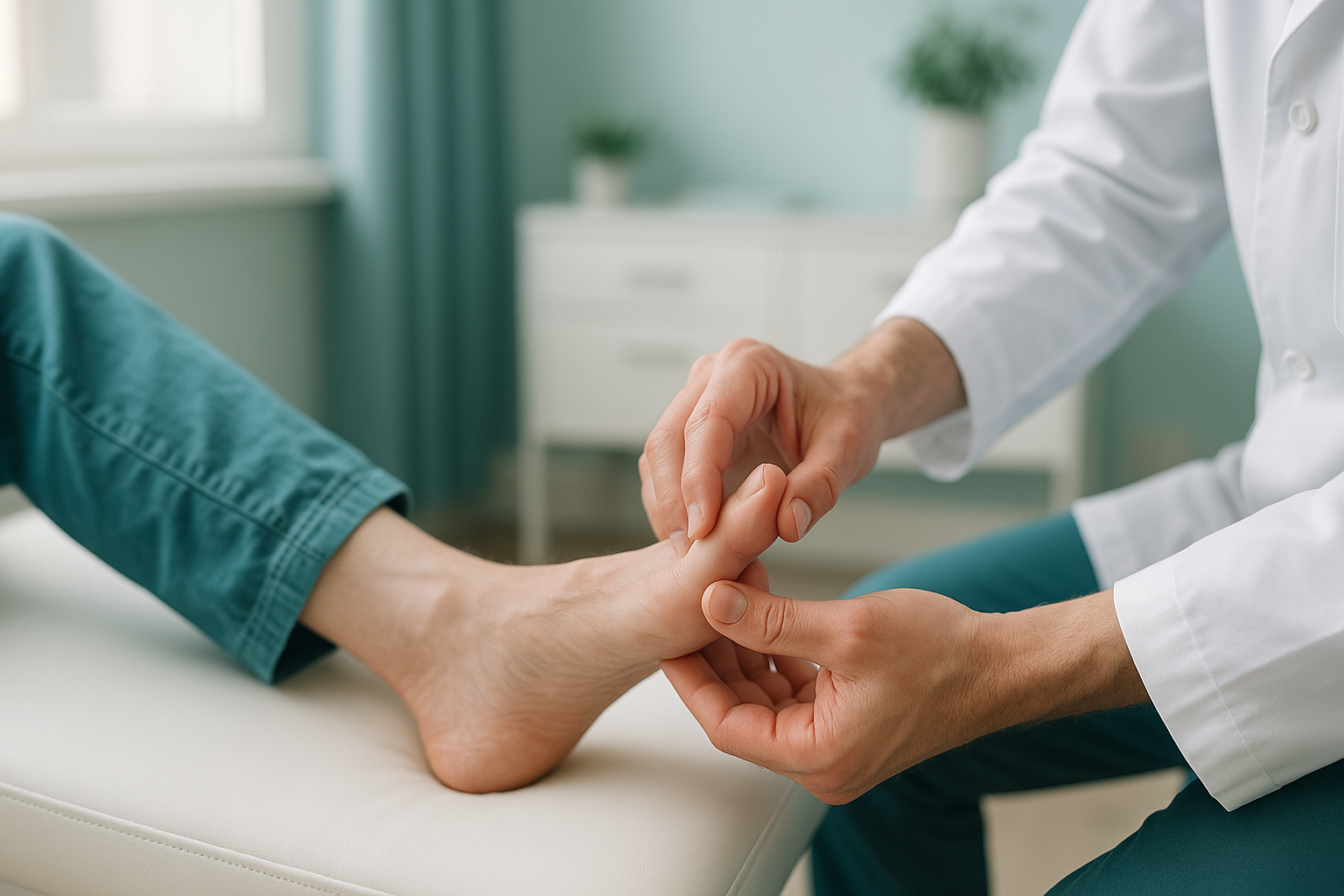
How is hallux rigidus assessed with standing imaging?
A standing weight-bearing x-ray captures the big toe joint while your full body weight presses through it, just as it does when you walk. This matters because a standard lying-down x-ray relaxes the muscles and takes pressure off the joint. In that relaxed position, the joint space can look wider than it really is. The true amount of cartilage loss may then be underestimated.
With ScanAlign, weight-bearing standing imaging, the EOS system captures your feet, ankles, knees, hips and spine in a single upright image. That whole-body view lets your clinician see the worn big toe joint. It also shows how your walking has changed and where compensations are showing up further along the chain. The scan uses about 90% less radiation than a standard x-ray, around ten times less.
What it shows: The joint space under real load. Osteophytes and how they relate to the joint surface. Alignment of the first metatarsal compared with the rest of the foot and the whole leg. Any compensation in the knee, hip or spine caused by the way you walk.
What it may miss: When there is no weight on the foot, gravity is no longer pressing the joint together. The space between the bones can look larger than it really is during walking. Compensating shifts in alignment in the ankle, knee and hip relax away, so they do not show on the image.
When MRI is the better tool: EOS shows bones, joints and alignment clearly. If your clinician needs to look at soft tissue, such as the cartilage surface in detail, the joint capsule or nearby tendons, MRI is usually the better choice. The two scans work well together.
What are the options for managing hallux rigidus?
Treatment depends on how far the condition has progressed and how much it affects your daily life. ScanAlign is a diagnostic imaging clinic and does not provide treatment. But knowing the range of approaches can help you have a better-informed talk with your treating clinician.
Non-surgical options often include stiff-soled or rocker-sole shoes that reduce how much the toe needs to bend, insoles or orthotic plates that support the joint, and changes to your activities. Anti-inflammatory medicine may help with flare-ups. Physiotherapy can keep the movement that remains and strengthen the muscles around the joint.
If non-surgical measures are not enough, your clinician may discuss surgery. Options include a cheilectomy, which removes the bony spurs to restore some movement, or a fusion, which locks the joint in a fixed position to eliminate pain. The right approach depends on how severe the arthritis is, how active you are and your goals. Accurate imaging is the starting point for any of these decisions.
Before you start treatment, or change the one you are on, it is worth getting a detailed diagnosis. Knowing whether the cause sits in the pelvis, the legs or the spine changes what will actually help.
Want to see how your big toe joint looks under real standing load? A weight-bearing scan gives your clinician the detail they need to guide the next step.
Book a free video consultationFrequently asked questions about hallux rigidus
No. A bunion (hallux valgus) pushes the big toe sideways towards the smaller toes and creates a bump on the inner side of the foot. Hallux rigidus keeps the toe roughly straight but makes it stiff and painful to bend upward. The two conditions affect the same joint, but in different ways.
Most people describe a deep ache or sharp pain at the base of the big toe as they push off. It tends to be worse on hard surfaces, when wearing flat, flexible shoes, or after long periods on your feet.
Yes. When the big toe cannot bend, the way you walk changes. You may roll your foot outward or take shorter steps. Over time these compensations can put stress on the ankle, knee, hip and even the lower back.
A standing x-ray loads the joint with your full body weight, just as it is during walking. This shows the true joint space and any changes in alignment. A lying-down x-ray removes that load and can make the joint look healthier than it really is.
EOS uses about 90% less radiation than a standard x-ray, around ten times less. It captures the whole body in one pass, so there is no need for multiple exposures.
No. ScanAlign is a private self-pay clinic and you can book yourself. You start with a free video consultation to check that a scan is right for your situation.
The price for patients travelling from abroad is confirmed during your free video consultation.
Hallux limitus is the earlier stage, where the big toe still has some upward movement, but less than normal. Hallux rigidus is the more advanced stage, where movement is severely limited or completely lost. The two sit on the same spectrum.
The cartilage loss itself does not reverse. But symptoms can often be managed well with stiff-soled shoes, orthotic insoles, changes to activity and sometimes anti-inflammatory medicine. Many people live well with the condition without needing surgery.
You stand inside the EOS machine in a natural upright position for around 20 seconds while it captures your image. There is no need to change into a gown unless your clothing has metal. The scan is quick, painless and needs no special preparation.
See your big toe joint under real load
A standing whole-body scan shows the joint space, bony spurs and any compensation further up the chain, all in one image.
Book a free video consultationWritten by Abbas Dhami (Specialist Diagnostic Radiographer)
Sources
- Coughlin MJ, Shurnas PS. Hallux rigidus: grading and long-term results of operative treatment. Journal of Bone and Joint Surgery (American). 2003;85(11):2072-2088.
- National Institute for Health and Care Excellence (NICE). Osteoarthritis: care and management. Clinical guideline CG177 (updated 2022).
- Deschamps K et al. Body of evidence supporting the clinical use of 3D multisegment foot models. Gait & Posture. 2011;33(3):338-349.
This page is general information and not a diagnosis.
ScanAlign is the trading name of CoreMed Solutions Ltd and operates under The Harley Street Hospital's CQC licence.