
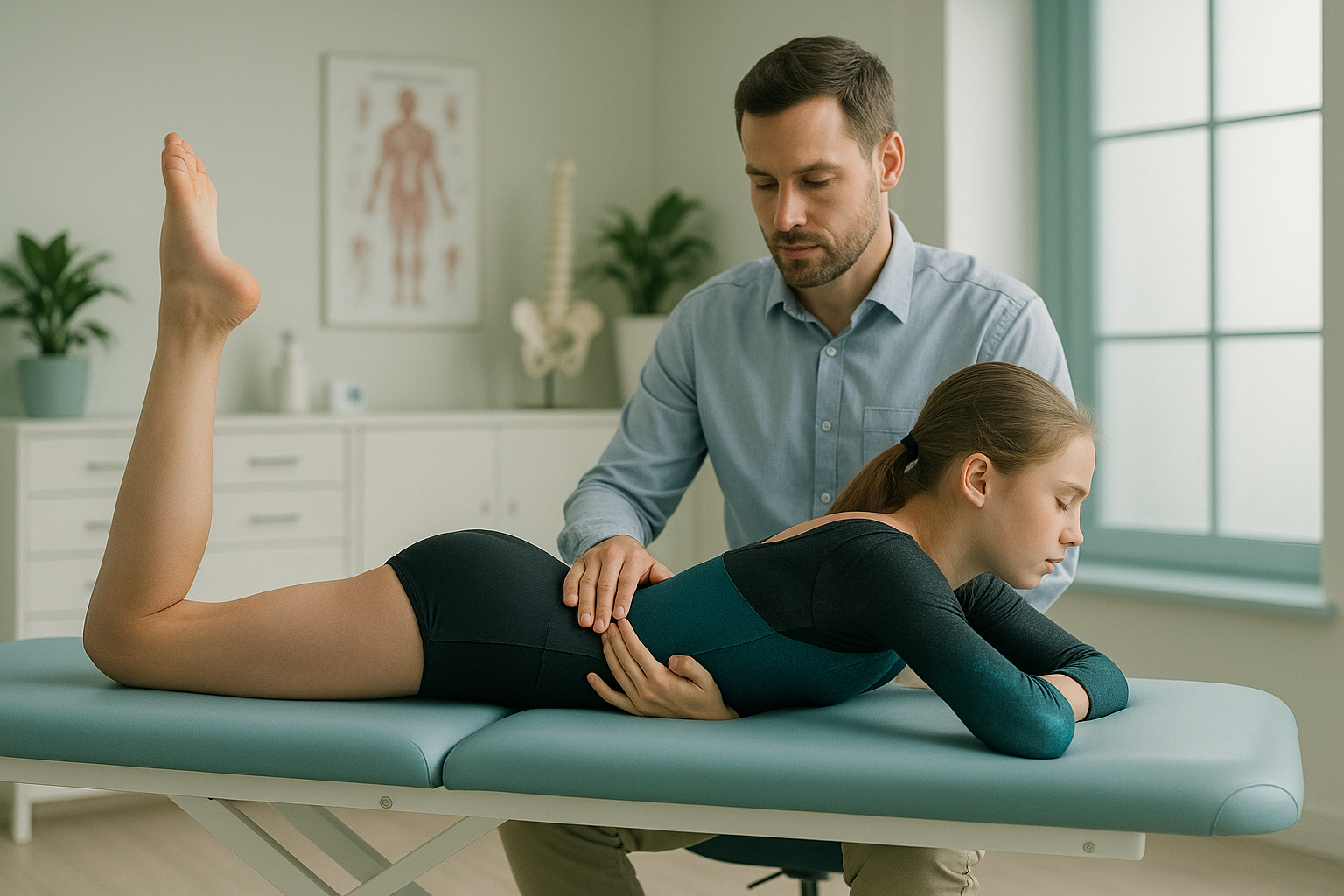
Why Do Young Gymnasts Get Back Injuries?
Young gymnasts get back injuries because the sport asks the spine to bend backwards into hyperextension again and again, while the skeleton is still growing. Growth plates and developing bone cope less well with stress. So long training hours can lead to stress reactions or fractures in the lower back. The most common is spondylolysis.
Key points
- Repeated back bends stress the part of the vertebra called the pars interarticularis, which is weaker in a growing spine.
- MRI is the first test to do when a young athlete may have an acute stress reaction.
- A standing, weight-bearing scan can show alignment problems that lying-down scans may miss.
- Spotting the problem early and changing training are the most effective ways to prevent serious damage.
- Pain during or after training is a warning sign, not something to push through.
Why does gymnastics put the spine at risk?
Gymnastics is one of the hardest sports on the lower back. Every back walkover, tumbling pass and dismount forces the lumbar spine into deep extension. In an adult, these forces spread across strong, fully formed bone. In a young athlete, the skeleton is still maturing. The growth plates and developing bone take less force before they start to break down.
The part of the vertebra most affected is called the pars interarticularis. It is a thin bridge of bone at the back of each lumbar vertebra. When this area is loaded again and again without enough time to recover, it develops a stress reaction. If training carries on, that reaction can turn into a stress fracture known as spondylolysis.

What are the signs of a gymnastics back injury?
The most common sign is a dull ache in the lower back that gets worse during or after training. It is often worse when bending backwards or landing from a height. It may start as mild stiffness and build up over weeks.
Aching or sharp pain when arching the back, especially during walkovers or back handsprings.
The back feels stiff first thing in the morning or after sitting for a long time.
Pain that sits on one side of the lower back rather than across the whole area.
A clear loss of flexibility, or not wanting to do skills that used to feel comfortable.
Seek urgent medical attention if there is any numbness, tingling, weakness in the legs, or any loss of bladder or bowel control. Contact your doctor or go to the nearest emergency department straight away.
What causes stress fractures in young gymnasts?
Stress fractures in young gymnasts are caused by a mix of a growing body's weak points and training load. No single factor is usually responsible. It is several risk factors together that tip the balance.
More hours of repeated loading means less recovery time for developing bone.
Fast growth makes bones weaker for a while and muscles tighter, which adds stress on the spine.
Back walkovers, flips and dismounts squeeze the pars interarticularis again and again.
Without enough rest days, bone remodelling cannot keep up with the micro-damage caused by training.
Coaches and parents play a vital part. A young athlete who reports persistent lower back pain during training should be assessed, not pushed to train through it. Finding a stress reaction early means training can be changed before a full fracture develops.
How is a gymnastics back injury diagnosed?
MRI is the first test to do when an acute pars stress reaction is suspected in a young athlete. MRI is excellent at picking up early bone stress, bone marrow oedema and soft-tissue changes before a fracture shows on a standard X-ray. If your child's doctor suspects a stress reaction, MRI should be the first scan they ask for.
A note on MRI. EOS shows bones, joints and whole-body alignment with about 90% less radiation than a standard X-ray, around ten times less. However, for soft tissue, discs, nerves and early bone stress reactions, MRI is usually the better tool. Your clinician will recommend the right imaging based on the clinical picture.
Standard X-rays may not show a stress reaction in its early stages. They are more useful once a fracture line has formed, or for checking overall spinal alignment over time. A CT scan gives detailed bone images but uses more radiation. This is an important point to weigh in younger patients.
How does a standing scan help after a gymnastics back injury?
Once an acute stress reaction has been ruled out or has healed, standing, weight-bearing imaging has a valuable role. Standard scans are taken lying down. When you lie flat, gravity is taken away and the muscles relax. This can hide alignment problems that only appear under the load of standing upright.
The body works as a connected chain from feet to head. A slight tilt at the pelvis, a difference in leg length, or a deeper curve in the lower back can all shift stress onto the pars interarticularis. These compensations often only show when the body is upright and carrying its own weight.
ScanAlign, low dose standing imaging, captures the full skeleton from head to feet in a single upright exposure. This whole-chain view helps clinicians understand why certain parts of the spine are being overloaded, not just what is damaged. That is especially useful for guiding a safe return to sport, and for finding alignment factors that may raise the risk of injury happening again.

Worried about a young gymnast's back and thinking of coming to London? Explore children's imaging at ScanAlign or speak with our team first.
Book a free video consultationWhat helps a young gymnast recover from a back injury?
Recovery is guided by the clinical team looking after the athlete. ScanAlign is a diagnostic imaging clinic and does not provide treatment. Even so, imaging plays a key role in the decisions that clinicians and coaches make.
In general, care usually involves a period of changed training so the bone can heal. This is followed by a gradual, supervised return to full activity. Knowing the underlying alignment picture helps clinicians decide when it is safe to move forward, and which changes might lower the risk of the injury coming back.
For parents and coaches, the most important step is to take lower back pain seriously in any young gymnast. Persistent pain during training that lasts more than a couple of weeks needs a proper clinical assessment, not a week of rest and a return to the same load.
Before your child starts treatment, or changes the one they are on, it is worth getting a detailed diagnosis. Knowing whether the cause sits in the pelvis, the legs or the spine changes what will actually help.
Frequently asked questions about gymnastics back injuries
The most common serious back injury in gymnastics is a stress fracture of the pars interarticularis, known as spondylolysis. It is caused by repeated hyperextension of the lumbar spine during skills such as back walkovers and tumbling.
Young athletes have growing skeletons. Growth plates and developing bone cope less well with repeated loading than mature bone. This makes stress reactions more likely when training volume is high.
MRI is the recommended first test for a suspected acute pars stress reaction. It can pick up bone stress and swelling before a fracture line shows on X-ray, so action can be taken earlier.
A standing EOS scan is most useful once an acute stress reaction has been addressed. It shows whole-body alignment under load. This helps clinicians find compensations that may be overloading the lower back, and guides a safer return to sport.
An EOS scan uses about 90% less radiation than a standard X-ray, around ten times less. This matters most for younger patients who may need imaging over time.
No. ScanAlign is a private, self-pay clinic. You can book yourself without a letter from your doctor. We recommend starting with a free video consultation so we can check imaging is right for your situation.
Yes. A full-body standing image can show uneven features, such as a pelvic tilt or a slight difference in leg length, that shift load onto one side of the spine. These compensations are often invisible on lying-down scans.
Healing time varies with how severe the injury is and with the person. Your clinical team will guide the return-to-sport plan. Imaging at key stages helps them check progress and decide when it is safe to increase load.
The price for patients travelling from abroad is confirmed during the free video consultation.
Imaging does not replace good coaching, sensible training loads and rest. However, a baseline alignment check can highlight risk factors, such as too much curve in the lower back or an uneven pelvis, that a coach or physiotherapist can work on before an injury develops.
Worried about a young gymnast's back?
Start with a free video consultation. Our team will help you understand whether imaging is the right next step before you plan a trip to London.
Book a free video consultationWritten by Abbas Dhami (Specialist Diagnostic Radiographer)
Sources
- Selhorst M, Fischer A, MacDonald J. Prevalence of spondylolysis in symptomatic adolescent athletes. Clinical Journal of Sport Medicine, 2019;29(5):421-426.
- Caine D, Maffulli N, Caine C. Epidemiology of injury in child and adolescent sports: Injury rates, risk factors, and prevention. Clinics in Sports Medicine, 2008;27(1):19-50.
- British Gymnastics. Injury prevention and management guidance for coaches and parents. britishgymnastics.org.
This page is general information and not a diagnosis.
ScanAlign is the trading name of CoreMed Solutions Ltd and operates under The Harley Street Hospital's CQC licence.