
Can You Have an EOS Scan If You Are Claustrophobic?
Yes. An EOS scan is completely open. You stand upright in an open cabin. There is no tunnel, no closed space and no sliding table. The scan takes seconds. You can keep your eyes open the whole time, and a radiographer stays in the room with you. No sedation is needed.
Key takeaways
- EOS uses an open, walk-in cabin. There is nothing to climb into or slide through.
- The scan itself lasts only seconds, and the whole appointment is short.
- You stand naturally. Your radiographer is right there with you.
- EOS uses about 90% less radiation than a standard X-ray, around ten times less.
- EOS shows bones, joints and alignment. For soft tissue, discs or nerves, MRI is usually the better tool.
Why is an MRI scan so hard if you are claustrophobic?
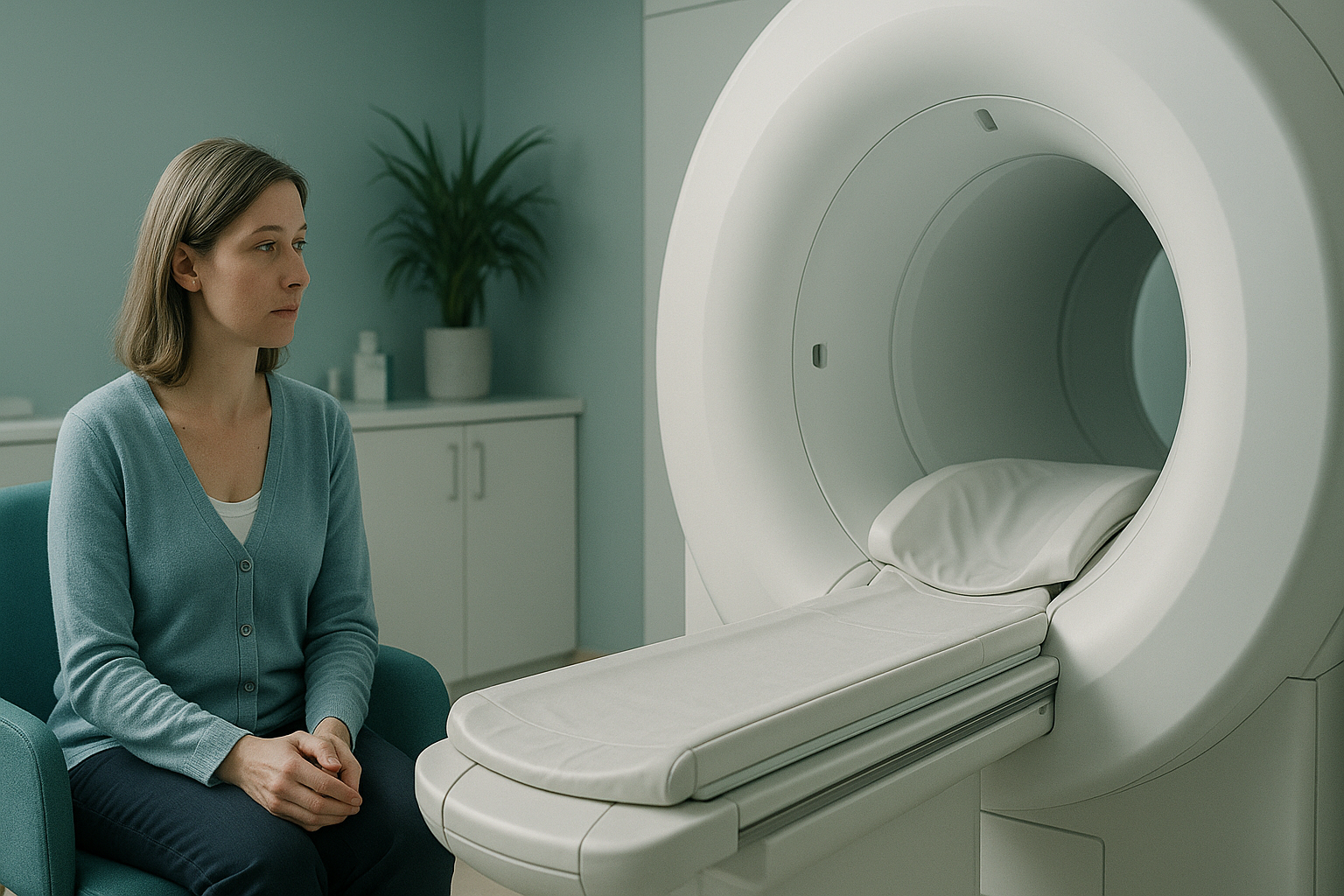
An MRI machine is a narrow tube, usually around 60 cm wide. You lie flat on a motorised table that slides you inside. For many scans you go in head first. The tube is close to your face, the machine is loud, and the scan can take 20 to 45 minutes. If you feel anxious in closed spaces, all of this together can cause real panic.
Some people cope with sedation, ear plugs or a family member close by. Others simply cannot bear it, however well they prepare. This often means cancelling the scan completely, and losing the medical information their doctor was looking for.
How is an EOS scan different from an MRI for claustrophobia?
An EOS scan is built in a completely different way. There is no tunnel. You walk into an open cabin, stand upright, and the scanner moves around you. The cabin is open on all sides at shoulder height, so you can see out and breathe freely. If you are scared of MRI scans, it feels closer to standing in a doorway than lying in a tube.
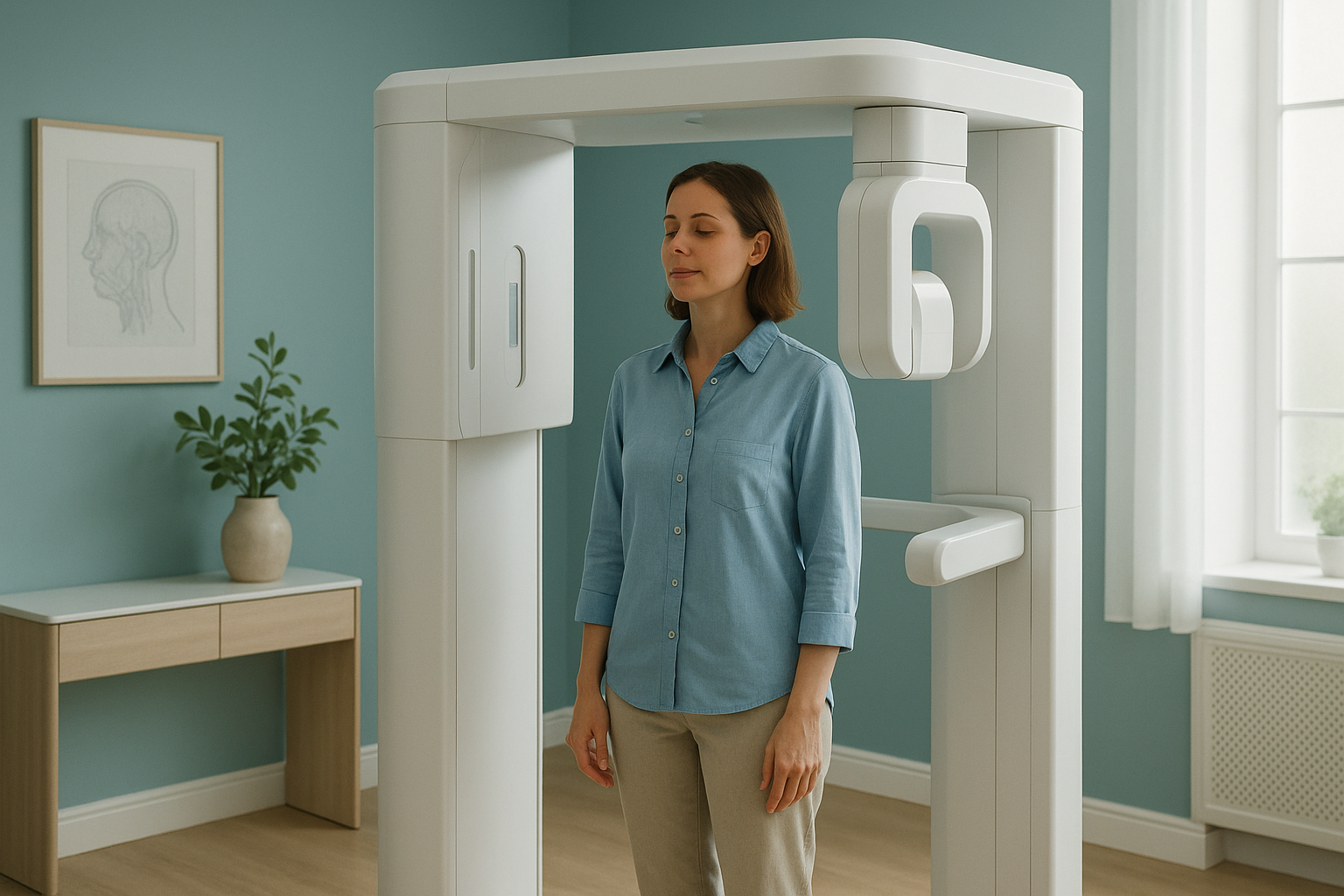
The scan itself takes seconds. There is no loud banging. You do not need to take off all your clothes. Sedation is not needed, because there is simply nothing around you to feel closed in by.
At ScanAlign, standing EOS imaging in Harley Street, the radiographer stays in the room with you the whole time. If you feel uneasy at any point, you can step out of the cabin straight away. You are always in control.
What happens during a standing EOS scan?
The appointment is simple and quick. Here is what to expect, step by step. You can also read our full guide on what to expect at an alignment assessment.
You arrive at 19 Harley Street, London. No special preparation is needed.
The radiographer guides you into the EOS cabin. You stand naturally with your eyes open. The cabin is open around you.
Two low-dose beams move from head to foot at the same time. You stand still for a few moments. That is all.
A reporting radiologist reviews your images. Your report and full-length alignment images are shared with you and, if you wish, with the clinician who is treating you.
If you are worried about feeling anxious on the day, our team is happy to talk you through the process beforehand. See our page on reducing anxiety at your appointment for practical tips.
Can EOS replace an MRI if you cannot manage one?
It depends on what your doctor needs to see. EOS and MRI answer different medical questions, so one does not simply replace the other.
- Full-body bone and joint alignment
- Posture assessment while bearing weight
- Spine, hip or knee alignment under gravity
- Images for planning before or after surgery
- Soft tissue detail (muscles, ligaments, tendons)
- Disc or nerve imaging
- Internal organ assessment
- Tumour or infection detail
Honest about MRI. EOS shows bones, joints and whole-body alignment very well. For soft tissue, discs or nerves, MRI is usually the better tool. If your medical question needs an MRI and you struggle with claustrophobia, talk to your doctor about open MRI options or sedation. We are happy to advise on which scan is right for you.
For a detailed comparison, see our guide to EOS compared with X-ray, CT and MRI.
Who is an EOS scan suitable for?
An EOS scan suits most adults who can stand without help for a few seconds. It is especially helpful if you have struggled with closed scanners in the past, or if you have long-term bone, joint or muscle problems where alignment matters.
You do not need a referral from your doctor to book a standing scan. If you are not sure whether EOS is the right choice, start with a free video consultation and we will guide you. You can also visit our patient support page for more information.
Before you start a treatment, or change the one you are on, it is worth getting a detailed diagnosis. Knowing whether the cause sits in the pelvis, the legs or the spine changes what will actually help.
Nervous about the scan? Talk to us first. Our radiographer will explain exactly what happens and answer your questions, with no obligation.
Book a free video consultationFrequently asked questions
Yes. The EOS cabin is completely open. You stand upright with nothing around your head or shoulders. Most people who cannot manage an MRI find EOS comfortable and stress-free.
No. The cabin is open and the scan lasts only seconds, so sedation is not needed. You stay fully alert and in control the whole time.
The scan itself takes seconds. The whole appointment is short, but your radiographer will take the time to position you properly and make sure you feel comfortable.
No. EOS is almost silent. There is no repeated banging or buzzing. You will hardly notice it running.
Your radiographer stays in the room the whole time. In most cases, a companion can also be close by, although they may need to stand behind a screen for radiation safety. Just tell us what you would prefer when you book.
EOS uses about 90% less radiation than a standard X-ray, around ten times less. It is one of the lowest-dose imaging systems available.
It depends on what needs to be seen. EOS is excellent at showing bone alignment and posture under gravity. If your doctor needs to see soft tissue, discs or nerves, MRI is usually the better choice. The two scans answer different questions and can work well together.
No. You can book directly yourself. We offer a free video consultation so our radiographer can check that EOS is the right scan for you before you commit.
ScanAlign is a private, self-pay service. The price for patients travelling from abroad is confirmed during your free video consultation.
That is completely understandable. Your radiographer will talk you through every step before anything happens. You can pause or stop at any point. There is no closed space to feel trapped in, and the scan is over in seconds.
Ready for a scan without the stress?
Talk to our radiographer in a free video call, with no obligation. We will confirm whether EOS is right for you and answer any questions about what to expect.
Book a free video consultationSources
- Deschênes S, Charron G, Beaudoin G, et al. Diagnostic imaging of spinal deformities: reducing patients' radiation dose with a new slot-scanning X-ray imager. Spine. 2010;35(9):989-994.
- NHS. Claustrophobia. nhs.uk. Available at: https://www.nhs.uk/mental-health/conditions/claustrophobia/
- Munn Z, Moola S, Lisy K, Riitano D, Murphy F. Claustrophobia in magnetic resonance imaging: a systematic review and meta-analysis. Radiography. 2015;21(2):e59-e63.
Written by Abbas Dhami (Specialist Diagnostic Radiographer)
This page is general information and not a diagnosis.
ScanAlign is the trading name of CoreMed Solutions Ltd and operates under The Harley Street Hospital's CQC licence.