
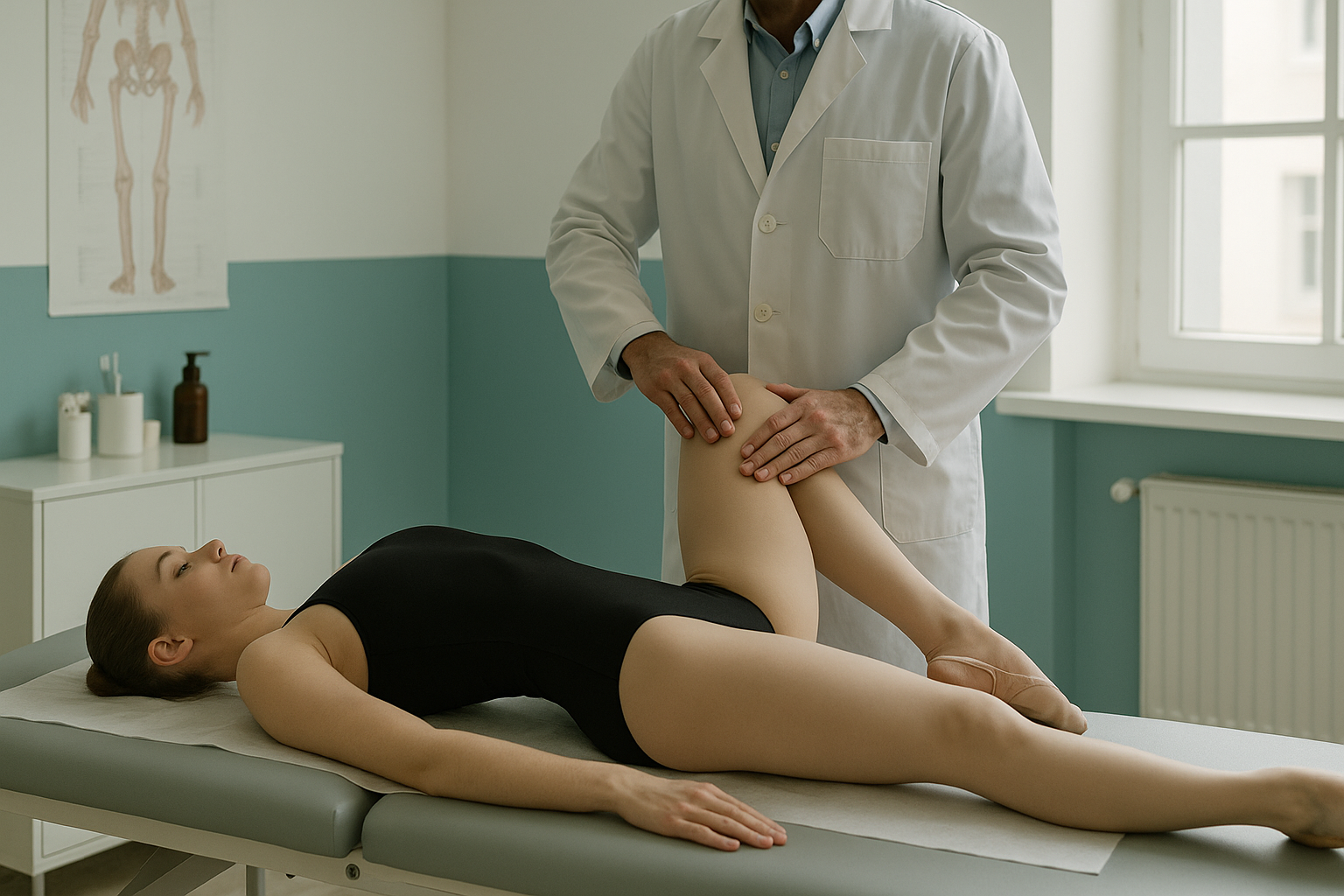
How Does Turnout Affect a Dancer's Hips and Spine?
Turnout is the outward rotation of the legs from the hip joints. How far you can turn out depends mainly on the shape of your hip bones, not just on how flexible you are. When dancers force turnout beyond their natural range, the strain travels up through the pelvis and lower spine. This often causes hip pain, back pain and injuries that seem unrelated to the hip itself.
Key points
- True turnout comes from the hip joint. The shape of the thigh bone and hip socket sets your natural limit.
- Forcing turnout beyond your anatomy strains the hips, knees, ankles and lower spine.
- Joint hypermobility is common in dancers and can hide early signs of overuse.
- Imaging done lying down can miss alignment problems that only appear when you stand and bear weight.
- A standing whole-body scan shows hip rotation, pelvic balance and spinal alignment together.
What decides how much turnout a dancer actually has?
Your available turnout is mostly decided by the bones of your hip. Two structures matter most. The first is the angle at which the thigh bone (femur) sits in the hip socket, known as femoral version. The second is the depth and direction of the hip socket itself, called acetabular orientation. These vary greatly from person to person. They are largely set by the time you finish growing.
Dancers with more natural outward rotation at the hip usually have a lower angle of femoral anteversion in adults. Those with a higher angle may find turnout harder to achieve, no matter how much they stretch. This is not a fault. It is simply how their bones are shaped.
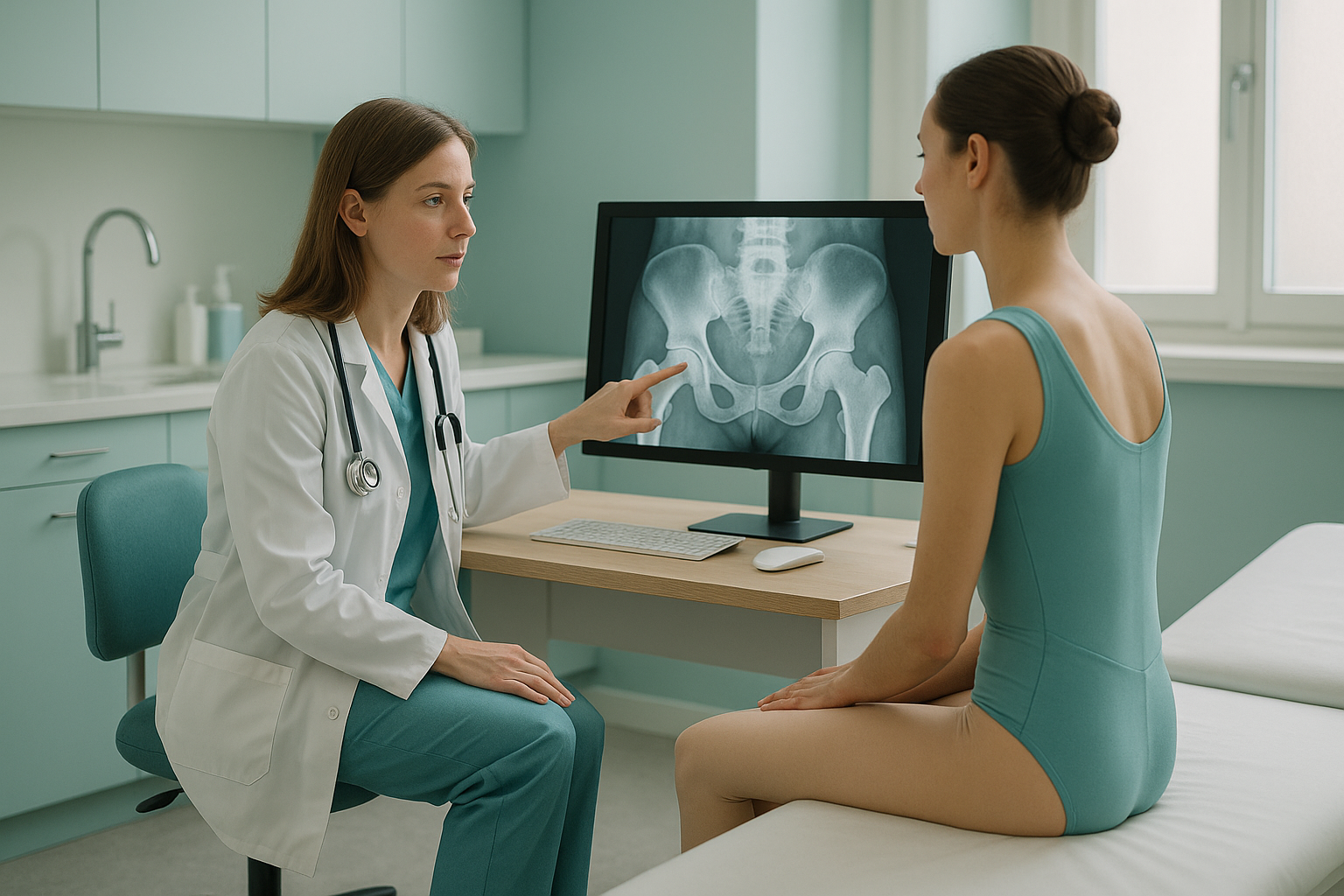
Soft tissue plays a supporting role. The joint capsule, ligaments and deep hip rotator muscles all help decide how smoothly you can rotate. In dancers with hypermobile joints and pain, the ligaments allow extra range. But that range may come at the cost of stability.
The lower leg can add a little extra visible turnout through tibial torsion (a slight outward twist in the shin bone). The foot and ankle also play a part. But the hip is where most working turnout should come from.
What happens when you force turnout beyond your natural range?
Forcing turnout means making it look as if the hip rotates outward more than it comfortably can. This is extremely common in training. When the hip runs out of range, the body borrows movement from other joints further down or further up the chain.
The arches roll inward to push the feet further apart. This stresses the ankle and midfoot.
The knee twists between a rotated foot and a less rotated thigh. This increases stress on the ligaments.
The pelvis tips forward to make it look like there is more hip rotation. This pulls the lower back into an exaggerated curve.
The lower spine arches too much. This compresses the facet joints and increases the risk of stress injuries.
This chain of compensation is a classic example of how the body works as a connected system. Pain in the lower back, the front of the hip or the inside of the knee may all trace back to forced turnout at the hip. But because the pain is not at the hip, the real cause can be missed.
What are the signs of dancer hip pain from forced turnout?
Dancer hip pain linked to turnout can show up in several ways. Some signs are felt at the hip. Others appear elsewhere because the body is compensating.
A catching feeling at the front or side of the hip, often during développé or grand battement.
A dull ache deep in the front of the hip that gets worse with held positions or passé.
Persistent tightness or aching across the lower back, especially after barre work.
Pain at the inner edge of the knee, caused by the twisting load from screwing the foot outward.
If you have sudden weakness in the leg, numbness, or loss of bladder or bowel control, get urgent medical help from your doctor or the nearest emergency department. These are not turnout-related symptoms and need to be checked straight away.
Why does a standing scan show more than a lying-down scan for dancers?
When you lie down for a standard X-ray, CT or MRI, your muscles relax, your pelvis settles and the weight comes off your joints. Many of the alignment problems dancers have only appear when gravity is acting, the muscles are working and the whole body is loaded from feet to head.
A standing EOS scan captures the whole body in one image, from the top of the head to the feet, while you bear your natural weight. It shows how your pelvis tilts, whether one hip sits higher than the other, the curve of your lower spine, and the rotation of the thigh bones compared with the knees. All of this appears together, in one picture, the way your body actually works when you dance.
EOS uses about 90% less radiation than a standard X-ray, around ten times less. That matters for dancers who may need imaging more than once over a career.
Imaging done lying down relaxes the muscles, unloads the joints and removes the effect of gravity. A pelvic tilt, a subtle leg-length difference, or lumbar hyperextension caused by forced turnout may not appear at all. Each image usually shows one area on its own, so the link between the hip, pelvis and spine is not captured.
ScanAlign standing EOS imaging is especially useful for dancers because it shows the full alignment chain. A problem at the hip may be causing your back pain. A difference in how each femur sits in its socket may explain why turnout feels easier on one side. These links only become clear when every joint can be seen at once, under load.
When is MRI the better tool? EOS shows bones, joints and alignment very clearly. For soft-tissue problems such as labral tears, disc injuries or nerve compression, MRI is usually the better choice. Your treating specialist can advise which scan you need.
How can dancers protect their hips and improve turnout safely?
Working within your natural anatomical range is the single most important thing you can do for your hips. That range is not a weakness. It is a fact about the shape of your bones, and understanding it puts you in control.
- Know your anatomy. A screening assessment can help you and your teacher understand where your turnout actually comes from. Then training can be tailored to your body rather than to one standard for everyone.
- Strengthen, do not just stretch. Strength in the deep hip rotators and glutes supports your available range and protects the joint. Stretching alone rarely increases bony range and can reduce stability, particularly in those whose results on the hip hypermobility test suggest laxity.
- Watch for compensation. If your teacher or physiotherapist notices foot pronation, forward pelvic tilt or lumbar hyperextension when you work in turnout, the hip has run out of range and the rest of the chain is taking over.
- Get the full picture. Imaging that shows the whole alignment chain, hips, pelvis and spine together, gives your treatment team the context to make better decisions.
ScanAlign does not provide treatment. It provides the imaging that helps your physiotherapist, dance medicine specialist or surgeon see the full picture and plan from there.
Before you start treatment, or change the one you are on, it is worth getting a detailed diagnosis. Knowing whether the cause sits in the pelvis, the legs or the spine changes what will actually help.
Want to understand your alignment before your next season? A standing whole-body scan shows your hip rotation, pelvic balance and spinal curves in one image.
Book a free video consultationIs a standing alignment scan right for me?
A standing EOS scan suits some dancers well. For others, it is not the right place to start.
- Have persistent hip, groin or lower back pain related to dance
- Feel your turnout is uneven between sides and want to understand why
- Have been told you force turnout but are not sure where the compensation happens
- Want a full-body alignment baseline before intensive training
- Have a history of joint hypermobility and repeated injuries
- Have sudden, severe hip pain and cannot bear weight (get urgent care)
- Suspect a labral tear or cartilage injury (MRI usually gives more information)
- Have a soft-tissue injury with swelling and no concern about alignment
- Need an assessment for nerve compression or disc problems (MRI first)
Frequently asked questions about dancer turnout and hip alignment
You can make the most of the range you have through strength and technique. But you cannot change the bony shape of your hip socket or thigh bone with stretching. Understanding your bony limits helps you train safely and get the most from the range you have.
Femoral version is the angle at which the top of the thigh bone is twisted compared with the knee. A lower angle generally allows more outward rotation (turnout), while a higher angle favours inward rotation. This is mostly decided by genetics and growth. You can read more about femoral anteversion in adults.
When the hip runs out of outward rotation, the pelvis tips forward and the lower back arches to make it look like there is more turnout. This lumbar hyperextension compresses the joints in the spine and can cause persistent lower back pain.
Yes. Many dancers are naturally hypermobile, and dance training can favour flexible people. Extra range can look good, but it can also reduce joint stability and hide overuse injuries. Learn more about hypermobile joints and pain.
An EOS scan is a low-dose standing X-ray that captures the whole body, from head to feet, in one image. It uses about 90% less radiation than a standard X-ray, around ten times less. You stand naturally during the scan, so the image shows your bones and joints while they carry your real body weight.
No. ScanAlign accepts self-referrals. You can book a rotation and alignment scan directly through a free video consultation.
The price for patients travelling from abroad is confirmed during the free video consultation. You can find more answers on the ScanAlign FAQs and cost page.
No. EOS shows bones, joint spacing and alignment. For soft-tissue structures like the labrum, cartilage or nerves, MRI is the right tool. Your treating specialist can advise which scan is most helpful.
Yes. Because the EOS system uses about 90% less radiation than a standard X-ray, repeated imaging carries a very low dose. This matters most for dancers who may benefit from regular screening throughout their career.
Wear close-fitting clothes without metal fastenings, zips or underwire. Leotards, leggings or fitted sportswear usually work well. Full details are on the FAQs page.
See your whole alignment, standing
A single standing image shows your hip rotation, pelvic balance and spinal curves together. Understand your body before your next season.
Book a free video consultationWritten by Abbas Dhami (Specialist Diagnostic Radiographer)
Sources
- Coplan, J.N. "Ballet Dancer's Turnout and Its Relationship to Self-Reported Injury." Journal of Orthopaedic & Sports Physical Therapy, 2002; 32(11): 579-584.
- Khan, K. et al. "Overuse Injuries in Classical Ballet." Sports Medicine, 1995; 19(5): 341-357.
- Royal Academy of Dance. "Turnout: Understanding the Anatomy." Safe Dance Practice guidance, rad.org.uk.
This page is general information and not a diagnosis.
ScanAlign is the trading name of CoreMed Solutions Ltd and operates under The Harley Street Hospital's CQC licence.