

How Much Radiation Builds Up From Repeated Scans?
Radiation does not stay stored inside your body. Each dose of medical radiation passes through you in a fraction of a second. The real concern is cumulative risk, not cumulative material. Every scan adds a tiny amount of statistical risk. Those small amounts add together over your lifetime. Choosing lower-dose imaging when possible is the simplest way to keep that total risk as low as it can be.
Key points
- Radiation does not stay in your body like a toxin. It passes through almost instantly.
- What builds up is a small statistical risk, and each scan adds to it.
- People who need repeated imaging, such as scoliosis monitoring, benefit most from lower-dose options.
- EOS imaging uses about 90% less radiation than a standard X-ray, around ten times less.
- Every justified scan is worth having. The goal is to keep each dose as low as reasonably achievable.
Does radiation build up in your body?
No. The X-ray energy used in medical imaging passes through your tissues in milliseconds. It is not stored like a chemical. Once the scan is over, the radiation is gone. Many people believe otherwise. It is worth correcting, because this belief causes needless worry.
What does build up is risk. Each time radiation passes through living cells, there is a very small chance it could cause a change in a cell's DNA. That chance is tiny for any single scan. But each scan adds a little more to your lifetime risk. Scientists call this a stochastic effect. It means the likelihood of harm rises with total exposure over time, even though any single exposure is very unlikely to cause a problem.
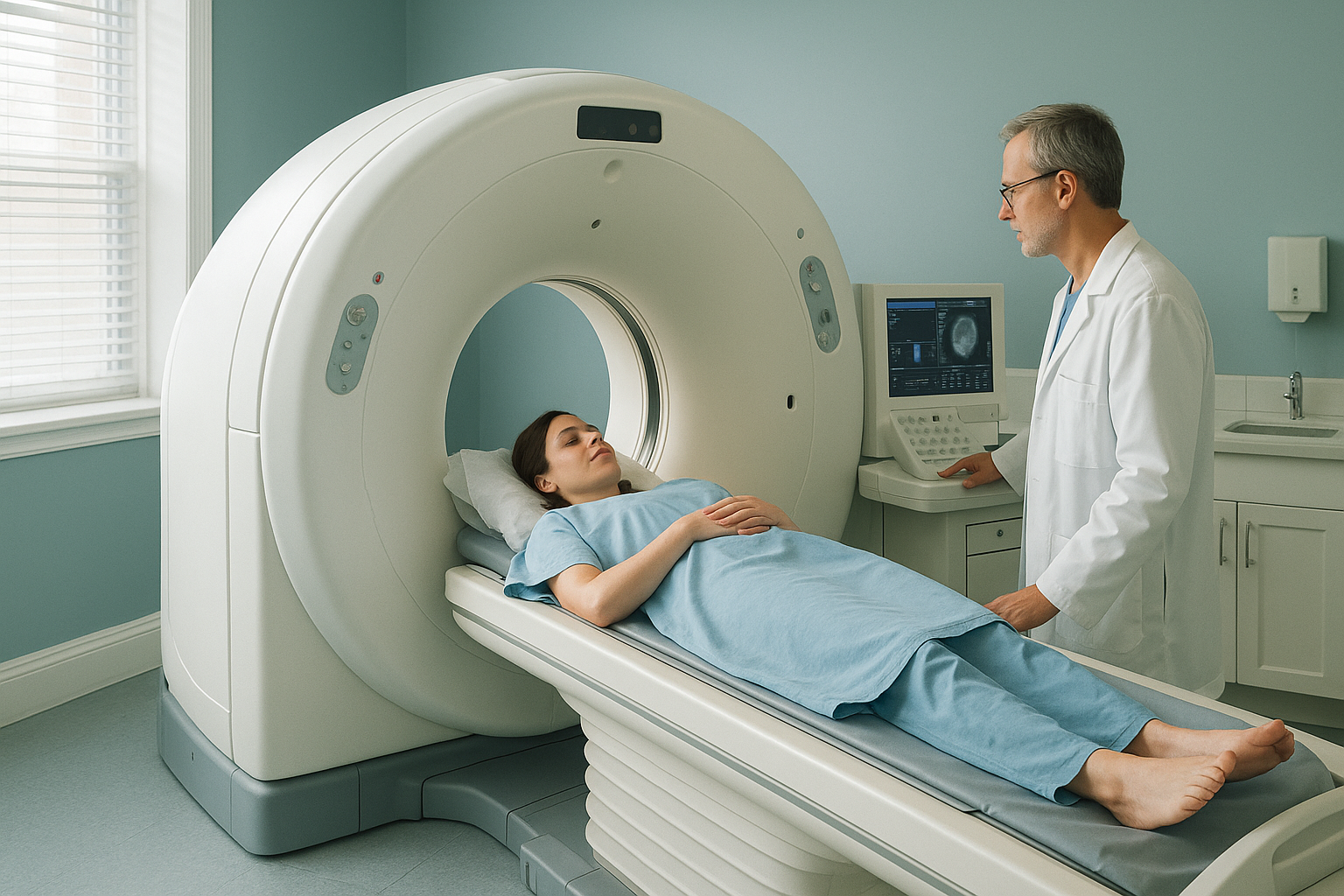
Think of it this way. A single scan is like one short walk in the sun. You get a tiny amount of UV exposure, and your body repairs the vast majority of any effect. But if you spend hundreds of hours in strong sun without protection over many years, your overall risk goes up. The same idea applies to medical radiation. Each small dose is safe on its own, but the total matters.
How does your cumulative radiation dose add up?
Your cumulative radiation dose is the total of every medical scan you have had. It also includes the natural background radiation everyone receives from the environment. Doctors measure what each scan adds as an "effective dose". The table below gives a rough idea of how common types of imaging compare.
| Scan type | Typical effective dose | Roughly equal to |
|---|---|---|
| Chest X-ray | Very low | A few days of natural background radiation |
| Standard spine X-ray | Low to moderate | Several months of background radiation |
| CT scan of the spine | Moderate to high | A few years of background radiation |
| EOS full-body standing scan | Very low | About 90% less than a standard X-ray |
| MRI | Zero ionising radiation | Uses magnets, not X-rays |
MRI uses no ionising radiation at all, which is one of its strengths. But MRI cannot show how your skeleton lines up under your own body weight, because you lie down inside the scanner. For bone alignment and posture, standing imaging plays a different role.
Who should think about cumulative radiation dose?
Everyone benefits from keeping needless radiation exposure low. But some people have more reason than others to pay attention.
- People having repeated spine X-rays for scoliosis monitoring
- Anyone with a long-term condition that needs regular follow-up imaging
- People who have already had several CT scans
- Anyone planning more imaging who wants to keep total exposure as low as possible
- Someone having a single, one-off X-ray for an acute injury
- Anyone whose only imaging has been MRI or ultrasound (no ionising radiation)
The key medical principle is called justification. Every scan should be clinically justified. This means the information it gives should be worth more to your health than the very small risk it adds. When a scan is justified, it is always worth having. The question is not whether to scan, but how to scan with the lowest dose that still gives a clear answer.
How can you reduce your lifetime radiation exposure from scans?
You cannot undo past exposure. But you can make informed choices about future imaging. Here are the main ways to keep your cumulative dose low.
Ask whether the scan will change your treatment plan. If not, it may not be needed yet.
When an X-ray is needed, a system like EOS gives about 90% less radiation than a standard X-ray, around ten times less.
Write down which scans you have had and when. This helps any future clinician avoid repeating imaging needlessly.
If you already have recent imaging, bring it to your appointment. A new scan may not be needed.
How does EOS imaging help reduce cumulative dose?
EOS was designed to give detailed, full-body standing images at a fraction of the radiation of ordinary X-rays. It uses about 90% less radiation than a standard X-ray, around ten times less. For anyone who needs repeated scans over months or years, that difference adds up in a meaningful way.
This matters most for people being monitored for conditions like scoliosis, where follow-up scans at regular intervals are part of good care. Each monitoring scan at a lower dose means a smaller addition to your lifetime total. You can read more about EOS scan safety and radiation or check whether an EOS scan is safe for your situation.
EOS captures a full standing image of your skeleton in a single pass. So it can also reduce the number of separate exposures you need. A standard assessment might need several individual X-rays of different parts of the body. EOS does this in one go.
When MRI is the better choice: EOS shows bones, joints and alignment under load. For soft tissue, discs or nerves, MRI is usually the better tool, and it uses no ionising radiation at all. Your clinician can advise which type of imaging is right for your question.
How do you book a low-dose monitoring scan?
If you need follow-up imaging and want to keep your cumulative dose as low as possible, ScanAlign, low dose standing imaging at 19 Harley Street, London, offers EOS scans on a self-referral basis. You do not need a referral letter from your doctor.
Before you start treatment, or change the one you are on, it is worth getting a detailed diagnosis. Knowing whether the cause sits in the pelvis, the legs or the spine changes what will actually help.
Free video consultation
A specialist radiographer reviews your history and confirms whether an EOS scan is suitable for you.
Come for your scan
You stand naturally inside the EOS system while it captures your full alignment in seconds. No gown needed.
Receive your report
A consultant radiologist reviews the images and prepares a detailed report for you and your treating clinician.
Use the results
Your report helps your specialist plan or adjust treatment with confidence, based on how your body actually stands under load.
Want to discuss whether a low-dose scan is right for your follow-up? Start with a free video call.
Book a free video consultationFrequently asked questions about cumulative radiation dose
No. X-ray radiation passes through your body in milliseconds and is gone. It is not stored like a chemical or a toxin. What remains is a very small statistical risk from the brief contact with your cells.
There is no fixed safe number. Each justified scan is worth having because the benefit outweighs the tiny risk. The principle is to avoid needless scans and to use the lowest-dose technology available when imaging is needed.
It is the total of all radiation you have received from medical scans over your lifetime, added to the natural background radiation everyone absorbs from the environment. It is measured as an effective dose.
It can be, because scoliosis often needs follow-up scans over months or years. Using a low-dose system like EOS for these monitoring scans significantly reduces the radiation added at each visit.
EOS uses about 90% less radiation than a standard X-ray, around ten times less. This makes a meaningful difference for anyone needing repeated scans.
No. You can refer yourself. The process starts with a free video consultation where a specialist radiographer confirms that the scan is suitable for your situation.
There is no single central record in the UK. But keeping your own note of which scans you have had, where and when, helps any future clinician estimate your cumulative exposure and avoid needless repeats.
EOS uses far less radiation than CT. But EOS and CT answer different clinical questions. CT shows detailed cross-sections, while EOS shows full-body alignment under load. Your clinician will recommend the right tool for your needs.
ScanAlign is a private, self-pay clinic. The price for patients travelling from abroad is confirmed during the free video consultation, which is how you book a monitoring scan.
No. MRI uses strong magnets and radio waves, not ionising radiation. It is the better choice for soft tissue, discs and nerves. EOS is the better choice for bone alignment and posture under load. The two work well together.
Worried about your cumulative dose?
If you need follow-up imaging, a free video consultation can help you understand whether a low-dose EOS scan is the right next step.
Book a free video consultationWritten by Abbas Dhami (Specialist Diagnostic Radiographer)
Sources
- International Commission on Radiological Protection (ICRP). Publication 103: The 2007 Recommendations of the International Commission on Radiological Protection. Ann ICRP. 2007;37(2-4).
- NHS England. Ionising radiation: dose comparisons. GOV.UK, Public Health England guidance (updated regularly).
- Deschênes S, Charron G, Beaudoin G, et al. Diagnostic imaging of spinal deformities: reducing patients radiation dose with a new slot-scanning X-ray imager. Spine. 2010;35(9):989-994.
This page is general information and not a diagnosis.
ScanAlign is the trading name of CoreMed Solutions Ltd and operates under The Harley Street Hospital's CQC licence.